Opens in a new tab
Categories Filter
  • 05/07/2015

    Post Link

    Saving lives by design

    If you are a medic, you will recognise much of this. If you are a potential patient, get worried. I have previously tried to explain this sort of thing to ‘hospital management’ but was met with the retort that this was all about academics wanting to highlight bad practices, so they could get ‘publications’. And anyway if you just think a little more, there is no problem. I am serious. There are lots of reasons for this paucity of insight, but here are a few.

    First, one that looms large in the NHS and many health care systems is they are largely a subsistence culture. If you spend all your time just keeping up with the daily demands, there is no time to build or improve, or think about doing things better. We are not quite nomads, required to  only use what we can carry, but there is not the space for innovation within the system.

    Second, the word ‘design’ is not a part of the intellectual toolkits that underpin most medical research or medical schools. We ‘get’ science, but design, whether we are talking about building a medical curriculum or creating a learning environment, is not something that most medical schools live and breathe. Until we make the ‘Sciences of the Artificial‘ a set text, little will change.

    [via Status-Q]

  • 05/07/2015

    Post Link

    Innovation without press releases.

    “I think that hackers—dedicated, innovative, irreverent computer programmers—are the most interesting and effective body of intellectuals since the framers of the US constitution. … No other group that I know of has set out to liberate a technology and succeeded. They not only did so against the active disinterest of corporate America, their success forced corporate America to adopt their style in the end….. The quietest of all the ‘60s subcultures has emerged as the most innovative and powerful” Stewart Brand, in ‘Hackers’ by Steven Levy.

    This has to be one of my all time favourite quotes. Brand, of the Whole Earth Catalogue, and amongst other things, ‘The Long Now Foundation’, and author of ‘How Buildings Learn’, is just the sort of intellectual and explorer that the US excels in producing. The UK not so much. And the topic itself reflects this. If you read ‘Hackers’, you cannot but marvel at the fecundity and chaos that led via the Model Railway club to modern computing. The necessary level of dissent, is something that could not have happened at any UK university, certainly not now. The closest I could imagine would be Watson, Crick, and Brenner et al, but even that burst of exploration took place within an academic setting, when there was an awareness that lone individuals or a handful of people could change the world.

    This was all brought back to me via John Naughton’s column in the Observer today. Naughton himself has been a great chronicler of the history of computing, and how real innovation works. He is talking about PGP and encryption, and recalls the story surrounding RSA and the US government’s attempt to close down the use of strong encryption and, in the modest words of Eben Moglen, how the US government fought hard to ‘prohibit 3.8 trillion dollars worth of electronic commerce from coming into existence in the world’.

    So public key encryption was invented by those nice people at GCHQ who kept schtum about it (remember, all is dual use), and then  independently by 3 US academics who found a way to implement it. Naughton writes:

    In 1991, an American geek and activist named Phil Zimmermann implemented an open-source implementation of RSA and called it “Pretty Good Privacy” or PGP. Its significance was that, for the first time in history, it enabled citizens to protect the privacy of their communications with military-grade cryptography. The US government was not amused, defined PGP as a “munition” and prosecuted Zimmermann for exporting munitions without a licence.

    With characteristic chutzpah, Zimmermann found a way round the government ban. Harnessing the power of the First Amendment, he published the entire source code of PGP in a hardback book that was distributed by MIT Press. Anyone purchasing the book could then rip off the covers and scan the code, thereby enabling him or her to build and compile their own version of PGP.

    Would MIT have done this now, post Aaron Swartz? And second, how many of those making academic careers would have had the ingenuity to solve this problem? Code, on a page, you then scan, all to stay in tune with that that other sort of code, the one that lawyers use.

  • 02/07/2015

    Post Link

    The Greek crisis and medical migration

    BTW: German and most European hospitals tend to look cleaner than UK ones. And they wear white coats.

  • 30/06/2015

    Post Link

    GMC proposes single test for all doctors wishing to work in UK

    So the GMC say that they want to introduce an exam that all doctors who want to work in the UK will need to pass. Lots of comments on the BMJ site, and of course twitchiness from medical school leaders, some of whom I suspect are nervous  at the thought of yet more league tables. I don’t know what to think of it all. In general, I think an exam is a good idea, although this belief assumes the exam is meaningful, unlike many postgraduate medical exams. But there are lots of questions, and I wonder how much this is all about playing to the gallery: anything to conceal the failings of the GMC in other areas.

    First, how does this fit into EU law and the single market? Would seem clear to me that given the need to open up professional services across Europe,  any such exam must be independent of any monopoly employer, so the government / NHS — and hence the GMC — should not be involved. Second, it continues the pretence that the ‘day of graduation’ is the key time to assess clinical competence. In the UK of course, nobody at graduation can practice independently, so testing at this stage seems perverse. Surely better to assess when people join the specialist register / GP register? Third, what do we do with specialists who want to move over to the UK later in their career? Make them go back and learn the Krebs cycle?

    There is no longer such a thing as a ‘standard’ or ‘qualified’ doctor,  just a drifting current of competence, a continuous interaction between person and professional environment. I still think medical school is in large part about producing graduates who have the knowledge and abilities so that when they are put in a clinical environment, they can learn on the job to become a ‘proper doctor’. As for many other professions, you shouldn’t expect too much of your recent graduates, nor should you employ them  in mission critical areas.

    One silver lining  of course is that if we move to serious summative assessment, we do not need the GMC to pretend that there is much meaningful quality assurance in medical education. Dylan Wiliam in one of  his many brilliant contributions, pointed this out many years ago. You can have quality assurance, as for instance in the oft-quoted  Toyota methodology. But in other areas (he quoted chip design) assurance doesn’t work, it just leads to the endless box ticking exercises that charactertise much of modern HigherEd and postgrad med ed (my words).

    We cannot—anybody who’s been in a classroom more than a nanosecond actually knows this—we cannot predict what it is that children will learn as a result of our teaching. So we cannot have quality assurance in learning. We have to have quality control. We have to keep on checking on what it is the kids have actually learned, because we cannot predict it.

    Well, putting to one side the  cheap (but accurate) comment that those making the rules often have no background in education, let alone classroom experience, the point here is that for professional degrees like medicine, we have to use quality control, not quality assurance. And we can. Remember the ironic phrase, “our students turned out competent doctors despite the best intentions of their medical school”. So, if we must have an exam, can we dispense with all the inspection nonsense?

  • 30/06/2015

    Post Link

    Hacking education

    No, not the site run by Audrey Watters, nor about providing eduction for hackers, but  a site where you hire hackers to achieve some purpose that interests you. Jonathan Mayer writes:

    In the sharing economy, you can hire a one-off driver (Uber), courier (Postmates), grocery shopper (Instacart), housekeeper (Homejoy), or just about any other variety of henchman (TaskRabbit). So, what about hiring a hacker? That’s the premise of Hacker’s List, a website launched in November. Anyone can post or bid on a hacking project. Hacker’s List arranges secure communication and payment escrow.

    A majority of requests are for compromising Cloud service accounts, what is the  second biggest group?

    The second most common scenario (8%) arises from academia. There is, apparently, enormous demand for artificially improving grades — especially at the undergraduate level. Targets include the University of California, UConn, and the City College of New York. 

    Once, I think people thought fraud in HigherEd was something unusual, something that you need not worry too much about. Now, many of us believe it is everyday. What is most interesting, is what they says about how far certification and ability are diverging.

  • 28/06/2015

    Post Link

    Worth a glance #17

    What you need to know before you blow the whistle. You just need to read Private Eye to understand how the NHS bullies those who criticise. I will use that awful cliché: bullying and stifling of dissent is part of the NHS’ DNA. Note the following: If a successful whistleblower loses their career, they may be awarded hundreds of thousands of pounds in compensation. However, there is no protection against blacklisting by future employers, so a whistleblower’s financial losses may be even greater. The author suggests doctors might contact the GMC, but again, Private Eye reporting (remember Bristol?) would suggest this may not be very helpful.

    Peer review: not as old as you might think. Aileen Fyfe in the Time Higher. Even in my professional lifetime I have seen the meaning of the term peer review change, with journals attempting to claim ownership for their own purposes. Of course, editors used to make decisions without external experts, and how silly to imagine that a couple of reviewers could act as a marker of truth. The web should sweep all this aside, with the possibility of returning to the idea of communities of scholars. But the resistance will come from the journals, who are largely about making money; and the universities and grant awarding bodies, who are unable to actually read what people publish, and prefer to view the world through an Excel spreadsheet. This unholy alliance is of course now the substrate that allows performance management and the other  nefarious rituals of verification.

    The invention of tradition: how ‘researchers’ replaced teachers. Again, I am feeling that one of the problems of being around awhile, is that you can see history being re-written to justify a particular point of view. There is much you can say and argue with about research in UK higher ed, but nothing compares with the neglect of teaching in many universities, or the lack of value in what students are paying for. As this article quotes, not long ago British academics were overwhelmingly orientated towards teaching rather than research. The marginalisation of scholarship and teaching, is particularly acute in medicine, where the need to have a third string to the bow — clinical practice — makes the problems worse. I used to use a quote from a web page of the late Roger Needham, who was Professor of Computing at Cambridge, but his web pages are no longer there. He said something along the lines of: the main form of tech transfer is something called ‘students’. Our biggest impact as academics is in the form of the graduates we produce.

    Ask Doctor Clarke Should I feel guilty about this? Many of our students pay for this sort of extracurricular tuition.How good it is, I do not know. But it makes me feel sad. Reminds me of parents paying for full time private education, then paying for coaching in the evenings. You go to med school, paying fees of 9K with another 10K throw in by the government, or if you are from outside the EU, maybe 30K+ a year, and then you feel the need to pay not just for books, but for tuition.

    Seven Questions for Personalized Medicine. This is from JAMA. I don’t think there is anything groundbreaking here, but it is nice to see some degree of scepticism, especially in a US journal. Again, the hype cycle is being remodelled. Its all business as usual.

    Capita wins £1bn NHS contract to oversee administration. Private Eye of course refers to them as Crapita. An interesting example of how biased and superficial much of the FT is (just follow the comments, for an account of what Capita are like). This is all about what JK Galbraith called welfare for the rich. Or in the UK, subsidies for the corporate donors to the main political parties. Healthcare along the lines of the ATOS model.

  • 28/06/2015

    Post Link

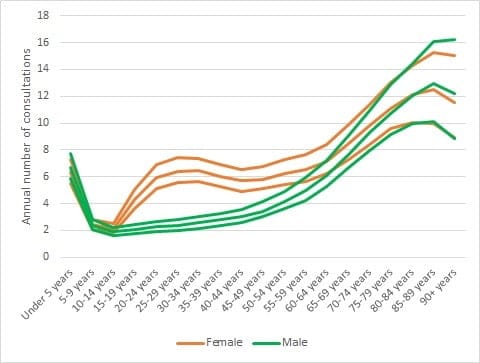
    One terrifying graph.

    This is via Andy Fugard on twitter, and is based on official data for consultation rates in GP. Just look at the raw number of consultations per person. In the area of medicine I know something about, with the increased ‘dumping’ of patients from secondary care to primary care, these numbers should be — and need to  be— a lot higher. This is a system that is unworkable, and broken; and where the NHS is content to rearrange the deckchairs as the ship sinks. Tweaks around the edges will make no difference. Nor should anybody be surprised: these demographic changes were taught to me by John Grimley Evans in my first term at med school almost 40 years ago. Do not ask why students are getting coy about careers in general practice. Nobody in Westminster or Edinburgh has any idea what to do. (median, 25th and 75th percentiles, by sex). Remember: there is nothing unexpected going on here.

    https://twitter.com/inductivestep/status/614512512940113920/photo/1
    https://twitter.com/inductivestep/status/614512512940113920/photo/1


  • 28/06/2015

    Post Link

    Innovation, inequality and how many bubbles are there on a bar of soap?

    This is an impassioned speech by Larry Lessig linking net neutrality, innovation and creativity, and political inequality.

    Seeing Through the Noise from lessig on Vimeo.

  • 22/06/2015

    Post Link

    somewhere between administration and giving tests to students

     in contrast to England, Krokfors says, where she feels teaching is “somewhere between administration and giving tests to students” Link here.  [direct link to this aside] 

  • 18/06/2015

    Post Link

    Early diagnosis of melanoma

    Harder than it seems — or at least, expertise in some domains is not really like expertise in banking. Our paper is here. Link to journal page here

    Viewing Exemplars of Melanomas and Benign Mimics of Melanoma Modestly Improves Diagnostic Skills in Comparison with the ABCD Method and Other Image-based Methods for Lay Identification of Melanoma

    Ella Cornell1#, Karen Robertson2#, Robert D. McIntosh1 and Jonathan L. Rees2,  Departments of 1Human Cognitive Neuroscience, Psychology and 2Dermatology, University of Edinburgh, UK. #These authors contributed equally to this paper and should be considered as first authors.

    Using an experimental task in which lay persons were asked to distinguish between 30 images of melanomas and common mimics of melanoma, we compared various training strategies including the ABC(D) method, use of images of both melanomas and mimics of melanoma, and alternative methods of choosing training image exemplars. Based on a sample size of 976 persons, and an online experimental task, we show that all the positive training approaches increased diagnostic sensitivity when compared with no training, but only the simultaneous use of melanoma and benign exemplars, as chosen by experts, increased specificity and diagnostic accuracy. The ABCD method and use of melanoma exemplar images chosen by laypersons decreased specificity in comparison with the control. The method of choosing exemplar images is important. The levels of change in performance are however very modest, with an increase in accuracy between control and best-performing strategy of only 9%. Key words: skin cancer; melonoma; melanocytic nevi; seborrheic keratosis; diagnosis.