Opens in a new tab
Categories Filter
  • 17/08/2015

    Post Link

    The universal method

    I can’t remember where I got this from. My memory is that it was in an article or talk by Larry Summers, but I can’t trace the source. Anyway, it may be from somewhere else, so if you know better, let me know. This is my universal graph, that I try and apply to everything.larry summers graph
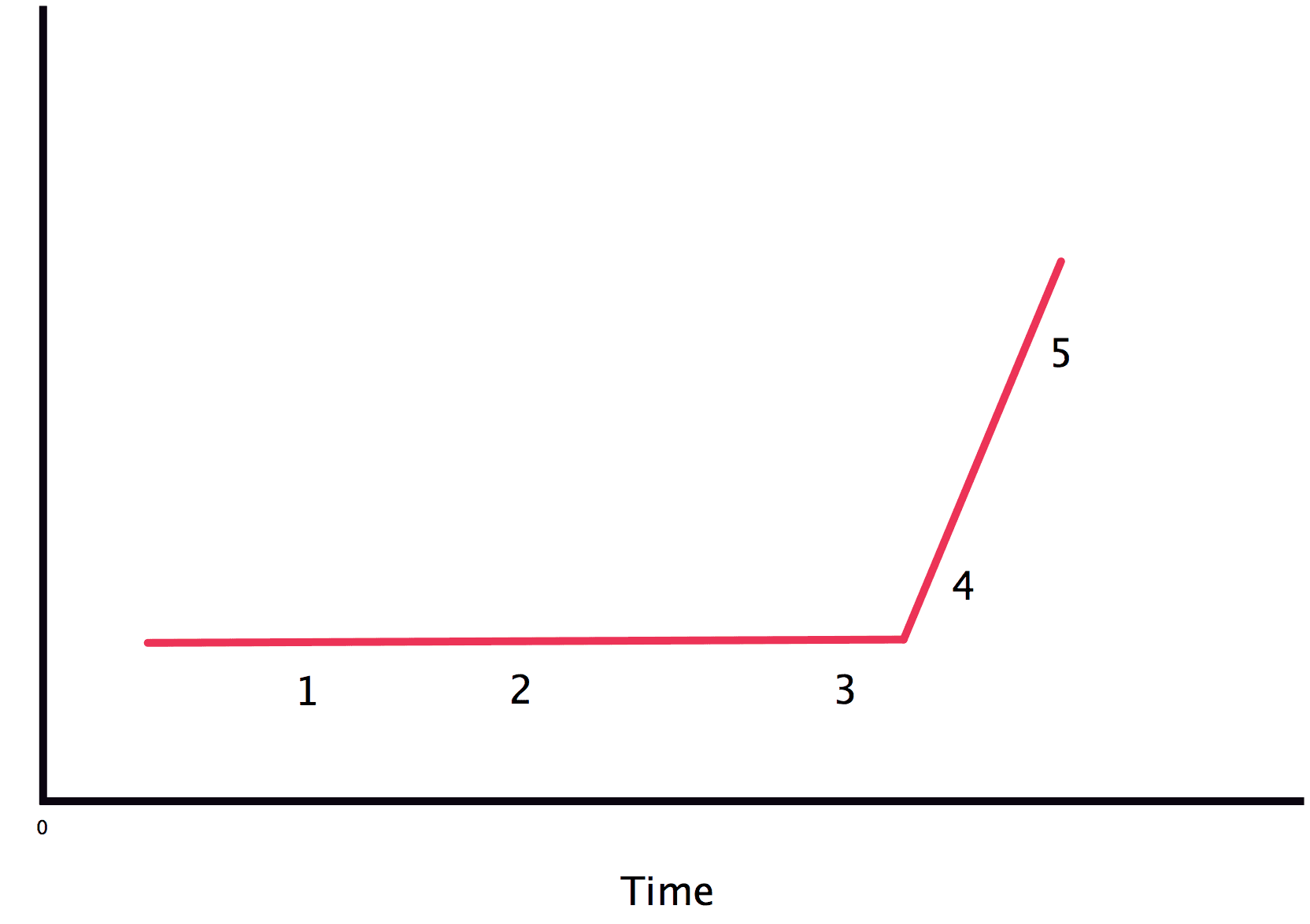
    Note, time is on the X axis, but the Y axis is unlabelled. Often the Y axis will be some measure of advance or progress. I have used it to think about science, and more recently education. They key point is that life is more fun if you are between points 3 and 4, around the inflection. If you move into a field just before the inflection point, your world changes, and what was once impossible now becomes tractable. Conversely, if you are patiently working somewhere between points 1 and 2, it is not clear much progress is being made: is the line horizontal, or the gradient just weakly positive or weakly negative? But as you move past the inflection, to point 5, you know that this sort of increase cannot go on for ever. At some point saturation will take over. The problem is simple: you are never really certain where you are at a single time point, and only if you are in a field say between points 3 and 4 can you feel the sense of excitement of the world changing and lots of progress being made. The difficulty of being on the first (flattish) line say at point 2, is that you don’t know how long it will take before you get to the exciting bit just after point 3. So, we know there is going to be catastrophic change or disruption, but we just don’t know when it will be. I think points 3 and 4 were where medical therapeutics was in 1960. For human genetics, the corresponding time was in the 1990s. For much of what interests me now — how we organise higher education and medical education in particular — I would like to think we are moving towards 3. Interesting times, maybe. Of course, the graph can be inverted or the Y axis reversed. Things can get worse, too.

  • 16/08/2015

    Post Link

    NHS funding to fall to 6% of GDP

    This is the most scary thing I have read in a while.

    “Public spending on the NHS is due to fall as a proportion of gross domestic product, from a peak of 8% in 2009-10 to just over 6% in 2020-21.”

    This is from this week’s BMJ, with the original source here.  Those close to the beginning of their career, or  thinking of studying medicine at university, need to think hard about what this means. Then there is the rest of the population, too. Even with optimistic forecasts for GNP such a change is impossible without a widespread collapse of the type of health care available in most of northern Europe. The alternative is simple: much medical care is going to be private.

  • 15/08/2015

    Post Link

    Award-winning case history of the care.data health privacy scandal

    Ross Anderson writes: 

    Each year we divide our masters of public policy students into teams and get them to write case studies of public policy failures. The winning team this year wrote a case study of the care.data fiasco. The UK government collected personal health information on tens of millions of people who had had hospital treatment in England and then sold it off to researchers, drug companies and even marketing firms, with only a token gesture of anonymisation. In practice patients were easy to identify. Theresultingscandalstalled plans to centralise GP data as well, at least for awhile.

    Paper here. [direct link to this aside]

    .

  • 14/08/2015

    Post Link

    Worth a glance #19

    Clinical research: Should patients pay to play?

    Social care chief savages failing system for elderly. And Care homes are getting worse, not better.

    The commencement speech: A look back at Jon Stewart’s 2004 commencement speech: ‘College is not necessarily predictive of your future success’

    White House: Innovation in Higher Education.‘ No one knows what HE is becoming. Forget the think tanks and the consultants and the keynote speakers. No one knows how these trends will track or what the university will look like in the future.’

    Certification gone mad: ‘Sometimes this is justified:airline pilots need licences. But often, as in the three years of training needed to become a security guard in Michigan or the thousands of hours required for hairdressers in Utah, the rationale is less clear.’

  • 13/08/2015

    Post Link

    The tyranny of counting in higher ed

    Larry Lessig has some good things to say about the tyranny of counting and how tech can inhibit the sort of architecture we need for teaching (and research). He also highlights how bad some aspects of the UK higher education scene look to a sensible  outsider.  He starts by imagining how easy it might be to ask students to click on ‘likes’ as they leave a lecture theatre  and what this might lead to. [I have transcribed from the video so there may be some minor errors]

    I would push hard to resist the tyranny of counting. There is no necessary connection between ease of counting and the production of education. [as in ‘likes’ etc after leaving lecture hall etc]….. And so it will be easy for the institution to say this is what we should be doing but we need to resist that to the extent that that kind of counting isn’t actually contributing to education. The best example of this, I am sure many of you know are familiar with this, is the tyranny of counting in the British educational system for academics, where everything is a function of how many pages you produce that get published by journals. So your whole scholarship is around this metric which is about counting something which is relatively easy to count. All of us have the sense that this can’t be right. That can’t be the way to think about what is contributing to good scholarship.

    It isn’t just future tech that worries me. Years ago, in another place (of course) I remember asking whether any of the student evaluation questionnaires we were using had been validated, and if not, why should a bunch of academics pay too much attention to them. There followed what I have christened the ‘petit mal’ phenomenon: a moments collective silence, followed by a resumption of the normal committee business, as though no question had been asked. As the e-world has made collecting junk and sending spam easier, we can collect more and more junk enquiry, which somebody somewhere will feel compelled to act on. This is not just garbage in, garbage out (GIGO), its actually worse than that:  just as bad money drives out good money, the currency of our  senses is debased.

  • 12/08/2015

    Post Link

    Uber this [education]; and more tech bubbles

    I know talking about education and Silicon valley may seem like feeding the trolls but…two quotes (well three actually):

    The first from an interview with Sebastian Thrun, the man who has revolutionised learning (irony++), without knowing much about it, and appears to have discovered everything ‘yesterday’. 

    Q. Teaching students to master a topic, difficult in any classroom, seems to be one of the biggest challenges facing online learning. You say your approach works. How does it?

    A. We very deeply believe, very passionately believe, that learning by doing trumps learning by listening. We believe the ultimate experience that really makes the master is to do something, build something, invent something, design something, code something. At Udacity, we built an Uber-like platform. 

    Same thing in the FT, with Thrun saying: 

    “We want to be the Uber of education,” Mr Thrun claims, following the start-up convention of comparing one’s business model to the current darling of the VC community.

    And the second from And John Markoff, somebody who I think knows some history.

    There’s been a dramatic shift in corporate America, and the time horizons have shortened. Even DARPA, which was created in the 1950s to prevent America from suffering from technological surprise, in the wake of 9/11 and the Iraq war DARPA shifted its focus and has become focused on much shorter term results. Clearly something has been lost. In Silicon Valley, we’re in the midst of a bubble right now, and it’ll be interesting to see what the culture is like after it resets. For the moment, we’re focused on things that will return. The term of art is now a unicorn, $1 billion startup in the space of just a short time. There have been some, but there are also lots and lots of failures. 

    The question is, how does this current bubble end? Not when, but how? What constitutes a bubble? For me, I can clearly see we’re in a bubble economy when relatively more money is chasing relatively few good ideas. When the conversation turns to Uber for “x,” you can tell there we’re out of ideas, that people are basically just trying to iterate and get lucky. I suppose some of them will be lucky. There was lots of good timing before the collapse of the last bubble, and so this bubble is and will continue to create billionaires. But something will cause a reset, and, for example, you can see this now with regard to new organizations such as The Battery Club.

    BTW: yet another example of journalists knowing more about a subject that academics.

  • 11/08/2015

    Post Link

    Multimedia learning

    This is a talk by Richard Mayer, one of the doyens of multimedia learning, at a HILT meeting. I find much of his work thought provoking and, at the very least, he makes me question much of what I do. But I have lots of questions: issues about transference and generalisability of the data; the applicability of the principles to advanced or at least non-novice learners (as he admits); and how this all interacts with Bjork’s desirable difficulty and motivation. A good intro to the topic is the book edited by him, The Cambridge Handbook of Multimedia Learning, although he has written stuff specifically for a medical audience too . My most insightful moment has been to realise that much as our students complain about lack of feedback, it is the lack of systematic student -> teacher feedback that limits what I do. The ‘curse of knowledge’ looms large, but I am deeply antagonistic to the idea that you cannot substantially improve teaching at both the macro and the micro levels. And without being ‘trendy’.

  • 10/08/2015

    Post Link

    The importance of unnatural science

    One of the dangers of focussing on  learning natural science is that you may become oblivious to all the unnatural science that may shape human society to a greater degree. I am talking here of the rules and institutions that we create to organise our combined social existence: money, the rules of a formal legal system, the created cultures and belief systems that underpin how we think society works, and so on (as in the conventional lies that get us through the day).

    The Economist has a couple of pieces on patents, recounting their origins and  the longstanding differences in opinion over their utility: how they can retard — as well as advance — enquiry. And we will put to one side for the moment the stupidities of modern patents on iPhones  and ‘one-clicking’ etc

    That is why proponents of patents see it as reasonable to let Bristol-Myers Squibb have a temporary monopoly on Opdivo, its new melanoma drug, and to charge $120,000 per course of treatment in America. If the company could not do so, the argument goes, it would not have spent a fortune on getting the drug and its complex manufacturing process approved. However, the history of the industry raises doubts about such arguments.

    I was surprised  — and I learned this from David Healy only a few years back — that until 1967, German companies could only patent the process by which they made a drug,and not the drug itself. (And the Economist states the German’s invented more drugs than the British). The article adds:

    Another interesting case is Italy, which had no patent protection for drugs until 1978. One study showed it invented a larger proportion of the world’s new medicines before that date than afterwards. 

    Awhile back I wrote a piece in the Lancet (Rees J. Patents and intellectual property: a salvation for patient-oriented research. Lancet. 2000;356:849–850 pdf here), pointing out that one side-effect of IP rules for medicine was that it tended to favour approaches that afforded IP protection over those that did not. I still think that observation is correct, although I suspect my solution owes more to irony than what how we should move forward. Just as for copyright, we are seeing shaping of the legal landscape to protect incumbents and to discourage innovation. The article ends with sentiments I can agree with:

    But a top-to-bottom re-examination of whether patents and other forms of intellectual-property protection actually do their job, and even whether they deserve to exist, is long overdue. Simple abolition raises problems in terms of the ethics of property rights (see leader). But reductions in the duration of exclusive rights and differentiation between those rights for different sorts of innovation are possible, and could be introduced in steps over a number of years, allowing plenty of time for any ill effects to surface. Experiments with other forms of financing innovation could be run alongside the patent system. If defenders of the patent system really seek to foster innovation, they should be prepared to do so in their own backyard.

  • 09/08/2015

    Post Link

    The view from Penglas

    I have just returned from a weekend in the the West of Ireland, staying with my brother Alun, and his wife Sue, in their home called ‘Penglas’ — a little piece of Wales, surrounded by the magic of West Cork. The view from Penglas is shown above.

    We talk rugby (naturally) — and I will avoid Saturday’s result (‘counts for nothing in the long run, bach.…’) — but because Alun is an ex-dentist,and for a number of years a dental business coach and consultant to dentists and other players in dentistry,  we talk dentistry  and medicine.

    The parallels between what has happened to UK dentistry and what has, and might happen to UK medicine, have always interested me. The government, for all sorts of reasons, have got away with things in dentistry that they would like to do to medicine, and in turn, the dental profession has failed to outwit the dark forces of central government. There are perhaps lessons to be learned. Some thoughts.

    1.  Despite words to the contrary, the major political parties in the UK want to privatise whole swathes of healthcare. Nye Bevan and Harold Wilson may have resigned over the introduction of charges for spectacles, but most politicians are unable to believe that there are any alternatives — or at least that is what they tell themselves. TINA.
    2.  Decision making is corrupted by on the one hand ‘compatible scholarship’ produced by the universities; and the revolving doors between those companies that pay politicians (as in fund political parties), and those people who move between government / NHS positions and the work for industry. Their opinions those of their masters.
    3. The private drivers are not about building responsible and credible long term businesses but are based around yet more financialization. So, private equity etc / debt /  2008 all over again
    4. I think neither of us is convinced that those tasked with educating the next generations of dentists (or dentistry related AHP) have thought hard about their responsibilities in terms of what sort of career there will be available for their graduates. Not so much meliorism, but a failure of critical scrutiny. Bums on seats, and a lack of moral integrity. Morality always loses out to institutional survival.
    5. Expect more and more of health care — especially from what might be called the periphery — to be removed from free provision.
    6. The commissars will keep saying everything is ‘world class’, when all the evidence points in the other direction.
    7. Nobody knows a way for Excel spreadsheets to reflect clinical expertise. So, everybody is an identical widget. Not so much ‘the drugs don’t work’ but ‘the incentives don’t work’.

    And below is the view from Casey’s in Glandore, after a couple of pints of Murphy’s.  And sadly, my phone is not doing it justice. BTW, Casey’s, a bar that has been in existence for close to 200 years. That is is a credible business model, but not one based on financialization.

    Cork

  • 08/08/2015

    Post Link

    Central problems of genetics

    William Harvey,  better known for describing the circulation of the blood, wondered in the 17th century what could explain why children’s skin colour was often a blend of their parents’, whereas they share a sex with only one, and can have an eye colour different from either. for describing.

    The central problems of human genetics.From a book review in the Economist. It has always fascinated my why Mendel modelled on the basis of discrete states, rather than thinking of traits as ‘blended’. The guess, is that for this monk, sex was the answer: male or female, but not a little bit of either. [direct link to this aside]