Opens in a new tab
Categories Filter
  • 07/08/2015

    Post Link

    Medicine has to talk the language of molecules and the language of insurers.

    There is a phrase used by engineers that goes roughly as follows: physics was made by God but to engineer is human. Engineers have, of course, to be cognisant of the laws of nature, but that is only part of what they need to know in order to build artefacts. This applies to medicine, too. Science may tell us about how the natural world works but we want more than that because we also have to know how science and society work. We want to intervene, and the test of our knowledge is how well we can do this in the social and economic systems we inhabit. UVR causes most skin cancer, but if the patient in front of us already has a thick nodular melanoma, we have to ask the following question: was it inevitable that they would present when they did, and what can we do for them now? But the answers to these questions do not just depend on biology. Medical engineers not only have to talk the language of molecules, but also the language of health insurers. Furthermore, medical engineers also have to know how to engineer their own cultures of discovery, along the way.

    From an article of  mine that is in press.

  • 06/08/2015

    Post Link

    Hiroshima: civilization face to face with its own implications.

    70 Years ago today the Atomic Bomb was dropped on Hiroshima. On Sunday, it was to be Nagasaki’s turn. The above title is from Jacob Bronowki’s book ‘Science and Human Values‘. He was part of an official visit to Nagasaki later in 1945. Two quotes from this book have never left me.

    The gravest indictment that can be made of our generalized culture is, in fact, that it erodes our sense of the context in which judgements must be made. Let me end with a practical example. When I returned from the physical shock of Nagasaki, which I have described in the first page of this book, I tried to persuade my colleagues in governments and in the United Nations that Nagasaki should be preserved exactly as it was then. I wanted all future conferences on disarmament, and on other issues which weigh the fates of nations, to be held in that ashy, clinical sea of rubble. I still think as I did then, that only in this forbidding context could statesmen make realistic judgements of the problems which they handle on our behalf. Alas, my official colleagues thought nothing of my scheme; on the contrary, they pointed out to me that delegates would be uncomfortable in Nagasaki……….

    Nothing happened in 1945 except that we changed the scale of our indifference to man; and conscience, in revenge, for an instant became immediate to us. Before this immediacy fades in a sequence of televised atomic tests, let us acknowledge our subject for what it is: civilization face to face with its own implications. The implications are both the industrial slum which Nagasaki was before it was bombed, and the ashy desolation which the bomb made of the slum.

    Bronowksi always wanted to build a natural philosophy fit for our age. It is our tragedy that he (and we have) failed.


  • 05/08/2015

    Post Link

    Why much medical science is bunk: institutions matter.

    John Kay of all people is surely not getting things quite correct. He starts the article with a complaint about the Economics profession (well, who wouldn’t) but then states:

    “And I have learnt that such bias is almost as common in academia as among the viewers of Fox News: the work of John Ioannidis has shown how few scientific studies can be replicated successfully.” 

    What John Ioannidis studied was largely the field of RCT or observational epidemiology in medicine — not science. RCT are, at best, a form of technology assessment usually with no scientific hypothesis in sight; and observational epidemiology is known to be largely bunk, because of confounding. Much pharma animal work is similarly devoid of a meaningful hypothesis. The real issue is, in a world where technology is usually so effortless, and where much or most of this technology relies on science, so much medicine (and some other branches of natural science) are so unreliable and insecure. To understand why this is the case, is the relevant question. The Mertonian norms have ended, and the currency is being actively debased. As John Kay knows, institutions matter, and it is to these we should look. A statistical hypothesis is not the same as a scientific hypothesis.

  • 04/08/2015

    Post Link

    Sunscreens

    There was  a recent article in the NEJM about regulation and sunscreens. Much of this world is more regulation than science, a la the murky worlds of pharma, and more about shifting units than providing value. I wrote a letter highlighting some of the problems of confusing ‘regulation’ with ‘science’. The text is below. Links here and here.

    The role of UVA, and sunscreens in preventing skin cancer

    The statement that UVA is ‘most closely linked to cancer’ is lacking in nuance. The evidence is probably firmer for UVB for some types of skin cancer, but there remains genuine debate about UVA, especially for melanoma. The attempt to demarcate sunscreens that prevent burning from those that might prevent cancer, is misplaced. Damage from UVR is a continuous variable,and burning is not a well defined term operationally. Erythema varies across orders of magnitude of UVR exposure,and it is easy to demonstrate DNA damage without erythema. If you prevent ‘erythema’ or ‘sub-erythema’ (that is changes in blood flow that you can measure but not see) you might imagine that you will prevent cancer in the long term, although the evidence to support this reasonable belief is sparse, especially for melanoma. Pretending that only a sunscreen with a SPF greater than 15 can achieve this, whereas those beneath 15 ‘just’ reduce erythema, seems to me to be taking a liberty with scientific common sense. How the sunscreens are used in the real world (thickness, frequency of re-application) probably adds in more variance, as the author notes.

  • 29/07/2015

    Post Link

    Wikipedia is a non-market form of activity—it’s a $3bn hole in the advertising world.

    Wikipedia is a non-market form of activity—it’s a $3bn hole in the advertising world. Paul Mason.

    Students are (or at least until recently) told not to use Wikipedia as a source. I really don’t understand why not. Of course, there are errors, but then there are lots of errors in books, too. And as for the peer reviewed literature, well just look at the publications on homeopathy and other drivel. But more, the admission of error, is part of the discipline that underlines citation. So, being told to not use Wikipedia, is  positively harmful. [direct link to this aside] 

  • 29/07/2015

    Post Link

    Medical students: Without deviation from the norm, progress is not possible.

    One of the memes that keeps bugging me is the folly of pretending that we are training one-size-fits-all medical student / doctors. We select that way, and we think of clones that way. We need to be concerned about variance, too. We are not in the business of cloning, and diversity is our best strategy for change and improvement. This cannot be passive, but has to be something we do deliberately. Otherwise we end up with all these kids with grade 8 piano, and nobody who gets punk (yes, showing my age: jazz, blues, techno will all do, thank you). This is a quote from Bruce Schneier in his book ‘Data and Goliath’ that speaks to what I think:

    There is value in dissent. And, perversely, there can be value in lawbreaking. These are both ways we improve as a society. Defending this assertion involves a subtle argument—something I wrote about in my previous book Liars and Outliers—but it’s vitally important to society. Think about it this way. Across the US, states are on the verge of reversing decades-old laws about homosexual relationships and marijuana use. If the old laws could have been perfectly enforced through surveillance, society would never have reached the point where the majority of citizens thought those things were okay. There has to be a period where they are still illegal yet increasingly tolerated, so that people can look around and say, “You know, that wasn’t so bad.” Frank Zappa said something similar in 1971: “Without deviation from the norm, progress is not possible.”

  • 29/07/2015

    Post Link

    Worth a glance #18

    I have been away, in Croatia. My former colleague (and troublemaker) Bruce Charlton remarked many years ago that many academics seemed to be embarrassed if they were found to be ‘just reading’ in their office. Reading and thinking, is not what most academics are about anymore. But holiday allows you to be a proper academic, so below are just a section of  the news items that bugged me.

    Can higher education’s golden age of plenty continue? No, is the correct answer. I linked to this article with a quote earlier. Wolf writes: These figures show that we have been uniquely favoured. Where can we go but down? They also and more importantly underline how totally universities still depend on the state. Overseas student fees are sometimes discussed as meaning that we could cut free. But it is the generous funding for science and the growing levels of support for home students that underpin English higher education’s global success. Students everywhere go for the best they can afford, not the cheapest on offer, and rationally so. Students come to the UK, and pay high fees, in large part because of our reputation. High fees themselves signal quality – we’re expensive, therefore we’re good – but the signal needs to be plausible. You can’t carry on indefinitely if you are sinking in the global research tables or if your buildings are falling apart. If the state is good to us, why worry? Because this system is being seriously destabilised* And then:We can predict with confidence what will happen. Further education will seem even less attractive: why go somewhere funded at £2,000 a student when somewhere funded at £9,000 is wooing you? Universities will expand their intakes rapidly. The academic record of new entrants will be lower. As participation rates rise higher, the average salaries of graduates will fall and so will loan repayments. What she gets right is the way that the FE sector has been canabalised by universities. The only wealth member of my family, a graduate (as in apprentice) of the idyllic Univeristy of Port Talbot (as in the then British Steel) had to close his light engineering business when he retired because, as he said, in the UK you no longer could access  the sort of bright interested apprentices that you once could —they just go to university instead. Compare Germany, and then understand Mittelstand.

    Writing an online, open textbook: is it worth it? This is from Tony Bates. I have a sort of online textbook, and students seem to like it and use it, but it could be a lot better.

    MIT and German research on the [appalling] use of video in xMOOCs. This is Tony Bates again via Stephen Downes. Lots to agree with. I am interested because I am a fan of the use of videos, and I do not think we have explored their benefits for undergraduate medicine in terms of procedures or personalising what we do for the benefit of students. And I have read Richard Mayer.

    In defence of the Research Excellence Framework. I am not alone, just in a minority in arguing that the RAE/REF has been a disaster for UK Higher Ed. Students and those interested in the greatest tech transfer universities can produce (i.e.students) are the losers. The recent announcement of the TEF will no doubt be another bureaucratic fit of nonsense. I am glad I am not at the beginning of my career. I hope Scotland ignores it, and concentrates on teaching instead.

    Students under surveillance. This is from the FT, although there is lots everywhere about it. I am sceptical of much of the supposed benefits (tech solutions, for not knowing who your students are or what they know). But be careful not to throw baby out with the…..And sinister too. But then Amazon tracks my reading, and I love the fact that google analytics tells me things about interactions with my online book

    This is the promise of learning – and the future of Pearson. I take the FT and the Economist although I tire of most of their supposed solutions to our many problems. But hey, the obits in the Economist are worth the subscriptions, and the book reviews influence what I read. But few have much good to say about Pearson. The line from Pearson, now divested of the FT and soon to be divested of the Economics is: We plan to reinvest the proceeds from today’s sale to accelerate our push into digital learning, educational services and emerging markets. We will focus our investment on products and businesses with a bigger, bolder impact on learning outcomes, underpinned by a stronger brand and high-performing culture. This will help us progress toward a future where learning is more effective, affordable, personal and accessible for people who need it most. By doing so, we can help more people discover a love of learning and make progress in their lives. This is the promise of learning– and the future of Pearson. I really hope not.

    Lots of money in ed-tech. And Pearson.

    ‘The poorest students will leave university with the biggest debts’. This is about the abolition of maintenance grants (as in, what I received). Paul Mason may be on to something. This is all going to fracture. I was only an amateur activist when young, but I am much angrier now. Perhaps even a little less cynical.

    You go to Stanford to get your ticket punched, and then you go off and you start your company. The NSF budget and the NIH budget are relatively frozen; they’re not growing. Venture capitalists are increasingly making short-term bets rather than long-term bets. Google was supposed to be the latest corporate entity that was going to try to fix that. They created Google X that was supposed to do these moon shots. Maybe there’s a little bit of it, but you don’t see it very much of the notion of basic research, of doing science. You see applied research everywhere. Even the national labs, you see projects that are intended to find ways to commercialize technology. The notion of science for science’s sake is under assault. Paul Mason, comes to mind again.

    I want to make the shocking prediction that the Internet of 2060 is going to look recognizably the same as the Internet today. ‘This exponential hangover leads to a feeling of exponential despair.’

    Giving Doctors Grades:Ask any medic and they will have seen this. Once you dismantle professionalism (as the GMC and the government are doing in the UK) you end up here.

    More Insights From Dylan Wiliam. Goes with being Welsh, bach!

  • 27/07/2015

    Post Link

    The next five years will be worse for English universities

    The next five years will be worse for English universities than the past five years have been. And the five after that could be worse still.


    Alison Wolf here [direct link to this aside]

  • 08/07/2015

    Post Link

    Some myths about the shortage of STEM skills.

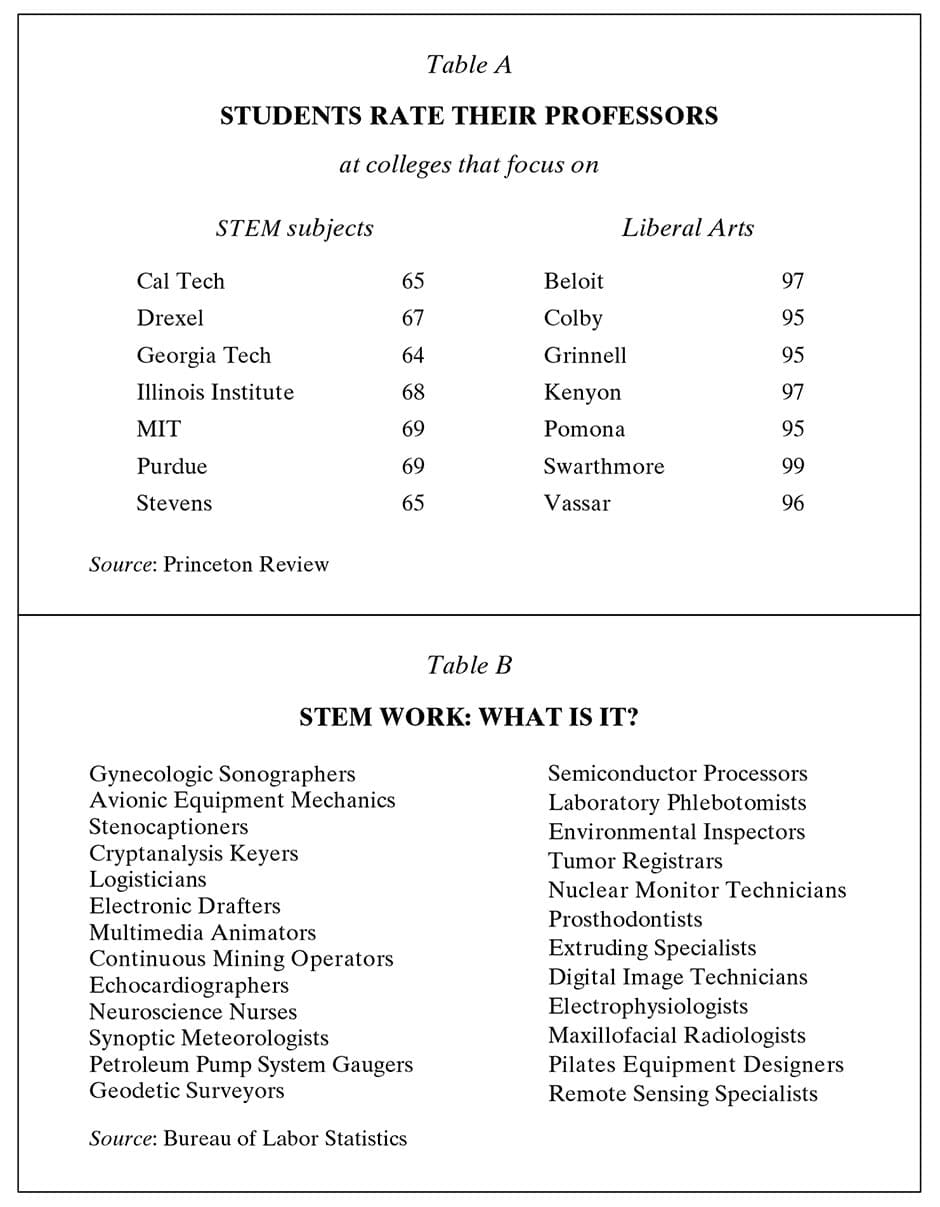
    This is from an excellent article by Andrew Hacker in the NYRB. He puts to bed various myths. Both tables tell a story.

    Hacker_Table_AB-070915

    He writes:

    Of course, bad teaching has varied causes. But it may be more apparent in STEM fields, where fixed material has to be covered; the reactions of many students suggests that many professors apparently see no need to make their teaching appealing. While student ratings have drawbacks, those in Table A hint at serious problems in STEM classrooms (see below). In mathematics, few freshmen meet a full-time professor close up. A recent survey by the American Mathematical Society found that 87 percent of all classes are taught by graduate assistants, adjuncts, or instructors on annual contracts.

  • 05/07/2015

    Post Link

    Chris Squire has died

    Chris Squire has died. A great bass guitarist, if not fashion stylist. But, as ever, what hits you in the first  few bars, after the bass, is Buford’s snare work. There is timing, and then there is Bill Bruford.