
“Imagine if we taught baseball the way we teach science. Until they were twelve, children would read about baseball technique and history, and occasionally hear inspirational stories of the great baseball players. They would fill out quizzes about baseball rules. College undergraduates might be allowed, under strict supervision, to reproduce famous historic baseball plays. But only in the second or third year of graduate school, would they, at last, actually get to play a game. If we taught baseball this way, we might expect about the same degree of success in the Little League World Series that we currently see in our children’s science scores.”
31/10/2016
Post LinkIn your final year, you get to crack eggs
30/10/2016
Post LinkThe UK needs 10,000 dermatology academics
No, it doesn’t: pure clickbait. But how many does it need? The headline was taken from a comment by Eric Schmidt, the former CEO of Google, that the ‘UK needs 10,000 computer science academics’, When I saw the headline, I initially read it as saying the UK needed another 10,000 computer science graduates. Oops. He means staff, not students.
But then I wondered, as I often have, how many academics in medicine we need, and how we might go about working out what the number should be. And I should add, I am sceptical we can know how many doctors we need, only those untouched by reality like Jeremy Hunt, know answers to question like that. But there are some numbers that are relevant, even if I cannot match Enrico Fermi’s ability to perform back of the envelope calculations (how many piano teachers are there in New York?).
Depending on how you parse the data, skin disease is said to be the commonest reason to visit a GP in the UK. Estimates suggest there are 15 million visits to GPs with a skin problem each year. In many countries all these patients would go direct to an office dermatologist (this distinction is important, but marginal to my argument here).
Each year about one million people with skin disease are referred from primary care to secondary care. New to follow up ratios are falling — being forced down without any clinical reason because of money — but assume 1 to 1.5. In terms of visits, the ratio is much higher, because we have to include surgery and phototherapy, so the ratio of new to follow up is much higher, at a guess 1:4. This would mean 4 million visits. This seems frighteningly high.
There are around 70,000 GPs on the register, and around 600 consultant dermatologists in the UK. GP recruitment problems are well known, and estimates are that close to one third of all dermatologist posts are vacant (‘no suitable candidates’). There are juniors (sic) on top, and other miscellaneous doctors too. In terms of new patients, I see 26 per week, and I am clinically part time, so around 1000 per year, plus some on call work, which is light. If we divide the 1,000,000 new referrals by 400 consultants, we get each consultant seeing around 2,500. But if we add in juniors, staff grades and locus, the numbers *feel* about right.
If we were to look at academic staffing, we have about 30-35 clinical academics in dermatology in the UK. They spend their time between clinical practice, research and teaching. Most UK students are taught for most of their time by people who are not ‘academics’ or at least by people without what in most subjects and in most advanced countries would be recognised as an academic apprenticeship. Skin biology or skin science is notable by its almost complete absence in many — possibly the majority— of medical schools. If we argue — and I would — that those who run and organise teaching in higher education need to view this task as a *professional* task, we are running with say 15 FTE providing the undergraduate teaching resource that underpins clinical practice and early training / education. Note: my argument is about undergraduate education, and not specialist training; and I believe that teaching is not a ‘bolt-on’ activity at the undergraduate level (if you don’t agree with this view, I suggest you could largely dispense with university medical schools).
There is a simple way to frame any answer to my question. Do you think it is possible to produce and maintain a culture of learning and clinical expertise given the numbers above?
29/10/2016
Post LinkEdTech the Devil’s way.
Great post by Bryan Alexander, titled ‘ A Devil’s Dictionary of Educational Technology’. If you work in it, you will recognise it. I will start off with my favourites
Powerpoint, n. 1. A popular and low cost narcotic, mysteriously decriminalized.
YouTube, n. The ideal educational technology: everyone likes and uses it, it’s reliable and free, and neither you nor anyone you know has to support it.
Here are a few more:
Active learning , n. 1.The opposite of obedience lessons.
Asynchronous, adj. The delightful state of being able to engage with someone online without their seeing you, while allowing you to make a sandwich.
Best practice, n. “An educational approach that someone heard worked well somewhere. See also ‘transformative,’ ‘game changer,’ and ‘disruptive.’” (by Jim Julius)
LMS, n. 1) A document management system, whereby a faculty member can transfer a single document to his or her students. Curiously overpowered for this purpose, nevertheless universally deployed.
2) A good way to avoid legal notices about copyright.
3) The graveyard of pedagogical intentions. A sump for IT budgets.
Nice procrastination piece, or reality check, depending on whether you teach or you deliver teaching.
27/10/2016
Post LinkTIJABP. Malthus, research funding, and despair. Institutions matter.
I try to avoid writing on this topic, finding it too depressing — although not as depressing as I once did, as I am closer to the end rather than the beginning. And there are signs of hope, just not where they once were.
There is an editorial in Nature titled ‘Early-career researchers need fewer burdens and more support’. It makes depressing reading. The contrast is with a talk on YouTube I listened to a few days back, by the legendary computer engineer (and Turing award winner and much else) Alan Kay, in which he points out that things were really much better in the 1960s and people at the time knew they were much better. Even within my short career, things were much better in 1990 than 2000, 2000 than 2010 and so on. When people ask me, is it sensible to pursue a career in science, I am nervous about offering advice. Science is great. Academia, in many places, is great. But you can only do most science or academia in a particular environment, and there are few places that I would want to work in if I were starting out. And I might not get into any of them, anyway (Michael Eisen’s comment: never a better time to do science, never a worse time to be a scientist’). I will share a few anecdotes.
Maybe 10-15 years ago I was talking to somebody who — with no exaggeration — I would describe as one of the UKs leading biologists. This person described how one of their offspring was at university and had, for the first few years not taken his/ her studies too seriously. Then things changed, and they wondered about doing a PhD and following a ‘classical’ scientific career. The senior biologist expressed concern, worried that there was now no sensible career in science, and that much as though he/she had enjoyed their career, he/she could not longer recommend it. There was some guilt, but your children are your children.
The second, was a brief conversation with the late physicist John Ziman. I had read some of Ziman’s work — his ‘Real Science’ is for me essential reading for anybody who wants to understand what has happened to the Mertonian norms, and why science is often increasingly dysfunctional — but he shared a bit of his life history with me. When he was appointed as a lecturer at Cambridge in physics, the topic of his lectures was ‘new’ and there were no established books. So he set out to remedy the situation and spent the first two years writing such a book (still available, I think), and after that, turned his attention back to physics research, and later much more (‘you have to retire to have the time to do serious work’). He commented that this would simply be impossible now.
With respect to medicine, there has been attempts for most of my life to develop schemes to encourage and support young trainees. I benefited from them, but I question whether they target the real problem. There are a number of issues.
First, the model of training of clinical academics in medicine is unusual. Universities tend to want external funders to support the research training of clinical academics (Fellowships), but that is a model with severe limitations. Nurturing talent is a core business of the universities, and they need to devote resource to it. It is their resposibility. Of course, they need to train and support academics, not just researchers. This is what career progression within academia is about: lecturer, reader, professor etc. What medical schools want to do is to off load the risk on to the person, and then only buy when the goods have been tasted. In a competitive world, where other career options are open, this might not work well. Worst of all, it funnels a large number of institutions — institutions that should show diversity of approaches — into the lowest common denominator of what is likely to be funded by the few central funders. Until you have independence of mind and action, you cut your chances of changing the world. (Yes, I hear you say, there is not enough money, but most universities need to cut back on ‘volume’.)
The second issue, is about whether the focus should be on schemes encouraging young people into science. I know I may sound rather curmudgeonly, but I worry that much activity relating to pursuing certain careers is reminiscent of ‘wonga like’ business models. I think we should do better. If youngsters look at what life is like at 40, 50 and 60 or beyond, and like it, they might move in that direction. You would not need to encourage them — we are dealing with bright people. A real problem for science funding is that for many individuals, it resembles a subsistence society, with little confidence about long term secure funding, and little resilience against changes in political will. Just look at Brexit. I remember once hearing somebody who had once considered a science career telling me that it seemed to him that most academics spent their life writing grants, and feeling uncomfortable about replacing what they wanted to do, with what might be funded. Conversations about funding occupied more time than serous thinking. I listened nervously.
Finally, I take no pleasure in making the point, but I do not see any reason to imagine that things will get better over a ten or twenty year period. One of my favourite quotes of the economist Kenneth Galbraith, is to the effect that the denigration of value judgement is one of the ways the scientific establishment maintains its irrelevance. I think there is a lot in that phrase. If we were to ask the question, what is more critical: understanding genetics, or understanding how institutions work, I know where my focus wold be be. I suspect there is more fun there too, just that much of the intellectual work might not be within academia’s walls.
Note: After writing this I worried that people would think that I was opposing schemes to encourage young people, or that I failed to understand that we have to treat those with new ideas differently. That was not my intention. Elsewhere I have quoted Christos Papadimitriou, and he gets my world view, too.
“Classics are written by people, often in their twenties, who take a good look at their field, are deeply dissatisfied with an important aspect of the state of affairs, put in a lot of time and intellectual effort into fixing it, and write their new ideas with self-conscious clarity. I want all Berkeley graduate students to read them.”
25/10/2016
Post LinkEdtech redux
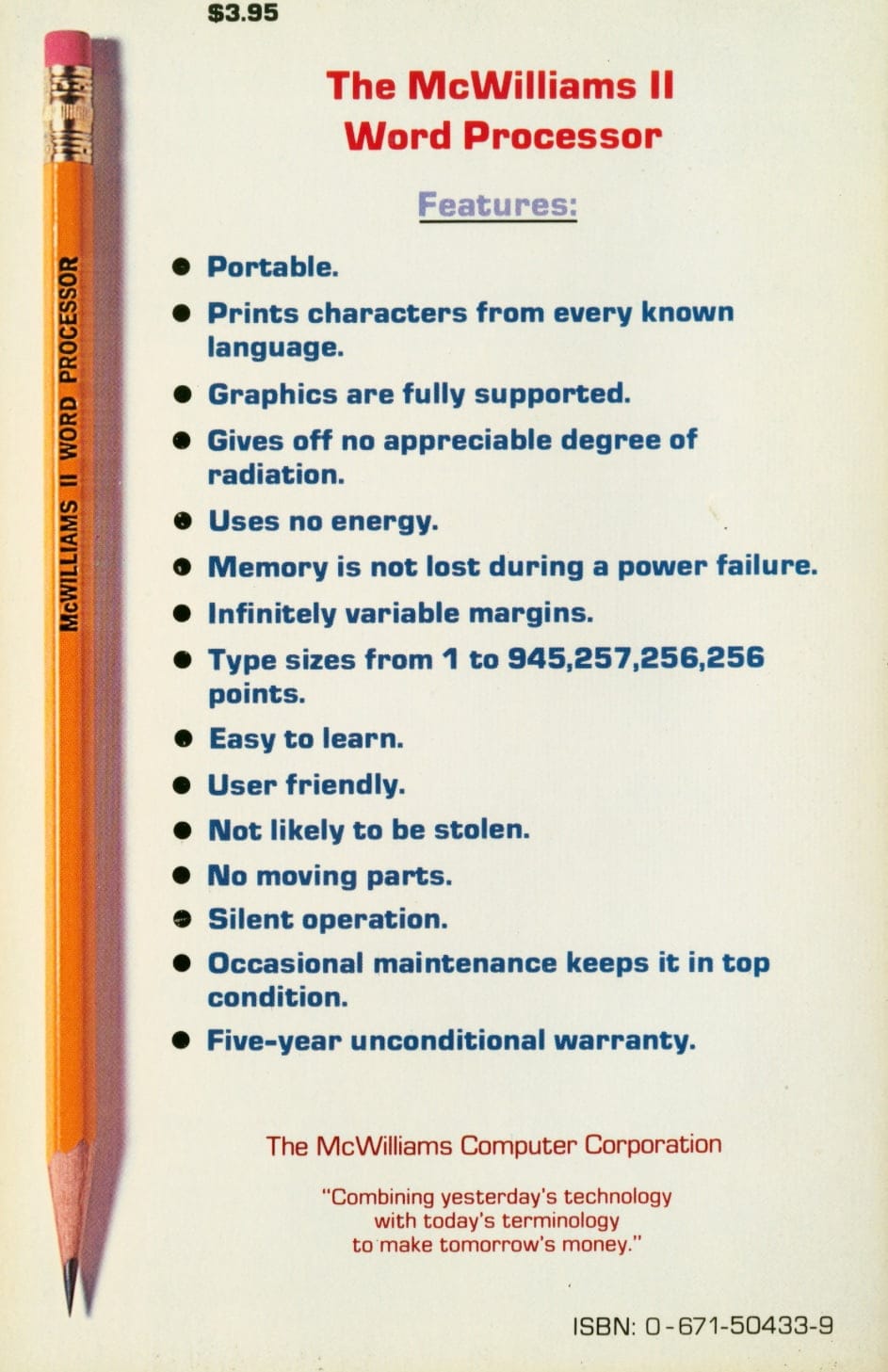
Blackboards, school buses, Nissen huts, and the pencil (via John Naughton, with original link here). Sadly, you have to invest time and effort in learning how to use it — so little to recommend to the multitaskers
24/10/2016
Post LinkWe don’t need no teachers
‘People pay a lot for a great education now, but you can become expert level on most things by looking at your phone.’
Sam Altman quoted in the New Yorker
It is just nice to see it in black and white. So simple. BTW, the quote came via the wiser (not ‘smarter’) Nick Carr, who commented: ‘By “a really good life,” Altman means a virtual reality headset and an opioid prescription’.
23/10/2016
Post LinkTechno-pessimism, MOOCs and market failure in med ed
Attention: Some slipping of the causal nexus is evident.
An article in the Economist reviewing, or at least discussing, a couple of books about the rate of innovation caught my eye, in particular a snippet that I will expand on below. The books were “The Rise and Fall of American Growth” by Robert Gordon, and the “The Innovation Illusion” by Fredrik Erixon and Bjorn Weigel. I haven’t read either, but enjoyed a review of the Gordon book in the NYRB by Willian Nordhaus. Based on my reading of the Nordhaus book review the issue is that the rate of innovation and productivity is declining — we are not hurtling towards any singularity — and that the century of out of the ordinary innovation was 1870 to 1970. Here is Nordhaus:
Gordon focuses on growth in the United States. Living standards, as measured by GDP per capita or real wages, accelerated after 1870. The growth rate looks like an inverted U. Productivity growth rose from the late nineteenth century and peaked in the 1950s, but has slowed to a crawl since 1970. In designating 1870–1970 as the special century, Gordon emphasizes that the period since 1970 has been less special. He argues that the pace of innovation has slowed since 1970 (a point that will surprise many people), and furthermore that the gains from technological improvement have been shared less broadly (a point that is widely appreciated and true).
In the Economist article, we read:
The figures from recent years are truly dismal. Karim Foda, of the Brookings Institution, calculates that labour productivity in the rich world is growing at its slowest rate since 1950. Total factor productivity (which tries to measure innovation) has grown at just 0.1% in advanced economies since 2004, well below its historical average.
I do not find this view strange. Medical advance is slowing, not accelerating. Medicine was transformed between 1940 and 1970, but the rate of new discovery has slowed. There is more data , more activity, and more scientists, of course. And a lot more hype and university press officers. Just less advance in comparison with what went before. The same is true about university education, too.
Criticisms of these views include questions about the data used to support the various arguments. In the Economist piece, the ‘techno optimists’ make two criticisms. The second is that the ‘techno’ revolution hasn’t really started yet, but it is the first one that caught my eye:
The first is that there must be something wrong with the figures. One possibility is that they fail to count the huge consumer surplus given away free of charge on the internet. But this is unconvincing. The official figures may well be understating the impact of the internet revolution, just as they downplayed the impact of electricity and cars in the past, but they are not understating it enough to explain the recent decline in productivity growth.
Paul Mason elsewhere uses the example of Wikipedia:
Wikipedia is a non-market form of activity—it’s a $3bn hole in the advertising world.
Now bringing this back to my own little world, I am intrigued by how the battle between, on the one hand, free or OER, and on the other, books or content, you have to pay for, will work out. I touched on this in an article on teaching and learning several years ago, and one of the reasons I wrote the freely accessible textbook of skin cancer, www.skincancer909.com* was out of frustration at the poor quality of dermatology textbooks targeted at medical students. When I surveyed medical students a large fraction did not buy a dermatology textbook, yet it is clear that the university did not provide suitable alternatives, nor was the university able to provide reasonable online alternatives. Now, I do not believe that free is always best, nor do I think that the endgame is anytime soon. But I do believe content is critical, and despair at how the med ed (medical education) world largely ignores it. But there are amazing commercial books out there — think Molecular Biology of the Cell for instance — and there is a battle to be waged about whether you invest large amounts of money in producing material used by many, or continue with the traditional approach taken by universities (those ‘bloody PowerPoints’ and dull lectures, all done on a shoestring budget).
Woodie Flowers touched on cognate issues in a critique of MOOCs and MITx
In the United States, our “education” system is choking to death on a failed training system. Each year, 600,000 first-year college students take calculus; 250,000 fail. At $2000/failed-course, that is half-a-billion dollars. That happens to be the approximate cost of the movie Avatar, a movie that took a thousand people four years to make. Many of those involved in the movie were the best in their field. The present worth of losses of $500 million/year, especially at current discount rates, is an enormous number. I believe even a $100 million investment could cut the calculus failure rate in half.
The criticism stings because Flowers is an educational legend (it also speaks to MIT that they broadcast such critiques of their own activities). Here is Flowers again:
Properly designed new media materials can improve K–12, residential, distance, and life-long learning. In their highly developed form, these learning materials would be as elegantly produced as movies and video games and would be as engaging as a great novel.
I do not know how all of this will work out. I am intrigued by the view that we might be underestimating ‘production’ because much of it is free, but I think we are seeing real market failure, both from the commercial world and from the universities.
* Skincancer909 is due an update, and I am aiming for early 2017.
22/10/2016
Post LinkRunning off a cliff in profit-harvesting mode
Cartoon characters not infrequently run off the edge of a cliff. Pause. They then realise there is nothing there to support their running. Time lags are awkward to deal with in any analysis, but since most things do not happen overnight, they are ubiquitous. In analysis, we replace with a fudge factor. Or we ignore them.
I haven’t seen much comment on what I think is the most interesting aspect of the science news over the last few weeks. Here is a line from THE.
Five out of nine laureates in the core prizes for physics, chemistry, medicine and economic sciences were born in the UK. All crossed the pond as rather valuable immigrants to the US.
UK science, and many UK universities, have been in profit-harvesting mode for a long time now. Over the edge of that cliff. Things are going to fall apart. OK, what the hell:
The falcon cannot hear the falconer;
Things fall apart; the centre cannot hold;
21/10/2016
Post Linked.derm.101 update and more SoundCloud tracks added
I have been busy updating some teaching stuff. It is never finished but there is time for a little pause. I have completed all the SoundCloud audio answers to the questions in ed.derm.101 (Part C) and there is a ‘completed’ version of ed.derm.101 Part C half way down the linked page. Not all the links have been checked, and a lot had to be redone because the superb New Zealand Dermnet site changed their design (the best source of dermatology images, IMHO). An example of the sort of audio material is below.