Well the US version
Anatomy begins at 7:00 am sharp.
Although even the dermatologists in Vienna were hard at work at 7am, I remember. It is just that the surgeons were there even earlier. Link here.

25/11/2016
Post LinkIn 1978, the distinguished professor of psychology Hans Eysenck delivered a scathing critique of what was then a new method, that of meta-analysis, which he described as “an exercise in mega-silliness.”
Matthew Page and David Moher here in a commentary on a paper by the ever ‘troublesome’ John Ioannidis, in his article titled, “The Mass Production of Redundant, Misleading, and Conflicted Systematic Reviews and Meta-analyses”
To which, some of use would say, this was all predictable when the EBM bandwagon jumped on the idea that collating some information, and ignoring other information was ‘novel’. Science advances by creating and testing coherent theories of how the world works. Adding together ‘treatment effects’ is messier, and more prone to error. Just because you can enter data in a spreadsheet, doesn’t mean you should.
24/11/2016
Post LinkThis —‘Remaking Tertiary Education’ — is a terrific read. The report’s author Alison Wolf, asks: “How did we get to where we are? The obvious answer is ‘Government funded it this way’ and of course that is correct.” But the UK Higher Ed community was cheering all the way. £££££££.
I first came across Alison Wolf, reading her book ‘Does Education Matter?’ a few years back. The answer is, of course, much more nuanced than the many providers like to think. The most recent report points out that the current direction of travel is unsustainable, and that the students and tax payer are accumulating large debts. Once you have the blank cheque tax-payer-backed scheme, providers will expand and expand, with little end in sight ( tip: a marker of quality for UK universities is finding an institution that is not trying to expand undergraduate numbers). This was all pointed out at the time, but was buried under the trope of ‘education, education, education’. What Wolf has been right about for a long time is how the expansion of the historical 3/4 year degree level course has been to the detriment of technical education. And the needs of the population.
The graph below gives you some idea of what has happened, and there are two figures that should accompany it:
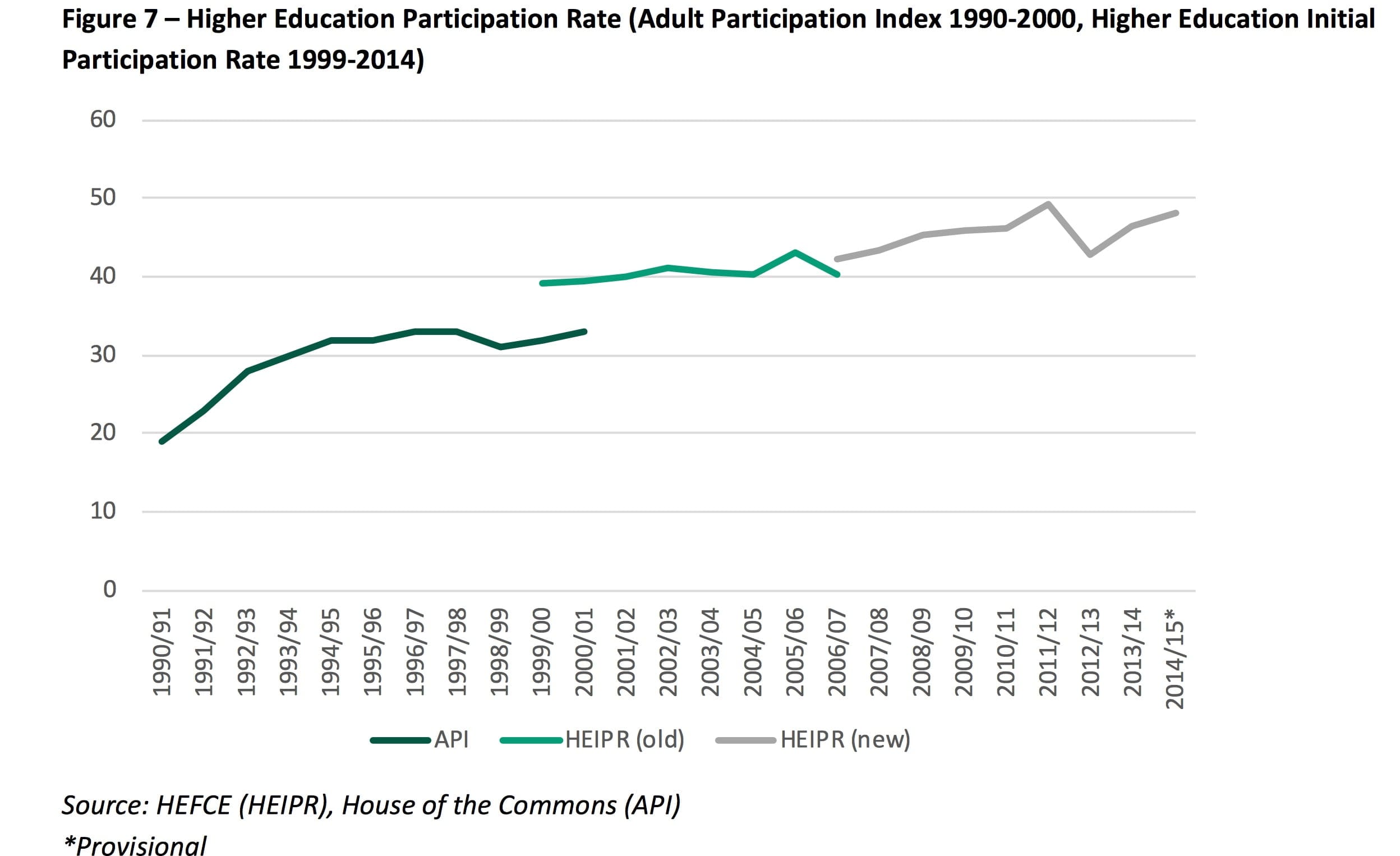
This is a massive bubble, not in learning, or producing rounded citizens, but in certification. And it is evident not just at Bachelor’s level. UK Higher education 3/4 year degrees need to be cut drastically.
23/11/2016
Post LinkSir Keith Burnett (VC, University of Sheffield) who accompanied Theresa May on a trade mission to India, quoted in the THE. Another quote provides a flavour:
I have tried to stay positive for the past four years as I’ve seen things rot. I have groaned as changes in visa regulations pushed more and more potential students away. The government has assured us that it was not deliberately trying to reduce the numbers. Well, that may be the truth, but the results are in. A 50 per cent drop!
Other countries are rubbing their hands with glee at our stupidity. Ms May is announcing that her trade mission has seen £1 billion in deals announced for the UK. But remember that international students are worth £14 billion to the UK economy every year. That’s equivalent to more than one major trade mission a month.
Now, this is indeed about direct threats to UK universities, but I will not be churlish here. You cannot have a strong and robust society without fine universities. What is worth remarking on, is how rare it is to see plain English being used to state the ‘bleedin’ obvious. That plain language is rare reveals how politicised the whole of education (and health) is in the UK. Remember the antithesis of science is not art, but politics.
22/11/2016
Post LinkAnother great video of Alan Kay, explaining how intellectual revolutions occur ( ‘appoint people who are not amenable to management’)
21/11/2016
Post LinkUCAS has just released its data on medical school applications for this year (2017 entry)……A few bits of background information are useful first. Total applications in 2015 were 82,034 for 7,424 places, which leads to the oft-cited ‘one place for eleven applicants’. However these numbers include multiple applications by students. The number of individual applicants was 20,100 and success at gaining a place depended on country of origin. Success rates were 40% for UK applicants, 10% for EU applicants and 20% for non-EU applicants.
Andrew Goddard, here. I am surprise that the acceptance rate is this high, but I guess there is a lot of self-selection. I do not have a good feel for what is influencing career choices, but the baby boomers had it better — once they got in, sadly. I will stick with my default opinion and change as the evidence changes: what happened to teaching, will happen to medicine. Politics is a dominant negative mutation, and all buckle before it.
19/11/2016
Post Link“You have the MOOCs and bla-bla-bla – you can quote me on that,” he says, laughing, “but the real revolution that has happened is in YouTube, Wikipedia, Minecraft, and people publishing things on the internet.”
I think MOOCs are interesting, mainly because of the light they cast on dated and inadequate models of university mass education, but he is right.
Mark Surman of Mozilla.
18/11/2016
Post LinkThis (‘Meaning and the Nature of Physicians’ Work’, NEJM 275;19:1813-5) is one of the best things I have read in a long time. It is right on some big issues, and is only depressing if you think positive action is not possible. The article speaks to the dehumanisation of the practice of medicine, and what happens when there is a gulf between those who practice, and those who think that a summary of practice is the same as actual practice. Tacit knowledge doesn’t fill cells in Excel spreadsheets. It is of course, not just medicine that is changing this way, but other professions — look at what has happened to schoolteaching and the bogus politics and ‘common sense’ that masquerades as evidence in education.
16/11/2016
Post LinkThere are lots of downsides to technology making it harder for some things to be forgotten. But lots of advantages too. I use a simple diarying App that is available on mobile and Mac, Day One.
One of its nice features is that gives you the option to see comments you have made on the same date in previous years. Now, like many people I tend to often agree with myself — at least over the short term— but it is fun to read earlier musings and wonder if the nuance needs changing, but also to see the same underlying memes appearing again and again. Often, I am still in agreement, with my earlier comments. Sometimes not. Here is one from three years ago.
On the usually sound principle that there is nothing in UK medicine that can’t be made worse by the involvement of the General Medical Council
Nigel Hawkes in BMJ,10 November 2012