
“The immune system is unknowable, dynamic, complicated, and it always surprises you.” Stephen Deeks quoted in Science. And yet, useful discoveries are made, and have been made for a long time.
20/10/2016
Post Linkimmune system quote
19/10/2016
Post LinkTwo good things
First of all a link to an interview with Joe Ito and Barack Obama. The latter you may have heard about, but Ito is the head of the MIT media lab. Interesting, in that he has no higher ed qualifications. But then again, Jacob Bronowski, was deemed ineligible for a Chair in the UK because he appeared on the radio and TV. But can you really imagine this sort of thing from the bunch of tyros we call a UK government?
The second, an example of how sometimes it seems that scholarship is more in evidence on the web than within the walls of the academy. You think you understand the scurvy story, or how medical progress happens. Read on.
18/10/2016
Post LinkRankings matter! But what matters in rankings?
Apart from money, that is.
HigherEd is awash with rankings. Governments like them, and so do publishers. Just look at the THE, with its myriad of bullshit scores. The allure of bogus numbers, over judgment. A feel-good frenzy of metrics. When rankings of US colleges first came in, the assessors used to actually live on campus for a while, go to lectures, and talk to students. There was an attempt at face validity. Not any more. All you need is GIGO data, and you can sell it, or use it to buy power and kickbacks like the politicians. There was even a time when the notion of common sense mattered, but then came the RAE/REF. Then the TEF. Larry Lessig’s comment is worth repeating, again.
The best example of this, I am sure many of you know are familiar with this, is the tyranny of counting in the British educational system for academics, where everything is a function of how many pages you produce that get published by journals. So your whole scholarship is around this metric which is about counting something which is relatively easy to count. All of us have the sense that this can’t be right. That can’t be the way to think about what is contributing to good scholarship.
Anyway, at the back of last week’s Economist I came across a single page advert in the ‘Courses’ section, about IMD (shown below).
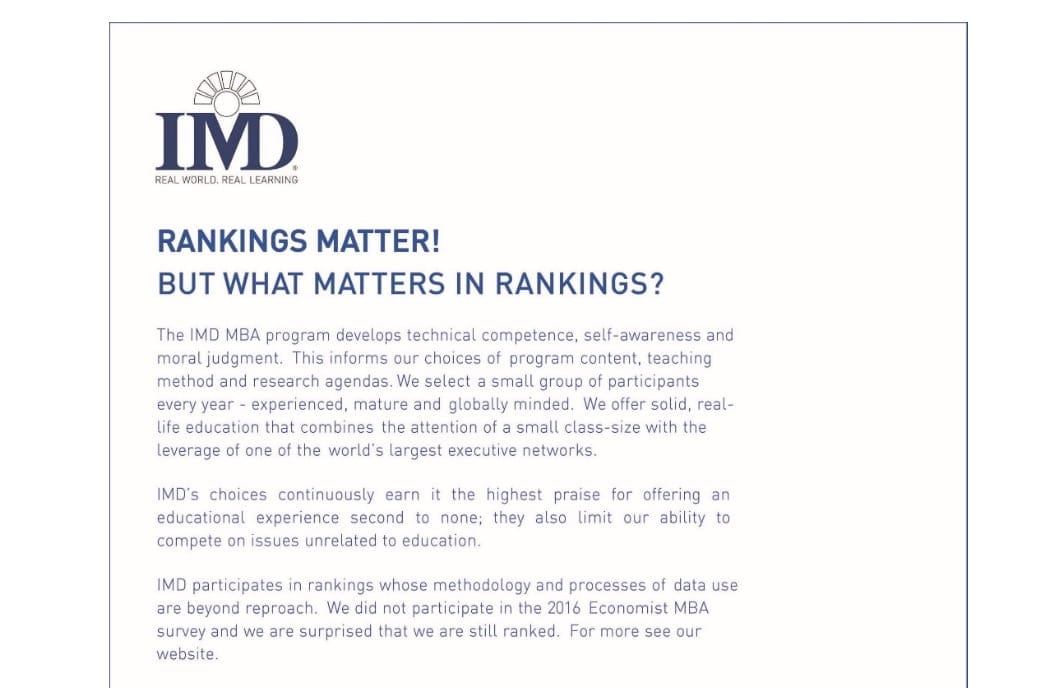
I suspect I would have passed over it, except that I used to meet up from time to time with a Professor of finance who lived in Edinburgh and worked at IMD. We had many conversations about teaching, and what impressed me was the focus on ‘education and teaching’ and thinking hard how to do it better. There is a lot about MBA programs that I do not understand, and a fair bit I am suspicious of, but I have little doubt they offer something medicine could learn from.
It piqued my interest enough to follow it up, so here is some more text from the IMD page.
At the end of September, we were informed that IMD would be included in the 2016 MBA ranking, despite the Economist’s initial agreement. This is surprising as we had not supplied any information and our participants and alumni had not been surveyed for this ranking. This contradicts the paper’s statistical method, which requires a minimum 25% survey response rate to be ranked.
Needless to say, IMD has serious reservations regarding the Economist’s methodology and its outcomes. In 2015, relative to the previous year’s ranking, LBS & IESE fell 9 ranks, IMD fell 11, and ESMT fell 23. Meanwhile, IE, Warwick and Macquire all jumped up 19 scores. As a result, Queensland, Warwick, Henley were ranked better than Cornell, London Business School, Carnegie Mellon and IMD!
They then go on to argue that the Economist ranking is scale dependent, and will discriminate against small schools (and, as we know small universities like Cal Tech are terrible…).They finish off with:
Again, IMD was not surveyed for the 2016 ranking and did not actively participate. Given this, we do not know which data the Economist will use to establish our position. What we do know is that the Economist ranking has just lost its last bit of credibility. Unfortunately, there is little IMD can do to stop the Economist from proceeding.
Says it all. Wake up. At least the Economist accepted the money (for the advert).
17/10/2016
Post LinkEdtech, Edinburgh and the blackboard.
“In the early 1800s, slate blackboards represented change. For centuries, students had used handheld tablets of wood or slate. Teachers moved about their classrooms, writing instructions and inspecting students’ work on individual slates. When the Scottish educational reformer James Pillans became the rector of Edinburgh High School, in 1810, his use of a blackboard was revolutionary. He explains in an 1856 memoir, Contributions to the Cause of Education:
I placed before my pupils, instead of a crowded and perplexing map, a large black board, having an unpolished non-reflecting surface, on which was inscribed in bold relief a delineation of the country, with its mountains, rivers, lakes, cities, and towns of note. The delineation was executed with chalks of different colours.
Widely recognized as the inventor of the blackboard, Pillans doesn’t specify how he constructed the apparatus……Pillans used his innovation to teach Greek as well as geography, noting,
The very novelty of all looking on one board, instead of each on his own book, had its effect in sustaining attention.”
Sounds familiar.
14/10/2016
Post LinkLMS as in management, rather than learning
“the state of most learning management systems is verging on embarrassing in the face of the smartphone generation” and that “grainy footage of an hour-long lecture, filmed from the back of the lecture hall, just won’t cut it”.
Simon Nelson of FutureLearn in the THE
13/10/2016
Post LinkJust thinking: what we do
I was sat in a meeting recently. We were discussing teaching, amongst other things. And I pencilled out what we in dermatology deliver each year, every year (subtext: I doubted that people realise how much effort and resource we need to teach clinical medicine).
We provide clinical placements for 36 weeks per year, with 12-14 students attached for each two week period, in 18 ‘cohorts’. Over the year we provide just under 400 hours of clinical seminars, in which patients appear, but are there for teaching purposes only, with the students in groups of around ten, and with the teacher having no other responsibility (they are not managing patients). In addition we provide around 1500 hours of clinical experience — timetabled events in which a student attends a session in which they are not the focus of attention. These latter sessions are real: they are timetabled by person and time, start and finish on time, and are rarely cancelled or changed.
Students like what we do, they like the online stuff, too, and the staff are enthusiastic. But this system does not run itself and, in the long term, I fear might not be sustainable, even though the funding is said to be there. It is certainly not optimal, even though our students get a better deal than students at most other UK medical schools. We need to do something else, building on what we do well. Just thinking.
12/10/2016
Post LinkThe Heavenly Emporium of Dermatological Knowledge
In my ‘online’ textbook of ‘rashes’ (ed.derm.101), that is the non-cancer bits of dermatology, I have a chapter called ragbag. I used to have two ragbag chapters, but now by combining them, the subject has been made simpler and easier, even though the content is unchanged. I am sure students agree. I put in this chapter all the things I do not put elsewhere. I thought I should now fess up a little, as Gödel would not have said.
In ‘John Wilkins’ Analytical Language’, Borges refers to the work of Franz Kuhn and his work on the the Chinese encyclopaedia the ‘Heavenly Emporium of Benevolent Knowledge’ (John Luis Borges, Selected Non-fiction, ISBN978-0-14-029011-0). This work is a classification of the world. For instance, you can classify the world into various groupings or categories. For animals we have:
- Those that belong to the emperor
- Embalmed ones
- Those that are trained
- Sucking pigs
- Mermaids
- Fabulous ones
- Stray dogs
- Those that are included in this classification
- Those that tremble as if they were mad
- Innumerable ones
- Those drawn with a very fine camel hair brush
- Et cetera
- Those that have just broken the flower vase
- Those that, at a distance, resemble flies
All very straightforward stuff, as any medical student will agree. I also like the system proposed by the Bibliographical Institute of Brussels (after Borges). It parcelled the universe into 1000 subdivisions with number 262 corresponding to the Pope, 268 to Sunday Schools, 298 to Mormonism, and 179 to cruelty to animals, duelling and suicide.
We have lots of similar systems in medicine, some of which seem less fit for purpose than those described above. My incomplete categorisation of categorisation (the grant was turned down) is as follows:
- A minority are generative — you get more out than you put in. We work hard to avoid these.
- Some are overtly vexatious.
- Soem are covertly vexatious.
- Some require more input that you get out (like fees).
- Some require so much learning to understand the nuances of the classification, that learning the ‘facts’ is a relief.
- Some reflect career enhancement on the part of the teacher.
- Some are designed to allow a subject to be examined in a MCQ.
- None of the above.
- All of the above.
- Ichthyoses.
Dreyfus and Dreyfus, the US philosophers and students of AI, pointed out that although we like to use rule-based systems in teaching, experts quickly forget them, and do not appear to use them (From Socrates to Expert Systems:The Limits of Calculative Rationality, 1984). We just inflict them on the young either because that is the only way we know how to encourage learning, or because we repeat what happened to us earlier in our career without good reason. Quoting Dreyfus and Dreyfus:
The beginning student wants to do a good job, but lacking any coherent sense of the overall task, he judges his performance mainly by how well he follows his learned rules. After he has acquired more than just a few rules, so much concentration is required that his capacity to talk or listen to advice is severely limited.
They were not writing about medical students. But I recognise what is going on. I can remember it too. Classifications may or may not be useful in learning a subject, and in chunking, may provide a guide to action. But the more experience you get, the less the clinician uses them. Academics, of course, play by different rules, and get to write the rules.
11/10/2016
Post LinkReflecting on tick boxing
They are qualified practitioners called on to make life-and-death decisions in conditions often far from ideal; simultaneously, they are treated rather as children at school, obliged to tick boxes to show progression, document feedback on performance, demonstrate written evidence of reflection, and comply with burdensome bureaucracy. Their protest is both an expression of breaking point frustration with their training and a clarion call to the country to wake up and recognise the true state of the nation’s health services.
From Neena Modi, President of the UK Royal College of Paediatrics and Child Health.
None of the above is surprising or not widely thought. It is just that untruth has been deemed more important than truth in postgraduate medical education. Politics reigns. BTW written reflection continues to be the bullshit canary in the colliery of medical education.
10/10/2016
Post LinkOn being human.
“If we want our health care practitioners to be more humanistic, perhaps we should begin by treating them as human beings.” Sarab Sodhi Academic Medicine
09/10/2016
Post LinkNever ever say Uber, Spotify, Netflix……
Michael Feldstein writes about ed tech companies and Pearson:
1 Never, ever, say that you want your company to be the Uber of education, the Airbnb of education, the Pokemon GO of education, or the insert name of tech darling of education unless you really enjoy being a recluse (or you are secretly a double agent for your employer’s direct competitor).
2 If you absolutely must say something like the above, then do not say you are the Netflix of education. Honestly, Netflix isn’t even great at being the Netflix of movies. The last time they recommended a movie that I actually wanted to watch was…uh…never.
There is a recurring cultural fantasy that “solving” the education “problem” consists of creating a customized playlist of little content bits. So really, more like the Spotify of education, if you want to play that game. This idea enrages educators because it trivializes what they do. Nobody who has taught believes that proper sequencing of content chunks is the hard part.
“We’re starting to meta-tag all the content so it can be chopped up into component parts and reassembled on the fly for each user,” explained Hitchcock………
Feldstein adds:
We’ve gone from Netflix to Google Ads. Out of the frying pan, into the fire. Can we get a spamming algorithm analogy just for good measure?
Worth a full read.