Opens in a new tab
Categories Filter
  • 23/10/2017

    Post Link

    Power

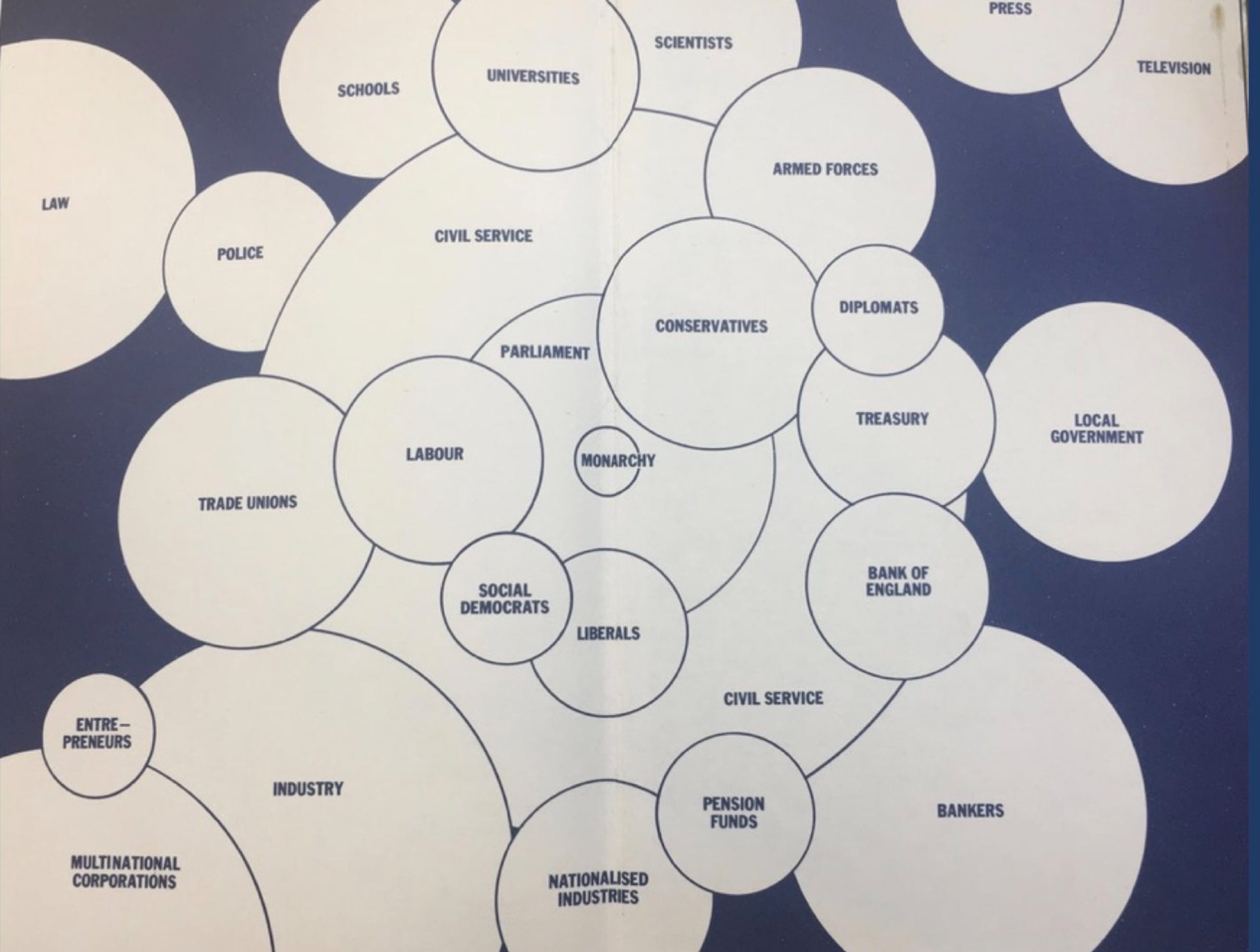
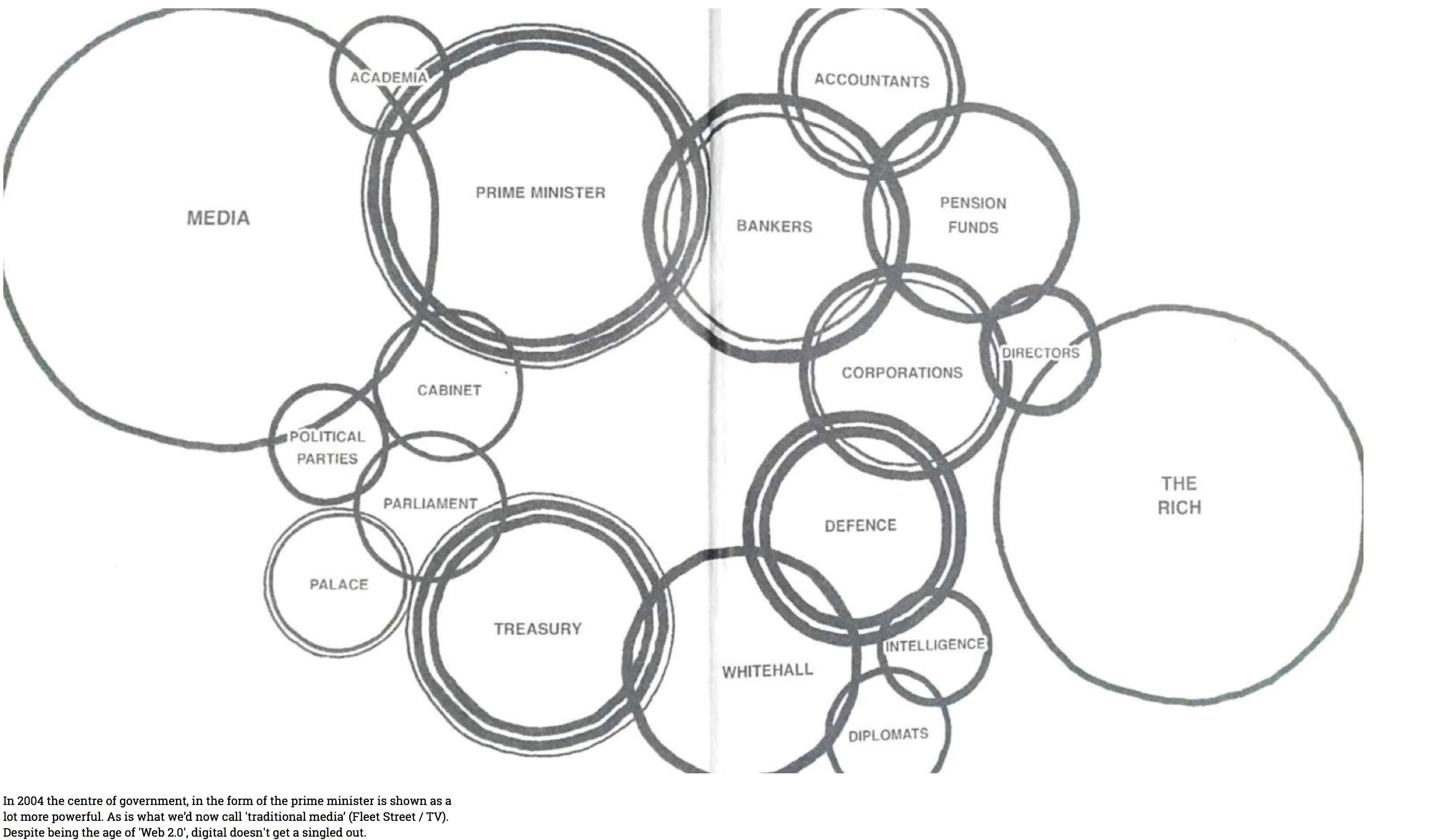
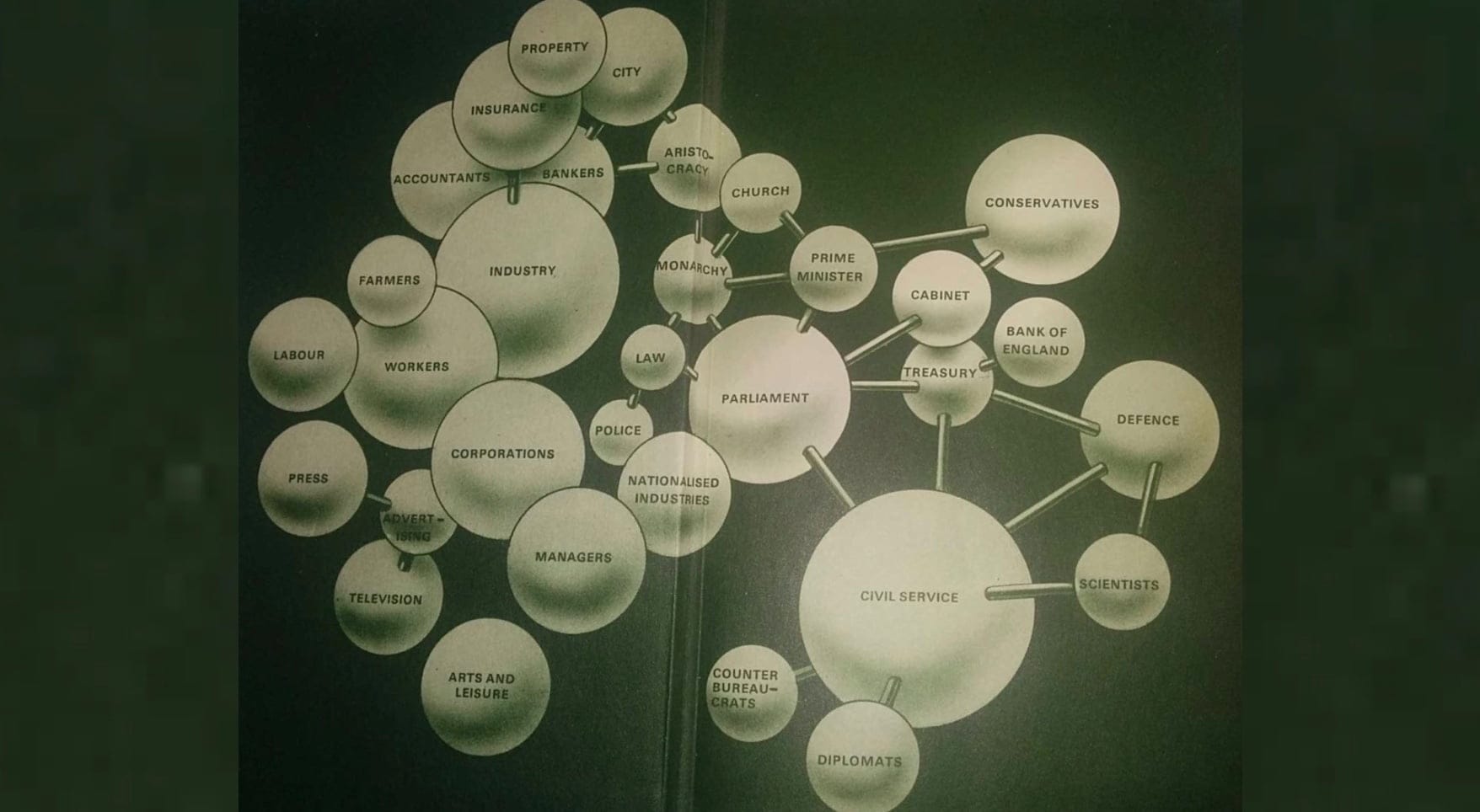
    I came across these images from the late Antony Sampson’s series of books on “Who runs this place”. They were part of a fascinating presentation by Tom Loosemore on tech in government and inter alia the design of Universal Credit. A lot I didn’t know, and well worth a listen — even to somebody who used to make me rage with anger. But I write this, having just read the story over the weekend about how if you are on or below the poverty line, you have to pay 50p a minute for telephone advice**, whereas if you want to report ‘cheaters’ (other than bankers)  the phone line is free. Even inspirational thinking and coding cannot escape this sort of evil. In the context of politics, Nye Bevan knew what to call such people.

    Check out the universities, academia and scientists in Sampson’s perceptual maps of power and influence over 40 years in the UK . The designs reflect the dates (top to bottom: 1962, 1980, 2004).

    ** telephone advice: an interesting example of how a technology allows you to charge for what once was free and a right of any citizen.


  • 20/10/2017

    Post Link

    Twenty years of schoolin’ and they put you on the day shift

    Is it medical education or medical training? This is almost an age-old question, one that I am not going to resolve here. But every generation has to ask it anew. Not least because the sands of time keep moving.

    In undergraduate medicine, in 2017, I fear we have got this wrong in a big way. Just when the future looks ever more uncertain, when we have to consider how much traditional ideas of medical careers — and even how we conceptualise doctors — is up for grabs, we are ever more focussed on short term goals: not medical education, but short term training (‘produce FY1 doctors’). But of course, the purpose of medical eduction is not to produce FY1 doctors — that is like saying that passing tests is the purpose of education. The purpose of medical education is to equip students to work (usually) in medicine for a lifetime. Graduates must be able to start learning safely in a clinical environment, but the purpose is not to be FY1’s or core medical trainees.

    But the other reason that this problem needs revisiting, is that medical education was framed in time when few people went to university, and when spending five years at university seemed unusual. No matter that much of it was ‘training’ rather than education: by comparison with ‘average’ there was some education in there. But what I fear now is that many medical students are being left behind, increasingly ‘trained’ for one employer and one niche, at the cost of their education. A niche that is threatened by ecological change. And to echo a theme of the day, young people are being made to pay (via debt) for what many other corporations rightly accept is their ‘training’ responsibility.

    Now, I do not see the solution in making medicine a postgraduate degree (for most), but I think we can start meaningfully thinking about what I would call ‘medicine plus’ degrees. Doing this, means we have to start unpicking ‘training’ and ‘education’ in ways that do not increase costs, and with an eye on the student’s future, not that of the NHS.

    MIT’s WoodyFlowers has some interesting things to say in a completely different context (that of the failure of the MOOC movement), but which I think we can meld to our purpose .

    The missed opportunity, I argued, involved recognition that education and training are different and that training could be dramatically improved through use of well structured, high quality modules that would help students train themself so person-to-person time could be used for education. Essentially the strategy would outsource training and nonjudgmental grading to digital systems, and thereby free instructors to serve as mentors.

    Woodie Flowers

    Title: borrowed from “Subterranean Homesick Blues”. There are lots of lines that students of the fees era would do well to reflect on, including: “Don’t follow leaders, Watch the parkin’ meters”.

  • 19/10/2017

    Post Link

    No HR solution available

    This was a comment on on the political question of our time by Janesh Ganash in the FT, but to me it has a wider relevance, including how we think about higher education. Of course, people will keep perseverating, believing the contrary.

    There is no human resources solution to an ideological problem.

  • 18/10/2017

    Post Link

    Strong and stable: the importance of neither

    Writing was invented to support taxation. Elites’ insatiable appetite for fully domesticated workers boosted forced labour and slavery. It almost comes as a relief to be reminded that the oppressive character of the state was leavened by its own brittleness: rather than precipitating a calamitous slide into chaos, periodic collapse would simply have disassembled larger states into their constituent communities. Plenty of fetters were loosened in the process.

    This is not too far from the antifragility, of Taleb

    Review of ‘Against the Grain’, by James C Scott in the FT.

  • 17/10/2017

    Post Link

    Most lawyers don’t make anything except hours.

    This was a quote from an article by an ex-lawyer who got into tech and writing about tech. Now some of by best friends are lawyers, but this chimed with something I came across by Benedict Evans on ‘why you must pay sales people commissions’. The article is here (the video no longer plays for me).

    The opening quote poses a question:

    I felt a little odd writing that title [ why you must pay sales people commissions]. It’s a little like asking “Why should you give engineers big monitors?” If you have to ask the question, then you probably won’t understand the answer. The short answer is: don’t, if you don’t want good engineers to work for you; and if they still do, they’ll be less productive. The same is true for sales people and commissions.

    The argument is as follows:

    Imagine that you are a great sales person who knows you can sell $10M worth of product in a year. Company A pays commissions and, if you do what you know you can do, you will earn $1M/year. Company B refuses to pay commissions for “cultural reasons” and offers $200K/year. Which job would you take? Now imagine that you are a horrible sales person who would be lucky to sell anything and will get fired in a performance-based commission culture, but may survive in a low-pressure, non-commission culture. Which job would you take?

    But the key message for me is:

    Speaking of culture, why should the sales culture be different from the engineering culture? To understand that, ask yourself the following: Do your engineers like programming? Might they even do a little programming on the side sometimes for fun? Great. I guarantee your sales people never sell enterprise software for fun. [emphasis mine].

    Now why does all this matter? Well personally, it still matters a bit, but it matters less and less. I am towards the end of my career, and for the most part I have loved what I have done. Sure, the NHS is increasingly a nightmare place to work, but it has been in decline most of my life:  I would not recommend it unreservedly to anybody. But I have loved my work in a university. Research was so much fun for so long, and the ability to think about how we teach and how we should teach still gives me enormous pleasure: it is, to use the cliche, still what I think about in the shower. The very idea of work-life balance was — when I was young and middle-aged at least — anathema. I viewed my job as a creative one, and building things and making things brought great pleasure. This did not mean that you had to work all the hours God made, although I often did. But it did mean that work brought so much pleasure that the boundary between my inner life and what I got paid to do was more apparent to others than to me. And in large part that is still true.

    Now in one sense, this whole question matters less and less to me personally. In the clinical area, many if not most clinicians I know now feel that they resemble those on commission more than the engineers. Only they don’t get commission. Most of my med school year who became GPs will have bailed out. And I do not envy the working lives of those who follow me in many other medical specialties in hospital. Similarly, universities were once full of academics who you almost didn’t need to pay, such was their love for the job. But modern universities have become more closed and centrally managed, and less tolerant of independence of mind.

    In one sense, this might go with the turf — I was 60 last week. Some introspection, perhaps. But I think there really is more going on. I think we will see more and more people bailing out as early as possible (no personal plans, here), and we will need to think and plan for the fact that many of our students will bail out of the front line of medical practice earlier than we are used to. I think you see the early stirrings of this all over: people want to work less than full-time; people limit their NHS work vis a vis private work; some seek administrative roles in order to minimise their face-to-face practice; and even young medics soon after graduation are looking for portfolio careers. And we need to think about how to educate our graduates for this: our obligations are to our students first and foremost.

    I do not think any of these responses are necessarily bad. But working primarily in higher education, has one advantage: there are lost of different institutions, and whilst in the UK there is a large degree of groupthink, there is still some diversity of approach. And if you are smart and you fall outwith the clinical guilds / extortion rackets, there is no reason to stay in the UK. For medics, recent graduates, need to think more strategically. The central dilemma is that depending on your specialty, your only choice might appear to be to work for a monopolist, one which seeks to control not so much the patients cradle-to-grave, but those staff who fall under its spell, cradle-to-grave. But there are those making other choices — just not enough, so far.

    An aside. Of course, even those who have achieved the most in research do not alway want to work for nothing, post retirement. I heard the following account first hand from one of Fred Sanger’s previous post-docs. The onetime post-doc was now a senior Professor, charged with opening and celebrating a new research institution. Sanger — a double Laureate — would be a great catch as a speaker. All seemed will until the man who personally created much of modern biology realised the date chosen was a couple of days after he was due to retire from the LMB. He could not oblige: the [garden] roses need me more!

  • 16/10/2017

    Post Link

    Left and right: where is the difference?

    There are now more demands and requirements placed on higher education institutions than ever before. It’s an unlikely truism, but Conservative governments generally tend to seek to centralise and control universities – in Michael Barber’s language of how policy is made: It’s the difference between “Trust and Altruism” and “Choice and Competition” drifting into “Command and Control.”

    Wonke newsletter 16 October 2017

  • 12/10/2017

    Post Link

    Surpluses from teaching

    Phil McNaull, director of finance at the University of Edinburgh and chair of the British Universities Finance Directors Group, says that “it has been clear for some time” that direct income for research “does not cover the full economic cost of conducting it, and the net deficit is subsidised by other sources”, such as surpluses from teaching.

    Quoted in THE, (emphasis mine). Factually, this is true. It is a mistake to believe that the price of things, equates to how much they cost to produce. Look at the differential pricing of home and non-EU students, for instance. Or the gap between the component parts of an iPhone and the retail price. Or why most successful drugs only cost a fraction of what pharma claims is the cost of development. But the possibilities for some sort of arbitrage are there. And in an area in which agents make up their own standards (i.e. higher education), I think a lot more scrutiny is required.

    Patents or graduates? I guess the latter are worth more.

  • 12/10/2017

    Post Link

    Education is an admirable thing,” wrote Oscar Wilde

    Education is an admirable thing,” wrote Oscar Wilde, “but it is well to remember from time to time that nothing that is worth knowing can be taught.

  • 11/10/2017

    Post Link

    Foundational knowledge

    You don’t learn to draw by knowing how pencils are made

    These sort of aphorisms always make me to want to think harder about what exactly is foundational in medical education. The suspicion is that it is far less than we think. Schooling is full of wasted time spent learning things that are of little use, but easy to test, meaning there is little time for students to learn things that are useful.

    The case for anatomy in surgery is robust and self-evident. If you remove tumours in the preauricular area or on the temple, you have to know what structures to avoid or which ones may have become compromised. If you ask any competent surgeon they will of course know what these structures are. But when you move into many areas of clinical medicine, I am always amazed by how much competent physicians have forgotten about all these things that were labelled ‘foundational’, and formed the basis of high-stakes exams. It is of course possible to be aware of schema, that structure your behaviour, and be unable to recall them — schema that experts implicitly know and novices don’t. But I suspect we need some sort of minimalism project, to work out how far we can go.

  • 10/10/2017

    Post Link

    What Toy Story got wrong. And more.

    If we go back to the traditional kindergarten, kindergarten was first invented about 200 years ago. It was explicitly designed to be different than the traditional school, where it was primarily about delivering instruction, delivering information that students who then dutifully wrote down on paper and recited it back. The early kindergartens recognized that something very different was needed for five-year-olds.

    And yet:

    There’s a real challenge today because even kindergartens are starting to become more like the rest of school with children filling out phonics worksheets and looking at arithmetic flashcards

    Interview with Mitch Resnick