Opens in a new tab
Categories Filter
  • 10/02/2016

    Post Link

    Pharma not the place for drug discovery

    Martin Wolf, the influential economist, wrote in the FT sometime back that the public might soon view pharma companies in the same way many viewed banks (or at least bankers). Here is a news item from today’s FT.

    A number of Pfizer scientists have told the Financial Times that they fear the company will move closer to the Allergan approach and step back from discovering new drugs, putting their jobs at risk.

    Dr Mikael Dolsten, president of worldwide research and development at Pfizer, said he was aware of the unease but that the combined company would occupy a “sweet spot” in R&D.

    Further on:

    Brent Saunders, Allergan chief executive, has questioned the efficiency of discovery research conducted by big pharma groups. In an interview with the FT last year, he argued that smaller companies and academic centres were better suited to this sort of science.

    Since then, he has modified his position somewhat, arguing that drug discovery has a role at big pharma companies, providing it is has a high chance of success and is targeted at illnesses where the company already has a strong selection of drugs.

    This is all about the merger between Allergen and Pfizer. The arguments may be more nuanced than I want to believe, but this is what happens when ‘financialization’ becomes more important than invention (and long term value). Lets just call it: the no James Black syndrome.

    And can we please skip the dreadful ‘sweet spot’ terminology.

  • 09/02/2016

    Post Link

    Publishing: compare and contrast

    Remember those compare and contrast questions (UC versus Crohns; DLE versus LP etc.). Well, look at these two quotes from articles in the same edition of  Nature.

    The first from the tsunami of papers showing that ‘Something in rotten in the state of Denmark Science’ — essentially that the Mertonian norms for science have been well and truly trampled over.

    Journals charge authors to correct others’ mistakes. For one article that we believed contained an invalidating error, our options were to post a comment in an online commenting system or pay a ‘discounted’ submission fee of US$1,716. With another journal from the same publisher, the fee was £1,470 (US$2,100) to publish a letter. Letters from the journal advised that “we are unable to take editorial considerations into account when assessing waiver requests, only the author’s documented ability to pay”. 

    The second is about attempts to piggyback on the arXiv server. An earlier article and blog post from Timothy Gowers says more.

    Discrete Analysis’[the journal] costs are only $10 per submitted paper, says Gowers; money required to make use of Scholastica, software that was developed at the University of Chicago in Illinois for managing peer review and for setting up journal websites. (The journal also relies on the continued existence of arXiv, whose running costs amount to less than $10 per paper). A grant from the University of Cambridge will cover the cost of the first 500 or so submissions, after which Gower hopes to find additional funding or ask researchers for a submission fee.

    Well done the Universities of Cambridge and Cornell (arXiv). For science, the way forward is clear. But for much clinical medicine, including much of my own field, we need to break down the barriers between publication and posting online information that others may find useful. This cannot happen until the financial costs approximate to zero.

  • 08/02/2016

    Post Link

    DARPA

    Nor did Mann have to worry that a good idea would struggle for funding. Whereas many government research heads fret about budgets that don’t at least keep pace with inflation, past DARPA directors are surprisingly blasé about the agency’s finances. “I never really felt constrained by money,” Tether says. “I was more constrained by ideas.” In fact, aerospace engineer Verne (Larry) Lynn, DARPA’s director from 1995 to 1998, says he successfully lobbied Congress to shrink his budget after the Clinton administration had boosted it to “dangerous levels” to finance a short-lived technology reinvestment program. “When an organization becomes bigger, it becomes more bureaucratic,” Lynn told an interviewer in 2006.

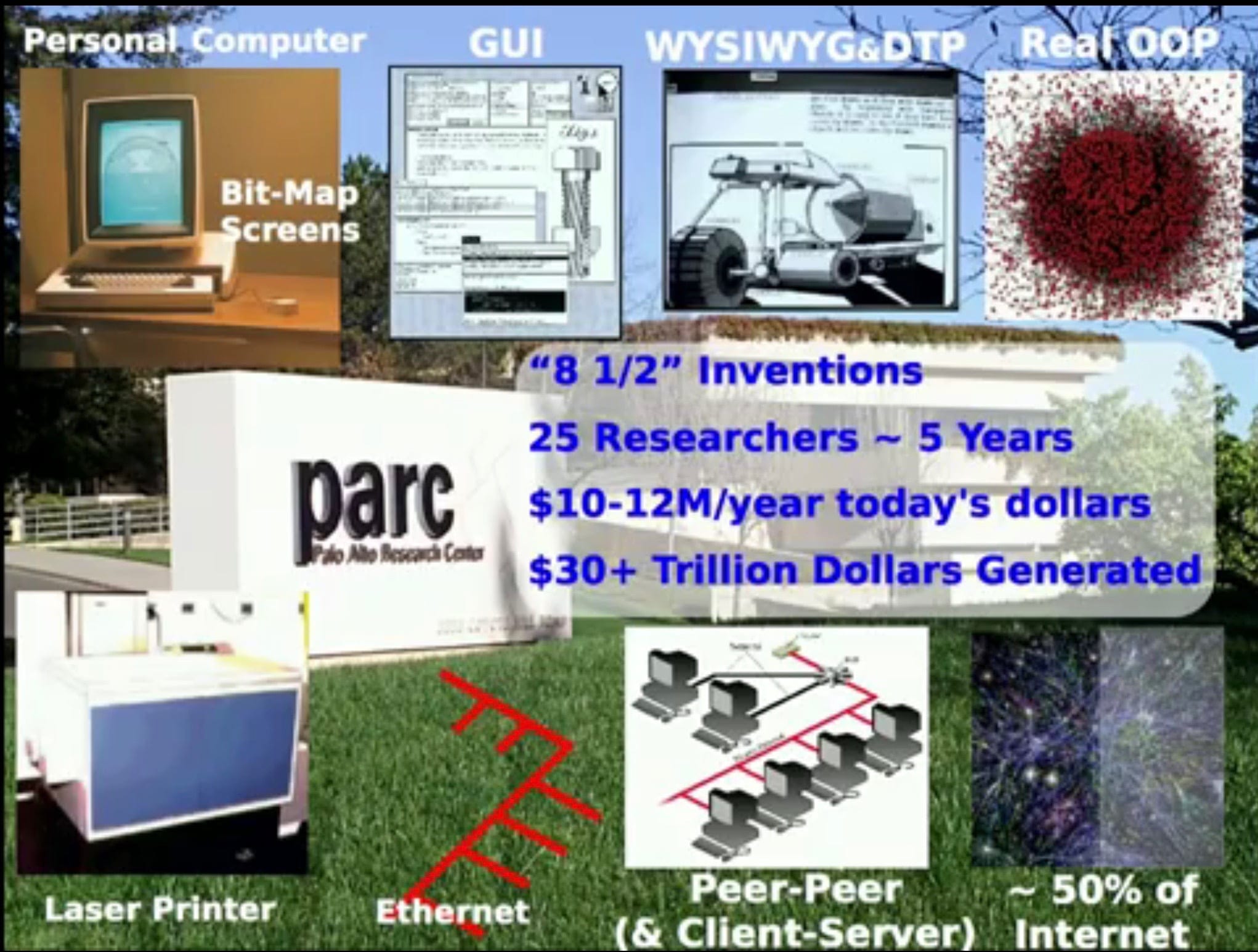
    A little about what makes DARPA tick. This reminds me of come of the comments from Xerox PARC (from John Seely Brown? — I can’t remember) about how important it was to keep the research budget (not the D, of R+D) below 1%. Any higher, and the bean counters would get interested, and start trying to manage the budget. [See my previous post from Alan Kay]. Not all increases in funding are a good idea (unless the success metric is money, rather than discovery)

    [direct link to this aside]

  • 30/01/2016

    Post Link

    Invention rather than innovation

    After yesterday’s post I couldn’t resist one more slide from Alan Kay. This is about how we once knew how to fund and support real discovery and invention.

    Alan Kay 1

  • 29/01/2016

    Post Link

    Rarer than the Dodo

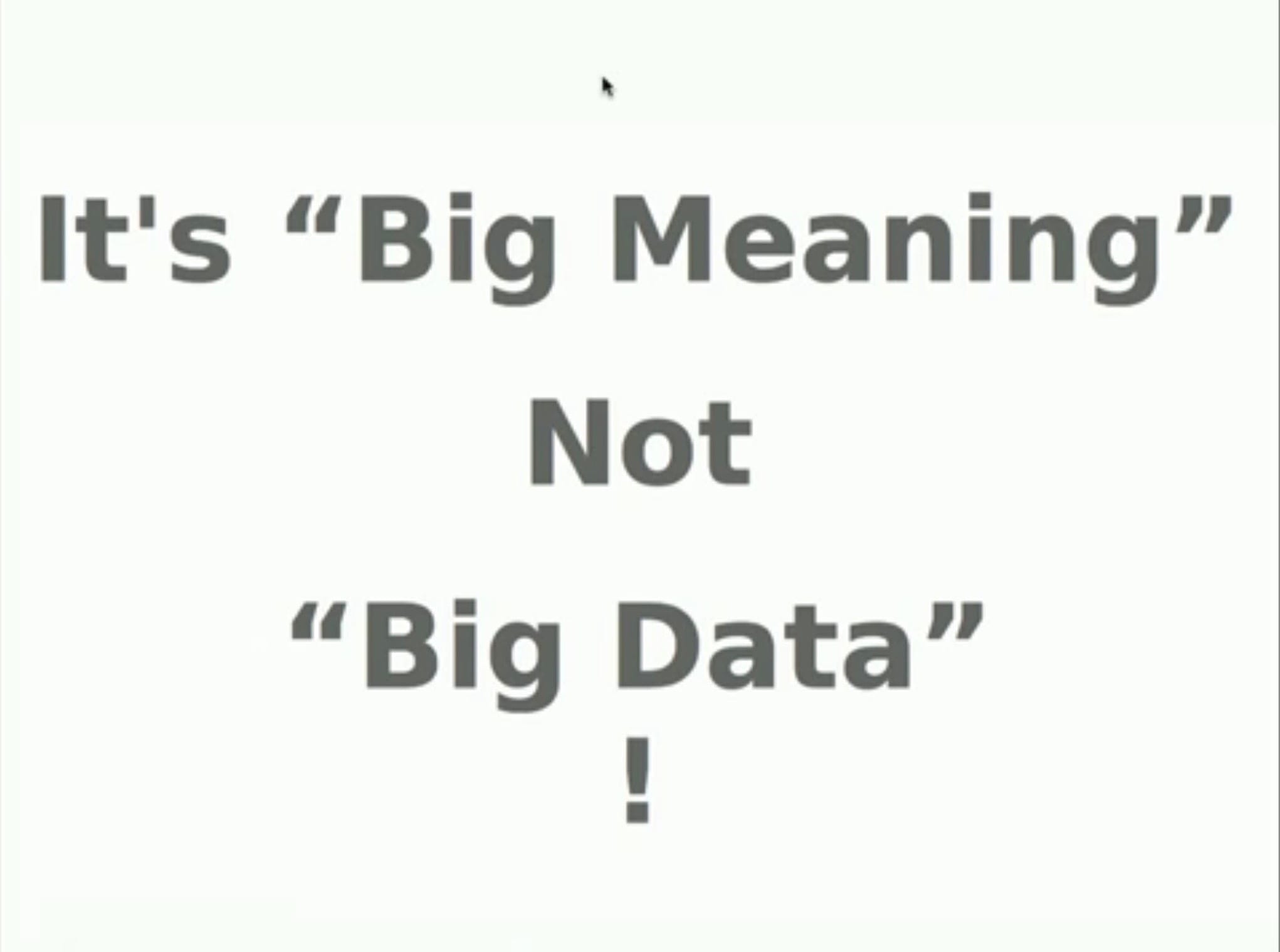
    From Alan Kay. If it comes from a Turing award winner, maybe people might take notice. Perhaps not.

    Big meaning not big data Alan kay

  • 29/01/2016

    Post Link

    Publishing and a race to the bottom

    There is an article in the FT highlighting the woes of Pearson, and the wisdom of selling the FT and the Economist. My interest is in the vigour and prospects for textbooks in a digital age, a topic that feature highly in the article. As some other commentators state, maybe we are going to see a race to the bottom with margins being slashed as ‘free’ but poor quality becomes the norm. Just like what has happened to most quality journalism. There are of course alternatives, if only the universities would step up.

  • 28/01/2016

    Post Link

    Who needs the feedback most?

    I have written previously about how we often do not know much about our own diagnostic processes. Curiously this does not mean we necessarily need to obtain large grants to get us out of our uncertainty. In many domains of life we can make a lot of progress using small tweaks to the system, experience, careful measures of outcomes, and interaction with the environment. The latter is crucial. In many crafts (and medicine is a craft, if a peculiar one) like cooking, or art, or music, we can rapidly remix inputs in the light of any output. Any teacher merely facilitates this. But what of the teachers themselves?

    When students do their dermatology attachment in Edinburgh, they are with us for just 2 weeks (far too little I hear you say, but his question deserves more thought and less partisanship than it usually gets, and so I will leave to another occasion). Most mornings they receive a 2.5 hour patient based clinical tutorial where patients are shown to them . In addition they will sit in a ‘business’ clinic and a surgical session within each two week block. They can also sit an online formative assessment if they wish, and in the second week, there is an MCQ quiz, which they self mark, as I go through the answers with them, and talk around the topics. I have been running the quiz for about 6 years with various questions. More recently I introduced a new set of questions, more carefully tuned to a major revision in the content we deliver.

    What I have found surprising is how difficult it has been to anticipate how they will fare on individual questions. I first came across this several years ago when I first set the quiz, and the results with the new quiz, are similar. There are a couple of dimensions to this.

    First, even in a seminar group of 16 or so, I find it almost impossible to anticipate how many students will have got the right answer based on my reading of their behaviour. Yes, some questions, stand out as being very easy, but given the dynamics of interaction and willingness to shout out answers, it is only when I see the written answers ( at the end of the seminar, they are collected in and collated over the year), that I have a good idea of what they know, and what they do not know. We have tried clickers, but had practical problems with them, but I do use simple ‘close you eyes and show fingers’ to reduce peer pressure. Second, when I ask other colleagues who also teach our students, objectively they also have a poor idea of how students will fare on particular questions, although they often think they know.

    Any school teacher will I expect be surprised by the above—not the difficulty in guessing what students know, which is to be expected —but the expectation that you can estimate what students know in the absence of testing or coursework. But for medicine this is a real issue, because regular day-to-day assessment of performance is rare. Why? First, student numbers are large, as are the numbers of staff involved with teaching. In our own unit most staff never see most students on more than one occasion. Repeated interactions are the exception, so sampling is a problem. Second, apprenticeship has been replaced largely by ‘observation’ with little opportunity for students to carry out tasks under supervision. Alison Gopnik, the distinguished psychologist of infant learning at Berkeley, has contrasted the way people learn to cook and the way they are supposed to learn science at University: would you really lecture them for three years before letting them crack an egg? We have similar problems in medicine (and they are not simply due to patient safety issues) where the link between seeing and doing has been broken).

    As has been said on more than one occasion, the core of feedback is allowing students to know how they are doing, with pointers to how they can change their state. Ditto for staff. The feedback loop is exactly that: a loop.

    Nothing surprising here, I hear you say. Indeed.

  • 26/01/2016

    Post Link

    first online course

    “Did you know that this is the 30th anniversary of the very first fully online course?” –

    Via Tony Bates.


  • 25/01/2016

    Post Link

    Study spaces

    One theme in what might happen to higher education is unbundling, so that for example certification might not be  provided by those who deliver the teaching. We have already seen this with student accommodation, and to some extent in (predictably disastrous) PFI schemes. But walking early evening in Zurich I came across this. There did indeed seem to be lots of young people looking at clothes, and some partying with fizzy, but there was the odd laptop too and textbook. I saw a more business like place in the middle of Zurich with swish cubicles — it looked very expensive, but there were definitely some students in it as well. You could reasonably say, Starbucks have doing it for years, but their coffee is not free.

    zurich study space

  • 25/01/2016

    Post Link

    The view at 30,000 feet

    I was on a plane from Amsterdam yesterday, sitting next to a particle physicist, after a trip to Zurich for the European Dermatology Foundation meeting. I didn’t get his name, but he had worked at CERN and FERMI ( I guess if you are a particle physicist…..), and was on his way to Edinburgh for a regular meeting of researchers.

    Couple of things in our conversation, that I would have liked to have known more about. First the phrase, ‘fees refugees’, referring to the increasing number of students from the UK now studying in the Netherlands (fees, 2000€). Strikes me that there are good opportunities for many small EU countries there. I know Maastricht plays this line, too. And the other — which we passed over quickly unfortunately — were attempts to emulate or recreate the US liberal arts college model. If much learning is ‘distant’, whether than means true distance learning, or just the poor ‘distant’ experience some of our students get on campus, then revisiting a sense of community and focus on teaching is worth taking further. In medicine, students are sent out from the city, because we cannot cope with the number in the city, in terms of the amount of clinical experience expected. Many students enjoy their regional experience, but not all. If every hospital is a teaching hospital, no hospital is a teaching hospital. It is also much easier to brand a city, rather than a region.