Nice graphic over at flowingdata.com. Lots of other great graphics, too.
06/03/2016
Post LinkCauses of death
05/03/2016
Post LinkImitation is the highest form of flattery, but is not always welcome
Somebody once remarked that two of the most powerful educational forces of the 20th century in the UK were Penguin books (I can still remember the money burning a whole in my pocket as I went into Lears in Cardiff and bought my copy of ‘Introducing Biology’), and the OU. As somebody who occasionally stumbled on these odd looking people (who didn’t look like my parents) early on a Sunday morning, the sense of evident pleasure in learning was obvious even at some ungodly hour. ‘Video’ as we now call it, worked. And for some of us the fire was lit.
From the THE
The institution’s latest accounts, which were published recently, show that it ran up a £7.2 million deficit in 2014–15, on the back of a £16.9 million shortfall the year before.
This came as the total number of students signed up for OU courses fell by 13,449 (7.2 per cent) year-on-year, to 173,889. From a high of 260,119 learners in 2009–10, the OU has now shed a third of its enrolment in the space of six years.
Mike Boxall, a higher education specialist at PA Consulting Group, said that the OU had been squeezed by a “double whammy” of the “catastrophe” in the part-time and postgraduate sectors, and the entry of other universities into the online learning marketplace.
“They have been hit by a market shift and competition for their core base,” Mr Boxall said. “It is quite challenging for them to stand back and say ‘how do we reposition ourselves against these trends’.”
Mr Boxall said that the gradual erosion of the three-year residential degree as the dominant model of higher education could “play to [the OU’s] strengths”, but warned that the university’s progress in this area was “not very visible yet”.
03/03/2016
Post LinkFuture doctors and ‘has beens’
Maybe I have reading Pulse too much, but it is always hard to attach meaning to the first tremors, before the ground visibly shakes. Lots of interesting memes: whether a medical degree is now a signal not of medical competence but of general skills (hard work, group work, perseverance, ambition); and whether we are seeing a widening of expectation gap between different groups of our own students. What seems clear, and has been for some while, is that an undergraduate medical degree needs to be dissociated from a career in the NHS: this can no longer be its prime educational purpose. Rash talk, perhaps. But please don’t think making medical apps will pay the bills.
28/02/2016
Post LinkHow many classes of <4 are you taught in?
“When I first looked at the Robbins report some years later, I was amazed that students had been surveyed on how many hours they were taught in classes of one to four, as I had no idea that university teaching ever occurred in such small groups”.
Nick Hillman in the THE.
FWIW, during my intercalated year (Newcastle, 1980/81), the core teaching over a summer of 3 months or so, had a mode class size of n=2.
28/02/2016
Post LinkPosh professors.
Private schools teach 7% of Britain’s pupils, but account for half the country’s senior civil servants, cabinet ministers and leading journalists. Seven in ten generals and judges went to independent schools, according to the Sutton Trust, a charity. In some jobs the proportion has even increased. A decade ago, half Britain’s senior doctors were privately educated; today the figure is 61%. The share has risen in the law, too.
Feels like it too. Economist.
24/02/2016
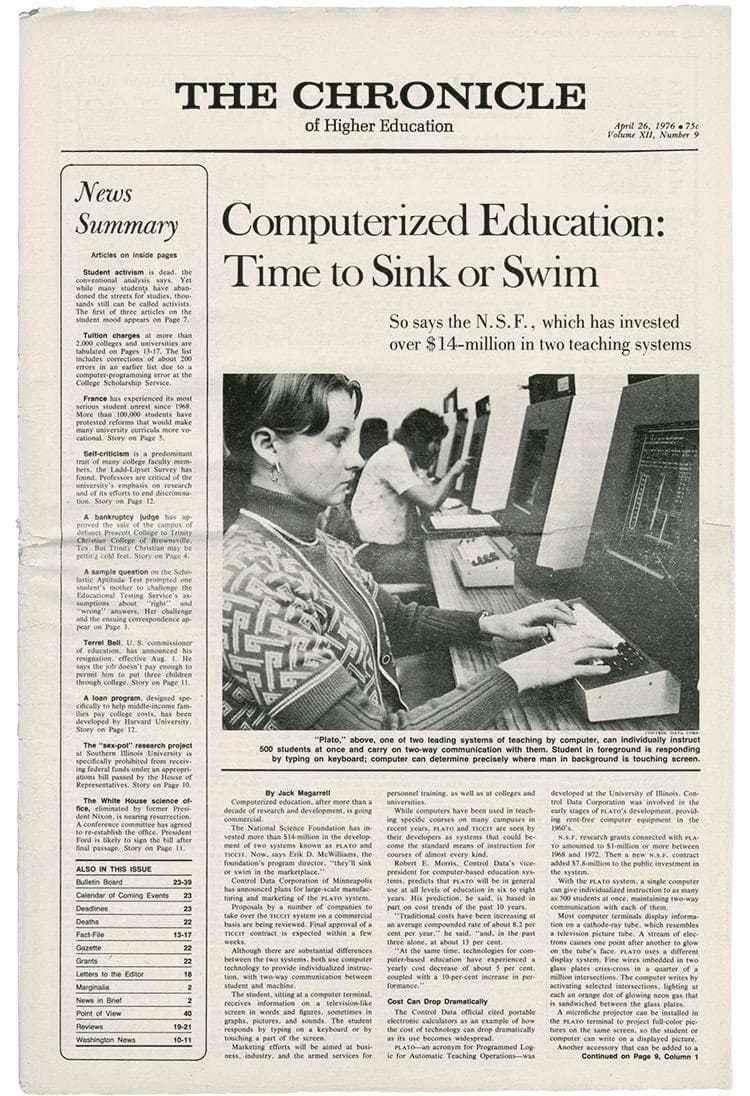
Post LinkTech and the classroom: deja vu all over again.
From the Chronicle of Higher Education.[via Audrey Watters].
23/02/2016
Post LinkWhat role, if any, do I want to have within this field?
There is a very insightful blog post in the THE from a final year med student at the Karolinska. He writes:
However, there were also negative aspects of medicine that made me question my career choice. For instance, I quickly realised that clinical decisions are heavily based on protocols and algorithms, leaving little room for individual reasoning. Moreover, the time with the patients seemed to be very limited, and the conversations almost always followed the same patterns. The monotonous work was in deep contrast to the adventurous job I had imagined.
To remain motivated, I had to answer the sensitive question that I had not previously addressed: what role, if any, do I want to have within this field?
These are pretty pertinent and sharp insights. His solution is to try and pursue research as well as clinical practice, but this too has its own drawbacks. It is the comments about protocols and how much medical practice is so time constrained, that chime with my dissatisfaction with so much NHS practice (and it is getting worse). Reminds me of Paul Seabright’s comments in his book, The Company of Strangers,
‘It is both an admirable and melancholy fact that training and and the standardisation of working methods are designed to reduce the impact of personal idiosyncrasy on the job’
If medicine is to keep attracting the best, medical jobs need to radically change; and those of us used to the old world, need to map out a new one and appreciate that talent in not infinite. But one of his lines is a good starting point for all students: what role, if any, do I want to have within this field?
22/02/2016
Post LinkKnowledge spaces
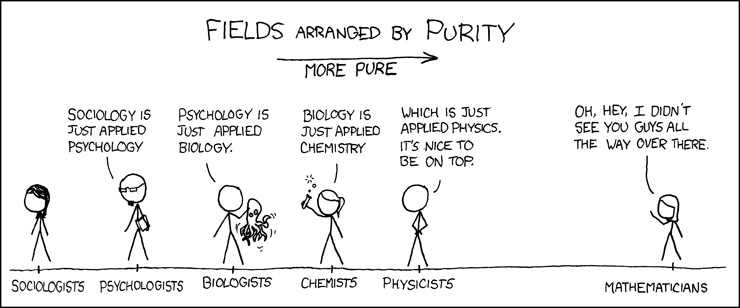
Yes, this is an old one, but it came up in a recent conversation. Of course, at one time, I might have wondered where medicine should figure on this gradient. Now I know better: it shouldn’t. This isn’t to say there is not lots of biology, or other domains referred to in medicine, it is just that medicine occupies a different dimension.