Opens in a new tab
Categories Filter
  • 29/05/2018

    Post Link

    The state of the nation

    Discussing the shortage of GPs, a locus GP writes:

    As so often, there are several factors. Many GPs have retired early – the causes are often quoted as falling GP work earnings, disenchantment with CCGs, the CQC, and revalidation. I think more significant is the sense that we have suffered a loss of control of our work, with QOF making us ask pointless questions about emergency contraception to 45-year-olds, prescribing software pop-ups that order us around for petty savings, warnings about FGM on computers of doctors in areas with no ethnic minorities. These are very harmful to our sense of doing a worthwhile job.

    And we have failed to recruit new GPs. Quite an achievement when one considers that the training is three years rather than seven, salaries are good, and there is no out-of-hours work if you don’t want it. How have the deaneries managed that? I have talked to many young doctors and most of the ones who have done F2 in general practice have felt exploited and hated it. They feel that have been chucked in at the deep end. There seems to have been lots of investment in the system for training registrars who often work at the practices of the doctors in the training hierarchy, but very little in F2 practices – who are after all the shop window that we need to perform well if we are to attract new GPs.
    Pulse

  • 28/05/2018

    Post Link

    ‘The most important thing humanity has ever built.’

    Well, this was the modest description of a ‘new’ way to test blood. Except it wasn’t. The reality distortion field in hyperspace. If you don’t know the Theranos story — or doubt the importance of real journalism — have a look.

    Link

    The journalist who broke the story, John Carreyrou, has a book coming out soon. Jean-Louis Gassée, a shrewd observer of Silicon Valley, has a nice piece about it. Note the turtle neck.

  • 26/05/2018

    Post Link

    Just talking ‘bout

    In this week’s privacy nightmare, an Oregon couple discovered their Amazon Echo smart speaker recorded their conversation and sent the audio to an acquaintance — without their knowledge.

    The claim seemed improbable, until the company confirmed it really happened. Amazon said it was reviewing how its smart speakers work to avoid similar situations.

    Link

  • 25/05/2018

    Post Link

    On the academy

    Business schools are being reinvigorated by the apprenticeship levy, with 40 out of 113 universities creating specific MBA courses to take advantage of the tax, according to a new survey.

    Businesses are permitted to spend the money on MBAs, but only up to £18,000, compared with the typical course fee of £24,000 in the UK. Tuition fees at the top MBA providers can rise up to £80,000.

    Several of the new courses, however, are stripped down to fall within the levy funding limits.

    Those that back levy-funded MBAs, however, point to research by the Office for National Statistics, which concluded that a 0.1 rise in management effectiveness led to a 9.6 per cent rise in productivity.

    Business schools create new courses to tap apprenticeship levy

  • 24/05/2018

    Post Link

    Something to live for.

    Vargas Llosa tells me he is starting a new novel, and I wonder if he will ever stop writing, as Philip Roth did as he approached 80. “Writing is what I do. It is my life,” he replies immediately. “To be alive but dead is the worst possible thing, although it happens to many people.” Vargas Llosa then bows his head low to the table in a gesture of the abundant grace and humanity that I had not expected to see two hours earlier. “In fact, I hope to die writing.”

    John Paul Rathbone in the FT

  • 23/05/2018

    Post Link

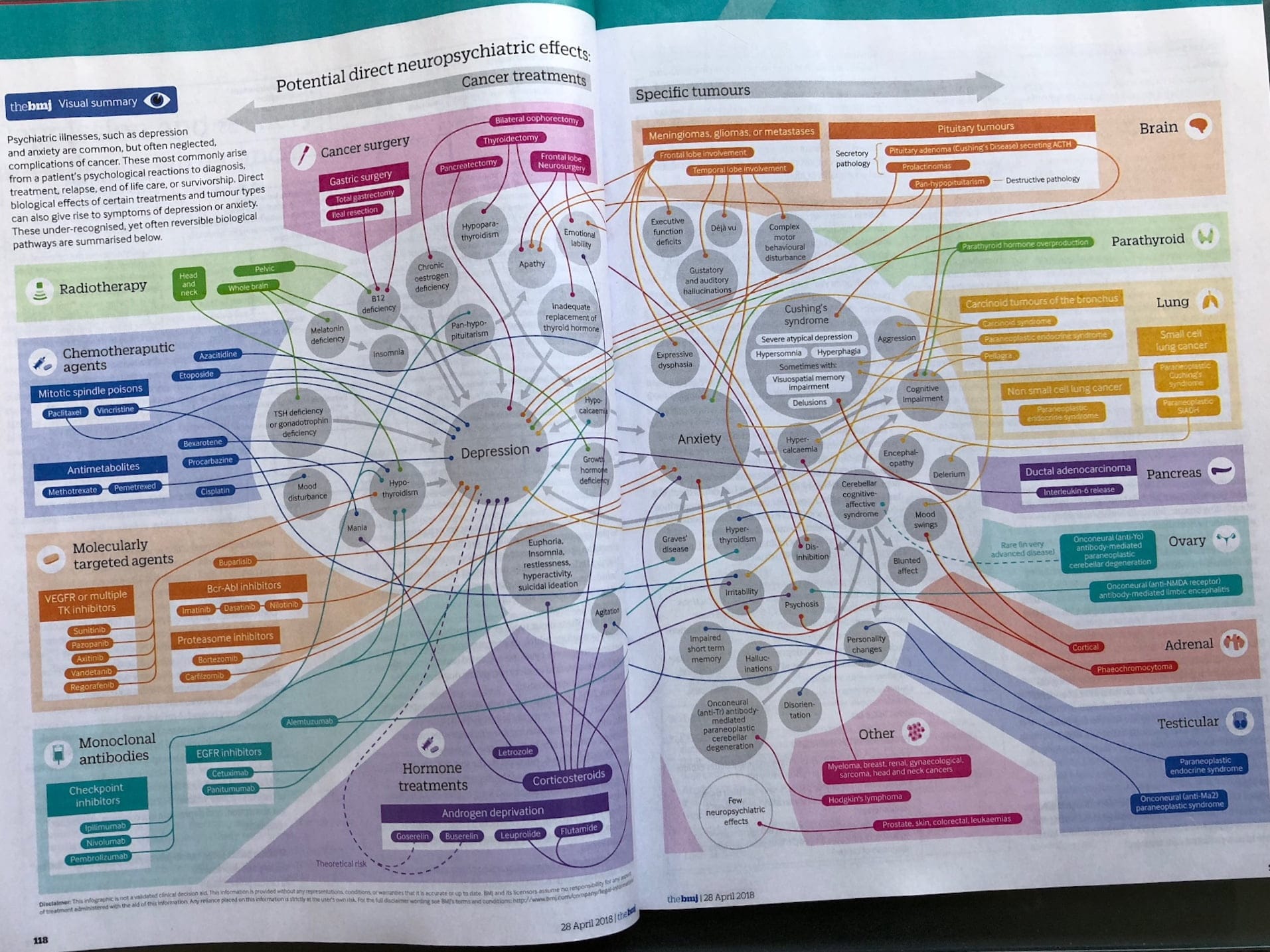
    BMJ visual summaries and not being wrong

    Maybe it is just me, but I find many of the graphics in the BMJ hard to follow. The image below is from a clinical update on “Depression and anxiety in patients with cancer” (BMJ 28 April 2018, p116-120). It occupies two whole pages. I am not certain what problem the graphic is trying to solve. For me, it just induces a sense of incomprehension. Or nausea.

    In dermatology, there was a famous US academic known for producing slides with numerous arrows, many involving feedback. It was professional cargo-cult science (as the BMJ is cargo-cult education). Sam Shuster always cautioned: more than 3 or 4 arrows per slide, usually means bullshit.

    That which is simple is wrong; that which is complicated is useless (Paul Valery).

  • 16/05/2018

    Post Link

    End of the world [refrain]


    But outside in Times Square, the LED news tickers were telling a different story. On Tuesday, Gibson Brands, Inc – with the biggest product line in the guitar business – filed for bankruptcy, succumbing to an estimated $500m debt load and a failed reinvention in 2014 as a “lifestyle brand”.

    Now I know things are really bad.

    Troubles in the land of the six-string are not restricted to Gibson. Ten years post-recession, the guitar industry in the US continues to bob, with the 2,633,000 units sold in the United States in 2017 about 5% short of where things stood in 2008, according to Music Trades magazine. The heavyweight retailer on the American scene, Guitar Center, carries $1.6bn in debt.

    Played out? Gibson’s bankruptcy fuels fears for the guitar’s future | Music | The Guardian

    And here, too.

  • 15/05/2018

    Post Link

    Politicians beware

    Factfulness ( the book)

    Factfulness: The stress-reducing habit of only carrying opinions for which you have strong supporting

    Hans Rosling

  • 14/05/2018

    Post Link

    Diagnosing money.

    Science 21 June 2013: 1394-1399.

    For most alumni, university fundraising may seem to be uncoordinated and lacking in focus—an assortment of phone calls, solicitous letters, and invitations to a class reunion. But for Steven Rum, it’s a science. And the goal is to carry out more research.

    Rum is senior vice president for development and chief fundraiser for Johns Hopkins Medicine in Baltimore, Maryland. Last year, his team had a banner year, raising $318 million. Their approach places the physician scientists at Hopkins on the donor front lines. The goal is to turn the positive feelings of “grateful patients” into support for new research, faculty chairs, academic scholarships, bricks and mortar, or simply defraying the cost of running a multibillion-dollar medical center.

    Rum has 65 full-time fundraisers on a staff of 165. Each one is responsible for meeting weekly with physicians—their “caseloads” range from a dozen to more than 30 docs—to discuss which of their patients might be potential donors. The conversation is designed to help them identify what Rum calls a donor’s “qualifying interest” and connect it to their “capacity,” that is, the ability to make a donation.

    More often than not, Rum’s team finds that sweet spot…..

    ”Ideally, I’d like to have one gift officer manage no more than six doctors,” he says.

    Link

  • 11/05/2018

    Post Link

    Facebook, as Big Tobacco for ‘the next billion’

    Exactly in the same way that Big Tobacco has been free to fill the lungs of Asian of African populations, with little interference from local health administrations, Facebook will have a free hand to lock up these markets. (If you find my comparison with the tobacco industry exaggerated, just ask the Rohingyas or people in the Philippines about the toxicity of Facebook to democracy — or read this Bloomberg Business Week piece, “What happens when the government uses Facebook as a weapon?”)

    Mark Zuckerberg’s long game: the next billion – Monday Note