The Scylla and Charybdis of the subject level TEF is that the aggregation of students into groups large enough to make meaningful statistical analysis possible debases the validity of the analysis by treating disparate groups of students with a variety of educational experiences, studying different subjects, located in disparate units of university governance, as if they were in fact homogeneous. Randomness is not something the Office for Students or the Department for Education can change. Without a robust account of how they intend to deal with it, the prospects for a viable subject level TEF look poor.
18/07/2018
Post LinkThe fatal attraction of meaningless metrics
17/07/2018
Post LinkNo time for sex at home, please
This article from the Economist is much more nuanced than you might think — especially about all the benefits of attending school that are unrelated to what specifically goes on in the classroom. But if you couple it with a close reading of Bryan Caplan’s ‘The Case Against Education’ then it is hard not to feel that the academy has been guilty of failing to check out their own entrails before passing judgement on everybody else’s.
It sounds like a counsel of despair. If every child went to school, millions more would sit in woeful, boring classrooms. But while this sounds awful, it would probably still be good for them, their families and broader society. For, as Justin Sandefur of CGD points out, there is plenty of evidence that even when children do not learn much at school, they still do better for having gone.
Some benefits are economic. Attending school for longer is associated with earning more in later life, in part because those with additional schooling are more likely to get non-agricultural jobs and move to cities. This may indicate that young people are in fact learning something useful at school that is not being picked up by researchers. But it could also be a signalling effect: a shopkeeper may prefer workers who stayed at school for at least five years.
One is simply that if girls are at school they are not having sex at home
16/07/2018
Post LinkExams and the internet
Algeria Shut Down the Internet to Prevent Students from Cheating on Exams
Via Bruce Schneier. The solution in New South Wales, Australia was to ban smartphones.
12/07/2018
Post LinkFifty years on
There are some interesting memes for our time in this FT podcast: 1968: The Year that Music Changed. Fifty years ago. What moved me most was the link (27:30 in) to the YouTube speech from Bobby Kennedy, where he told an audience — who were still unaware — that Martin Luther King has just been assassinated, making use of the following lines of Aeschylus.
“Even in our sleep, pain which cannot forget falls drop by drop upon the heart, until, in our own despair, against our will, comes wisdom through the awful grace of God.”
I am not certain what other people of my age say in answer to the question, “Where were you when JFK died?” I have no memory for Dallas. But I do remember where I was in Cardiff, when my Irish mother picking me up to drive me somewhere, told me that Bobby Kennedy had just been assassinated. And I was expected to know why this was important, and why it was important to her. And just go compare with what we see now across the pond, drifting.
11/07/2018
Post LinkA theory of everything
the problem is that education has become the default solution to everything.
Andrew Keen, in How to Fix the Future. A speaker at last year’s OEB meeting. Worth a read.
09/07/2018
Post LinkMOOCs revisited
One selling point of MOOCs (massive online open courses) has been that students can access courses from the world’s most famous universities. The assumption—especially in the marketing messages from major providers like Coursera and edX—is that the winners of traditional higher education will also end up the winners in the world of online courses.
But that isn’t always happening.
In fact, three of the 10 most popular courses on Coursera aren’t produced by a college or university at all, but by a company. That company—called Deeplearning.ai—is a unique provider of higher education. It is essentially built on the reputation of its founder, Andrew Ng, who teaches all five of the courses it offers so far. Link
The MOOC story is like so much of tech — or drug discovery for that matter. Finding a use for a drug invented for another reason often offers the biggest payback. This story has barely begun.
06/07/2018
Post LinkReinventing the personal physician
Davidson had had enough. “I wasn’t even making 6 figures, and I was killing myself,” she recalled.
“Frustrated, she googled “ideal practice” one sleepless night and came across Atlas MD in Wichita, Kansas. That practice does not accept insurance, although patients still need to have insurance to cover health care beyond the scope of primary care. Instead of co-payments and deductibles, Atlas MD patients pay a monthly “membership fee” that covers all of the primary care their physician provides. But more importantly, this retainer guarantees unhurried, same-day appointments and round-the-clock accessibility to their physician, who would get to know their story “inside and out,” thanks to having to care for only around 500 patients.”
The most interesting thing in this article is the lengths the opponents go to to oppose such a change:
“For now, said Weisbart, chair of the Missouri chapter of Physicians for a National Health Program, there’s no evidence to support the argument that DPC [the model describe here], by allowing physicians to spend more time with patients, can prevent expensive downstream medical problems. “If they could prove it, I’d be one of their advocates,” he said, adding that he understands the attraction of DPC for physicians. “They can see a third or a quarter of the number of patients (as fee-for-service practices) and preserve their income.”
“Weisbart remains skeptical, though. Direct primary care practices might attract a different population of patients. The only way to compare how well the 2 models improve health and cut costs would be to conduct a trial that randomly assigned patients to DPC or fee-for-service practices. But, Weisbart added, such a trial would be difficult if not impossible to conduct. For one, it’s unlikely that a representative sample of US patients would agree to enroll in a study in which they were randomly assigned to a primary care physician. “And,” he added, “it would have to be large to show meaningful impact, which means the study would be expensive.”
04/07/2018
Post LinkNobody cares anymore
Polling undertaken for the NHS recruitment campaign found that many people had an outdated view of nursing. It suggested most saw nurses primarily as “caring”, with far fewer regarding them as “leaders” or “innovators”.
Apparently this is not approved of. My mother would be turning over in her grave.
03/07/2018
Post Linkskincancer909 usage
Just saying….
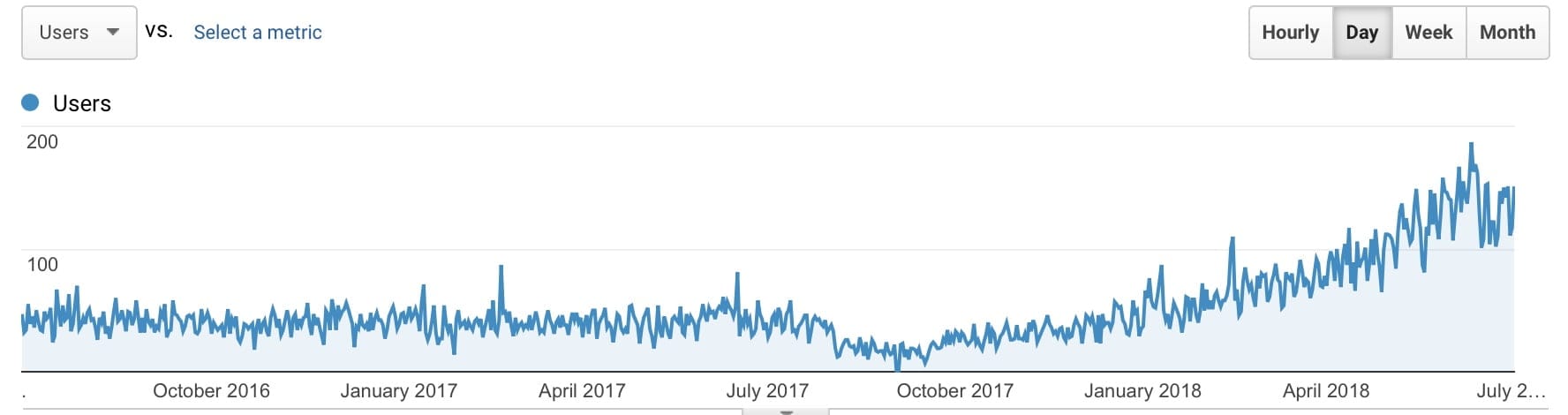
Here are the figures for skincancer909 my online textbook of skin cancer for medical students. The site was rewritten and updated in the final quarter of last year (with videos). Usage is 80% from search, with the rest from direct links. In June about 4,600 sessions. Local usage (Edinburgh) is around 5%. I am pleased, but financially poorer.