Late night thoughts on medical education #1: we have no doctors
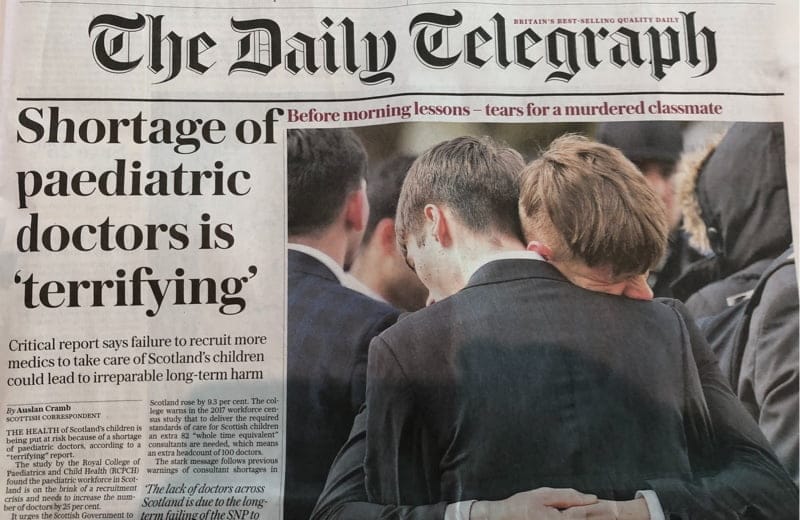
Today’s (Scottish) Daily Telegraph ran with a story about the shortage of paediatricians in Scotland. The Herald had a similar story, too. It is not just paediatrics that has major shortages. The same can be said about dermatology, radiology and a host of other areas of medicine. And that is not to mention GP land, which normally seems to attract most ‘government’ attention.
I find none of this surprising. The NHS has long been in subsistence mode, eating the seed corn (or to use that other phrase, ‘eating its young’), spending its moral and cultural capital at an alarming rate. Management is notable by its absence, whereas the administrators think they are ‘managers’, in part, because they can’t administrate and stay sane. By lack of management I meant those functions of management we see in most corporations or freestanding institutions. Changes in demography have not happened suddenly; the relation between age and health care provision, has been well known for a century or more; the impact of family structure and geography on care provision of elderly relatives evident since the early 1960s; changes in work force have been growing for at least 40 years; and UK medicine has a long history of ignoring why people wish to leave either the UK (or want to leave the NHS). The attempt to run health care as a Taylor-like post-industrial service industry using staff who value their autonomy and professionalism, may not end well for doctors — or patients.
All the above, management should have been grappling with over the last quarter century: instead they have been AWOL. Meanwhile, politicians engage in speculative future-selling, where electoral vapourware is often a vehicle for the maintenance of political power. Given the state of UK politics (as in the BxxxxT word), it seems reasonable not to give politicians the benefit of the doubt any more. As individuals, no doubt, most of them mean well, and love their kids etc, but the system they have helped co-create, cannot command respect (that is now electorally obvious).
There are however some aspects of this that bear on what keeps me awake at night: how we educate — and to a lesser extent—how we train doctors.
- The UK has not been self-sufficient in physicians since the birth of the NHS, rather choosing to import staff from the rest of the world. Despite this, doctor numbers are low in comparison with many other advanced economies. More dermatologists in the city of Vienna than in the UK……
- Manpower estimates AFAIK, seem to reflect realpolitik rather than be based on bottom up data. Whatever is estimated is decided by the ‘realistic medicine’ availability of cash. Our politicians and the commissars of the medical establishment do not dissect animals in order to learn how the world works, they sacrifice them to the gods of political power, hoping some of the blood runs off on them.
- The idea that you can plan on the basis that ‘x’ is the number of doctors you need in 10, 20, or40 years seems foolish. Hayek was not wrong about everything, even if Uncle Joe didn’t read him. Dead reckoning usually loses out to a good GPS system.
- Most importantly of all, you must overproduce doctors. There are various ways you can think about this, but the current system of taking a bunch of 18 year olds into medical school and assuming that attrition will be low, will breed complacency. You cannot build any organisation that is worth working for when the ratio of applicants to vacant posts is less than one. And to miraculously imagine you can get the figure right over a score of years, is well….(and no, the running mean isn’t the right figure, here).
- Medical education is claimed to be expensive and rate limiting (a Mr Hunt line, I think). There are various comments to make. First, the figures are inflated for political effect and possibly for accounting reasons. Claims that it costs £x to produce a consultant write off all ‘work’ the individual has done on the way to that position. By contrast, the NHS subverts market rates for many jobs done by ‘juniors’. And, as for undergraduate medical education, we know most of the money is an accounting sleight of hand. If you ask could we do it better, for less money, I will tell you for free.
- The comments in the last point not withstanding, it must be an immediate goal to reduce the cost of medical education; and to think how the workforce of non-physicians can piggyback on what we know about training doctors. These conversations were alive half a century ago, and we have made little progress. The key issue is straightforward enough: without national accreditation, these posts will not encourage candidates to undergo training — you don’t need to read Gary Becker to get this, just talk to those who leave nursing — there are enough of them)
- Even with more fluidity within professional careers, you need to allow for sideways movement and retraining of many middle aged doctors. You need to encourage staff, and move our focus from competencies(ugh!) to skills.
- Without funnelling a lot more students into medicine as a career, little of what I have said above will make much difference. There are ways, but that is for another day.