Opens in a new tab
Categories Filter
  • 03/08/2020

    Post Link

    In the year of the plague 1666

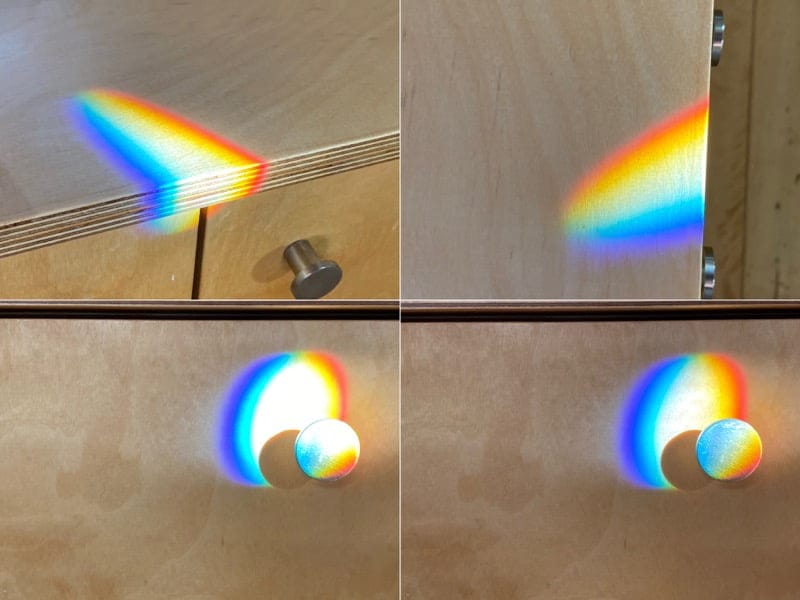
    I procured me a Triangular glass-Prisme, to try therewith the celebrated Phenomena of Colours. And in order thereto having darkened my chamber and made a small hole in my window-shuts, to let in a convenient quantity of the Suns light…but I surprised to see them in an oblong form; which, according to the received laws of Refraction, I expected should have been circular.

    Well, Isaac Newton obviously had better functioning shutters than my bedroom blackout blinds. Most summer mornings (which at this latitude last much of the night…) I receive — without choice — lessons in physics 101. Here are some iPhone shots from this morning. The quote says a lot about science: note the terms, convenient quantity, surprised and expected.

  • 31/07/2020

    Post Link

    No Mercy / No Malice / Killer whales

    No Mercy / No Malice / Killer whales

    The killer whales (cash cows) of high-tuition prestige universities are international students. We claim we let them in for diversity. This is bullshit. International students are the least diverse cohort on earth. They are all rich kids who pay full tuition, get jobs at multinational corporations, and often return to the family business. At NYU, they constitute 27% of our student body and likely half our cash flow, as they are ineligible for financial aid. We have a pandemic coupled with an administration committed to the demonization of foreigners, including severely limiting the prospects of highly skilled grad students. This means the whales may just not show up this fall, leaving us with otters and penguins — an enormous fiscal hole.

    Post Corona: Higher Ed, Part Deux | No Mercy / No Malice

    Straight talking from Scott Galloway of Stern, NYU.

  • 30/07/2020

    Post Link

    Late night thoughts of a clinical scientist.

    More accurately, late night thoughts from 26 years ago. I have no written record of my Edinburgh inaugural, but my Newcastle inaugural given in 1994 was edited and published by Bruce Charlton in the Northern Review. As I continue to sift through the detritus of a lifetime of work, I have just come across it. I haven’t looked at it for over 20 years, and it is interesting to reread it and muse over some of the (for me) familiar themes. There is plenty to criticise. I am not certain all the metaphors should survive, and I fear some examples I quote from out with my field may not be as sound as I imply. But it is a product of its time, a time when there was some unity of purpose in being a clinical academic, when teaching, research and praxis were of a piece. No more. Feinstein was right. It is probably for the best, but I couldn’t see this at the time.


    Late night thoughts of a clinical scientist

    The practice of medicine is made up of two elements. The first is an ability to identify with the patient: a sense of a common humanity, of compassion. The second is intellectual, and is based on an ethic that states you must make a clear judgement of what is at stake before acting. That, without a trace of deception, you must know the result of your actions. In Leo Szilard’s words, you must “recognise the connections of things and the laws and conduct of men so that you may know what you are doing”.

    This is the ethic of science. William Gifford, the 19th century mathematician, described scientific thought as “the guide of action”: “that the truth at which it arrives is not that which we can ideally contemplate without error, but that which we may act upon without fear”.

    Late last year when I was starting to think what I wanted to say in my inaugural lecture, the BBC Late Show devoted a few programmes to science. One of these concerned itself with medical practice and the opportunities offered by advances in medical science. On the one side. Professor Lewis Wolpert, a developmental biologist, and Dr Markus Pembrey, a clinical geneticist, described how they went about their work. How, they asked, can you decide whether novel treatments are appropriate for a patient except by a judgement based on your assessment of the patient’s wishes, and imperfect knowledge. Science always comes with confidence limits attached.

    On the opposing side were two academic ethicists, including the barrister and former Reith Lecturer Professor Ian Kennedy. You may remember it was Kennedy in his Reith lectures who quoting Ivan Illicit described medicine itself as the biggest threat to people’s health. The debate, or at least the lack of it. clearly showed that we haven’t moved on very far from when C P Snow (in the year I was born) gave his Two cultures lecture. What do I mean by two cultures? Is it that people are not aware of the facts of science or new techniques?… It was recently reported in the journal Science that over half the graduates of Harvard University were unable to explain why it is warmer in summer than winter. A third of the British population still believe that the sun goes round the earth.

    But, in a really crucial way, this absence of cultural knowledge is not nearly so depressing as the failure to understand the activity rather the artefacts of science. Kennedy in a memorable phrase described knowledge as a ‘tyranny’1. It is as though he wanted us back with Galen and Aristotle, safe in our dogma, our knowledge fossilised and therefore ethically safe and neutered. There is, however, with any practical knowledge always a sense of uncertainly. When you lift your foot off the ground you never quite know where it is going to come down. And, as in Alice in Wonderland, “it takes all the running you can do to stay in the same place”.

    It is this relationship, between practice and knowledge and how if affects my subject that I want to talk about. And in turn, I shall talk about clinical teaching and diagnosis, research and the treatment of skin disease.

     
    (more…)

  • 29/07/2020

    Post Link

    Politics as a class of dominant negative mutation

    Today many scientists describe their research as apolitical, but Haldane knew that was impossible: ‘I began to realise that even if the professors leave politics alone, politics won’t leave the professors alone.’

    From a review in the Economist of a biography of JBS Haldane by Samanth Subramanian.

    Two things to add. Haldane’s paper A Defense of Beanbag Genetics is a personal favourite, but sticking with the genetics theme, I think of politics, and many politicians, as examples of dominant negative mutations.

  • 27/07/2020

    Post Link

    Not Waiting to be an Actor

    Not Waiting to be an Actor

    At the beginning of his career, an actor is a waiter who goes to auditions. Getting work makes him a successful actor, but he doesn’t only become an actor when he’s successful.

    Paul Graham

  • 27/07/2020

    Post Link

    Peter Green (1946-2020)

    Most of the music I enjoy I came to via my brother (Al of Penglas in West Cork). There are a few exceptions: I discovered Ralph Towner and the whole ECM catalogue after an aside in an interview  with Larry Coryell; and Mahler, and morning music, from my time in Vienna.

    I can remember one particular album that Alun bought as something special. It was a compilation and cost 19/11, and not surprisingly had a blue cover: The World of Blues Power. To my ear the music was incredibly varied, such that I couldn’t imagine how this was a coherent genre. Some tracks I disliked intensely whilst others were just magical. Amongst the latter were three tracks featuring John Mayall’s Bluesbreakers. On two, Eric Clapton was the lead: Steppin Out, which I later learned to play (badly), and All the Love, the guitar part of which — still to this day—  makes the hairs on the back of my neck stand up. If you listen 1’22” in you hear what digital amps and gear now refer to as the British Blues sound (or some such similar name). It is slowhand playing slowly. Magical. A giant beneficial  mutation in the history of the blues.

    The third track, Greeny, was very different. It was John Mayall again, but this time with the late Peter Green who died just two days ago. The guitar was just so different, a delta of influences. BB King captures both the sound and Green:

    He has the sweetest tone I ever heard; he was the only one who gave me the cold sweats.

  • 26/07/2020

    Post Link

    On truth

    Yes, a big word. From a review by Martin Wolf of Anne Applebaum’s Twilight of Democracy. Just pencil in your favourite organisation or person.

    Her theme is not just this split. It is about the role of intellectuals in supporting the would-be despots. In this, she follows Julien Benda, author of a classic book, La trahison des clercs (1927). Benda’s target were the ideologues of his time, whom he accused, in Applebaum’s words, “of betraying the central task of the intellectual, the search for truth, in favor of particular political causes”.

    How did people she knew come to support these new authoritarians? One answer, is “resentment, revenge and envy”. Replacing people of talent and principles with mediocrities who will do anything for success has never been difficult. Finding greedy people happy to join a corrupt new business elite is just as simple. She describes perceptively people who have done such things.

    Alarm signals of our authoritarian age | Financial Times

  • 25/07/2020

    Post Link

    Surplus collagen

    Surplus collagen

    His younger co-workers, with their zippy metabolisms and surplus collagen, started referring to him as “the elder.”

    A New Luxury Retreat Caters to Elderly Workers in Tech (Ages 30 and Up) – The New York Times

  • 25/07/2020

    Post Link

    The Cognitive load of everyday life

    The Cognitive load of everyday life

    I’m struggling. There is this continuous battle to counteract the exaggerations and misinformation that corporations spend so much time creating. Including universities, now. Those seeking to subvert the intention of regulators, have more money, more time, and abuse the externalities that society has allowed them to work within.

  • 24/07/2020

    Post Link

    Poor Celine

    Poor Celine

    The Economist heaps praise on Ireland’s ability to get its way:

    Ireland has a good claim to be the world’s most diplomatically powerful country

    We learn that Ireland beat off Canada to win a seat on the UN Security Council but that like Canada Ireland also has ‘a bigger, sometimes boorish, neighbour’.

    Alongside more subtle overtures, the push for the Security Council seat [by Ireland] involved free tickets to Riverdance and a U2 gig. The best that Canada could muster was Celine Dion.

    Charlemagne – How Ireland gets its way | Europe | The Economist