
Categories Filter
  • 23/02/2021

    Post Link

    The Bondage of Thine Own Desire

    Perry Anderson · Ever Closer Union? · LRB 7 January 2021

    Perry Anderson wrote three articles recently in the LRB on the EU. The first I found hard to get into, but the second and third are terrific. Whether he is right about everything or makes the right calls, I cannot say. But strongly recommended. I will be interested to check out any letters.

    The quote below is, about, and in part, from Chris Bickerton who is a regular on Talking Politics podcast. He wields a scalpel more sharply through your eyes than your ears.

    Christopher Bickerton’s European Integration, whose anodyne title, shared by dozens of other books, conceals its distinction, which comes in the subtitle that delivers its argument: ‘From Nation-States to Member States’. Everyone has an idea what a nation-state is, and many know that 27 countries (with the UK’s departure) are member states of the European Union. What is the conceptual difference between the two? Bickerton’s definition is succinct. ‘The concept of member state expresses a fundamental change in the political structure of the state, with horizontal ties between national executives taking precedence over vertical ties between governments and their own societies.’ This development first struck him, he explains, at the time of the Irish referendum on the Treaty of Lisbon. ‘When the No result was announced, members of the Irish government expressed a mixture of surprise and embarrassment: surprise as they were unfamiliar with the sentiments prevailing within their own population, and embarrassment because this compromised many of the promises they had made to their peers at previous meetings in Brussels.’ (The description is something of an understatement. Spotted outside a pub in Dublin that evening, Brian Lenihan, minister of finance at the time, was white around the gills.)

    Bickerton again.

    With the advent of the European Community, once the Court of Justice had succeeded in effectively, if not formally, constitutionalising it, member states accepted a set of external constraints whose form was radically different. ‘The active subject, namely the people, is not doing the binding…

    Now I get this! This is a device used by just so many organisations. They choose the bondage of their own desire (literally, it seems, for some politicians).

    Anderson:

    Rather, national governments commit to limit their own powers in order to contain the political power of domestic populations. Instead of the people expressing themselves qua constituent power through this constitutional architecture, national governments seek to limit popular power by binding themselves through an external set of rules, procedures and norms.

    Perry Anderson · The Breakaway: Goodbye Europe · LRB 21 January 2021

    Anderson in the third essay:

    Much of​ the anger aroused by Brexit in once Tory circles comes from an acute sense of the anachronism of leading advocates of departure, the ostentatious fogeyism of Rees-Mogg, Bone, Baker and others, defenders of the indefensible in the age of climate change, crowd-sourcing and correct speech. What is the order they uphold? A first-past-the-post electoral system dating back to the 16th century, before most constituencies were even contested, which regularly produces results that bear no resemblance to the divisions of opinion in the country; an unelected upper chamber crammed with flunkies and friends of the two dominant parties; an honours system devised to reward bagmen and sycophants; a Parliament that can be bundled into a poll at a day’s notice; a judiciary capable of covering any administrative enormity. Little wonder its admirers quote Latin statutes from the time of Richard II or Henry VIII in praise of its workings.


    The Great Dick Faker

    To predict government policy, listen to Boris and wait for the opposite

    John Crace writing in the Guardian:

    During the biggest national health crisis in 100 years, it’s just our luck to have Johnson in charge. A man pathologically unable to make the right calls at the right time. The prime minister is a narcissistic charlatan. The Great Dick Faker. Someone who can’t bear to be the bearer of bad news or to be proved wrong by people who disagree with him. So he stubbornly ignores the evidence until he becomes overwhelmed by it and public opinion has turned against him. He isn’t just a liability as a leader, his indecision has cost lives. His hubris will only cost him his job.


    Incoherence

    Frontline UK teams query ability to vaccinate most vulnerable | Financial Times

    A comment from Risk Man:

    This Government is not capable of coherence.


    A necessary and immodest proposal

    These dark materials | Books | The Guardian

    The great physicist Richard Feynman expressed the methodology of science beautifully: “It doesn’t matter how beautiful your guess is or how smart you are or what your name is. If [your idea] disagrees with experience, it’s wrong. That’s all there is to it.”

    Note the world experience.

    But here, another great physicist and thinker says something even more profound for how we think about science.

    Physical science has historically progressed not only by finding precise explanations of natural phenomena, but also by discovering what sorts of things can be precisely explained. These may be fewer than we had thought.

    Steven Weinberg

    Depending on your point of view you can either find this sentiment reassuring or — as in my case — terrifying.


    The quality of the stool is not strained…

    NIH’s ‘precision nutrition’ bet aims for individualized diets | Science

    Well, lets leave the likes of real science and Feynman and Weinberg to one side.

    A few posts ago, I talked about the hype that is the claimed discovery of, or facility for, precision medicine. Life is getting more and more messy as the story runs down and out…

    The study “has the potential to truly transform the field of nutrition science,” generating new tools, methods, and “a wealth of data to fuel discovery science for years to come,” Griffin Rodgers, director of the National Institute of Diabetes and Digestive and Kidney Diseases (NIDDK), said last year at an NIH board meeting where he introduced the project. Ultimately, it might enable nutritionists to tailor diets to an individual’s genes and microbiome.

    With a few notable exceptions — usually from long ago — the words nutrition and science should rarely appear in the same sentence. When they do, they are best flushed down the pan.
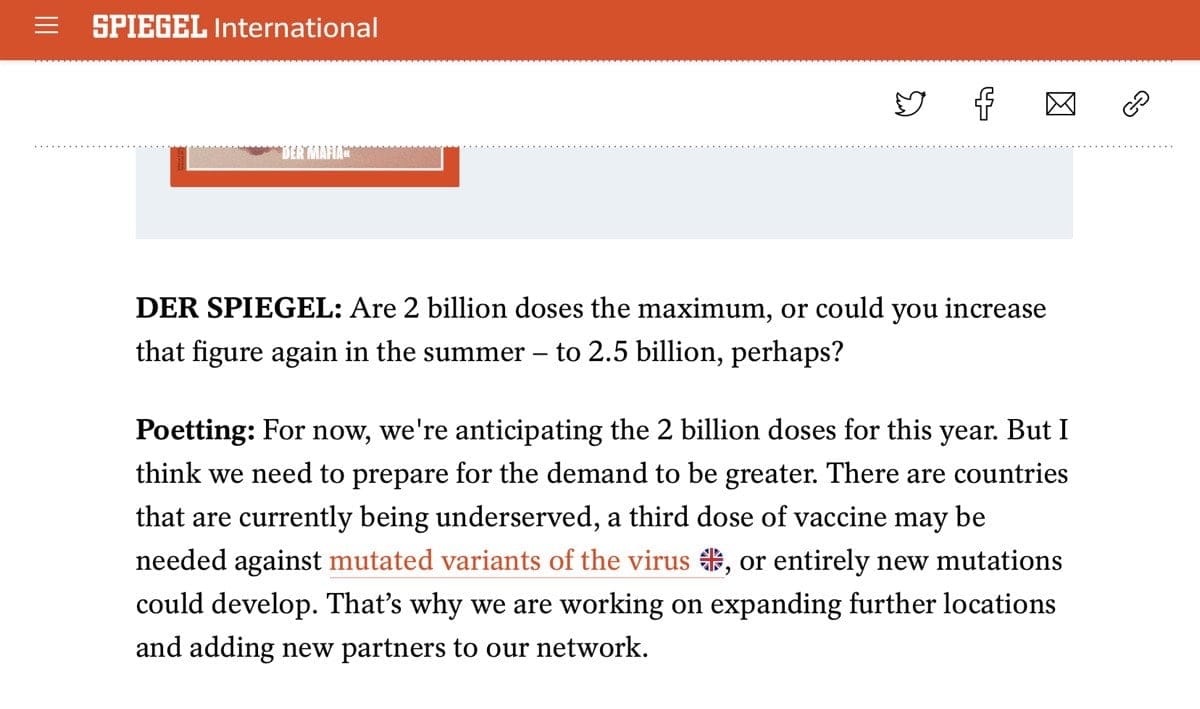
  • 21/02/2021

    Post Link

    Winnowing MMXXI

    The Wealth of Nations

    China’s hidden crisis

    Much of the blame for all this rests with Mao, whose Cultural Revolution was “perhaps the largest intentional destruction of human capital the world has ever seen”.

    The story is…

    Their team gave an IQ-like test to thousands of rural Chinese toddlers. They found that more than 50% were cognitively delayed and unlikely to reach an IQ of 90 (in a typical population, only 16% score so poorly).

    Why?

    Half of rural babies are undernourished. Caregivers (often illiterate grandmothers) cram them with rice, noodles and steamed buns, not realising that they also need micronutrients… A third of rural 11- and 12-year-olds have poor vision but no glasses, so struggle to read their schoolbooks.

    Some of these problems would be laughably cheap to fix. A pair of glasses costs $30. Multivitamin pills are a few cents. De-worming tablets cost $2 per child each year. One reason the problems persist is that harmful myths abound. Many rural folk believe that—as a grandmother told this reviewer—glasses are bad for children’s eyesight. Some fret that de-worming pills reduce fertility in girls. A recent study found that 99% of Chinese farmers gave their pigs de-worming drugs, but hardly any did the same for their children.

    Read that last sentence again.


    Having a thing for snails.

    The Economist | The lives of others

    Patricia Highsmith had a thing for snails. She admired their self-sufficiency and found it “relaxing” to watch them copulate, delighted by the impossibility of distinguishing male from female. She collected them for decades, keeping hundreds at home and scores in her handbag, which she let loose when bored at dinner parties. Her affection for snails was matched by her ambivalence towards people, whom she often found baffling and kept at a distance. When a literary agent suggested Americans didn’t buy her books because they were “too subtle” and the characters too unlikeable, Highsmith responded: “Perhaps it is because I don’t like anyone.”


    Not having a fling …for rotifers

    The Economist | Godzilla the rotifer

    Rotifers are famously asexual. The last time members of one group of the animals, the bdelloids, had sex is reckoned by zoologists to have been about 80 million years ago.


    Who is cheating who?

    Skidmore hopes to push UK government to outlaw essay mills | Times Higher Education (THE)

    Former universities minister Chris Skidmore hopes that his private member’s bill on essay mills will prompt the Westminster government to finally take legislative action against contract cheating. Proposing the bill, which would make the operation and advertising of essay mill services illegal in the UK, Mr Skidmore said contract cheating was “a rot that infects the very discipline of learning and has the potential to damage academic integrity beyond repair”.

    Hard to argue with, but would the essay mills fool school teachers? I suspect not. There is more than one way to cheat, just as there is more than one agent in any con.


    Is that a fact!

    The Economist | Betting all the chips

    When microchips were invented in 1958, the first significant market for them was inside nuclear missiles. Today about a trillion chips are made a year, or 128 for every person on the planet.


    We’re all just naked apes

    Letter to the economist from Allan Milne Lees.

    As Johnson rightly notes, we humans need regular undemanding social interactions such as small talk to support our well-being (January 2nd). As a primate species that is relatively hairless we are unable to use grooming rituals to establish and maintain social bonds. Chatting about the weather and stock performances is our equivalent of removing salt crystals and lice from each other.

    The dermatologists might add that the value of host responses to such infestations, like stock prices, may go up and down in value.


    The regulator as Ouroboros

    WONKHE

    Some lives leave love, others just a trail of utter destruction.

    There was much amusement on Wednesday when outgoing OfS chair Michael Barber used his King’s College London Commemoration Oration to wade in on “no platforming”. He said he was willing to believe that the vast majority of controversial speaking engagements do in fact go ahead on campus, but that he would love to see figures — adding, “It’s hardly a job for a regulator but if I were a university administrator or an influence at UUK, I would be collecting the data.”

    What he hadn’t clocked is that it is, in fact, a job for a regulator, given the Prevent duty — his regulator, whose most recent figures show that just 0.09 per cent of such events don’t go ahead. When we pointed that out later in the Q&A, adding that the example of a problematic speech code he’d picked from a book was both inaccurate and eighteen years old, Barber offered praise for our work here at Wonkhe but suggested that we may want to “spend less time on the detail”. We can’t imagine why.


    Worthy of Wallace and Gromet

    How clams fight pollution

    The system is nifty. When the molluscs encounter heavy metals, pesticides or other pollutants, they close their shells, explains Piotr Domek of Adam Mickiewicz University in Poznan, who has worked on the project for three decades. To create a natural early-warning system, Mr Domek and his colleagues collect the clams from rivers or reservoirs, and attach a coil and a magnet to their shells. Computers register whether their shells are open or closed by detecting changes in the magnetic field.

    Priti Patel will be on the case

    In the case of a terrorist attack, an ecological disaster or another contamination of the water supply, the clams will close,” says Mr Domek. This, in turn, will automatically cut off the water supply. The clams, he thinks, are life-savers.

  • 20/02/2021

    Post Link

    Make certain you have your documents ready and open on..

    Academics are promoting the wrong kind of rigour | Times Higher Education (THE)

    When I was teaching — and I taught a lot towards the end of my paid career — there were many opportunities to talk to medical students off the record. It takes time, and some trust from both parties, but many students know what talking off the record means. To my surprise — yes, I am that paranoid — some of the online feedback they provide is also informative. My favourite, was a comment about specialty X, saying that they were certain that the teaching would have been of a high standard if they had actually had any. If you scour the BMJ online responses for comments from students, you can find similar views.

    For many students, undergraduate medicine resembles flying in the pre-Covid days: the journey’s end is worth it, but you have put up with all the crap that passing through airport security entails. There is just no other practical way to get from A to B. Getting uptight about it as you pass through may come back to bite you.

    I think medicine is worse than many other degrees, but there is plenty of misery to go around. The following is from an article in the Times Higher:

    Leaning forward, he takes a deep breath and says: “Well, it’s like we’re running some kind of gauntlet, course after course, semester after semester, one year to the next, working hard, but our real selves are asleep. ‘Get good grades, good internships. Do lots of activities. Build an impressive résumé.’ That’s all we hear. We’re so busy proving ourselves that there’s no time to breathe, let alone think or reflect, and the stuff we have to do for classes mostly feels meaningless — to me, anyway. So we just go to sleep to get through it and hope it’s all worth it when the grind is over.” 

    But my student wonders out loud why learning in college must be a forced march and not a playful adventure — and I silently wonder the same about the process of tenure and promotion.

  • 19/02/2021

    Post Link

    Winnowing XXMMI

    Thinking clearly

    It is a fun trope to imagine that ability in one domain comes at the cost of another. Scientists are geeks etc. I knew the quote below, but not who had said it. Perhaps technocrats devoted to public service are what we are missing.

    We are not a great power and never will be again,” wrote Tizard. “We are a great nation, but if we continue to behave like a great power we shall soon cease to be a great nation.”

    A distinguished Whitehall scientist, Henry Tizard, sounding the alarm. Quoted in Britain Alone: The Path from Suez to Brexit, by Philip Stephens.


    Fast and slow-moving metaphors

    Graduate deans ‘must speak up for PhD students’ | Times Higher Education (THE)

    “Even today, people applying to graduate school feel obliged to say: “My goal is research”, according to Robert Weisbuch, former president of Drew University in New Jersey. Yet in reality only a small proportion will go on to find a permanent academic position, and failure to acknowledge this often prevents them making the most of their knowledge and talents.

    “We teach them to believe they are Lamborghinis,” suggested Leonard Cassuto, professor of English and American studies at Fordham University in New York, “when in fact they are all-terrain vehicles. If you are an all-terrain vehicle and believe you are a Lamborghini, all you are going to do is stay on the racetrack, no matter how much traffic there is on it.”


    Just so you know

    Why can’t the UK tax year start on January 1? | Financial Times

    Our April 5 year-end originates from when people in England were required to pay rents to their landlords quarterly on what were, and still are, known as quarter days; March 25, June 24, September 29 and December 25. The first in the year, known as Lady Day, came to be regarded as the start of the financial year.

    In 1582, Pope Gregory XIII ordered that the old Julian calendar introduced by Julius Caesar should be replaced by the Gregorian calendar we use today. The old calendar, although reasonably accurate, was slightly too short and had slipped over the years. Much of Europe moved across immediately, but Britain took a little longer — 170 years in fact. By then, our calendar was out of step by 11 days and so it was that after the taxes had been paid on March 25 1752, 11 days were removed from the calendar and the new tax year started on April 5 1752. 


    The Long Now: Plant the oaks now for we do not know when we might need them

    Political union through science | Nature Physics

    Almost 100 years later, in a Europe that had been forced apart by war, 17 nations from around the world came together in Paris on 20 May 1875 to sign what is now known as the Metre Convention. The aim of the convention — in the spirit of Talleyrand’s proposal — appears prominently on the first page, and states that the signatories desired “to assure the international unification and perfection of the metric system” and they undertook “to create and maintain, at their common expense, a scientific and permanent International Bureau of Weights and Measures with its headquarters in Paris”.


    Turn of phrase

    Moving mountains: the reforms that would push academia to new heights | Times Higher Education (THE)

    It remains one of the great ironies of higher education that while most of us in the sector are employed to educate, any professional learning offered to improve our practice leaves us as repulsed and as lost as Jack Nicholson at a women’s studies conference.

    I not in love with the gist of the article, all those dilemmas about whether opening doors for colleagues or strangers is micro-aggression or not, but a nice turn of phrase. Personally, I would have thought Nicholson would have gone down well (academically speaking, that is).


    Just brilliant!

    Outbreaks are inevitable, but pandemics are optional.

    Larry Brilliant, an epidemiologist who contribute greatly to the global eradication of smallpox. Quoted in via Private Eye MD No 1541

    I knew another scientist called Brilliant, Murray Brilliant, a melanocyte biologist. Always wondered what it was like being called Brilliant, and how Oscar Wilde might have played with it.


    Retirement has its rewards

    W.H. Auden imagined “The Fall of Rome” as the moment in which:

    “an unimportant clerk/Writes I DO NOT LIKE MY WORK/On a pink official form.”

    Quoted here


  • 18/02/2021

    Post Link

    Red, white and blue

  • 13/02/2021

    Post Link

    Winnowing MMXXI

    Canada pushes abundant PhD graduates towards industry needs | Times Higher Education (THE)

    Canada’s universities need to adjust their doctoral degree programmes to help make their swelling surplus of PhD graduates more attractive to industry, a government-chartered assessment has concluded.

    Perhaps they need fewer PhDs. And as for how to make a bad situation worse:

    Universities, meanwhile, should keep adjusting the content of their doctoral degree programmes to include skills in management, teamwork and communication that are valued by companies, the experts say.

    David Hubel, a Canadian by birth, and a Nobel Laureate, wrote that one of the advantages of having an MD was that — in those days, but not now — you didn’t need to do a PhD. Like many so many of his ideas about doing science, he was spot-on. I was delighted to have got through in the wonderful bad-old days, managing to avoid this credential.


    Its just business

    Australian universities in ‘deep trouble’ as borders stay closed | Times Higher Education (THE)

    Simon Marginson, professor of higher education at the University of Oxford, said in 2018 that Australia was poised to overtake the UK as the second most popular global destination for international students in 2019. However, speaking to Times Higher Education, he said it was now “impossible to see that position being restored.…in fact, Australia may not recover market share in the longer run”.

    He goes on:

    My sense is that international education in Australia is in deep, deep trouble. That means higher education is in deep trouble and scientific research is in equally deep trouble because this is heavily financed from international student fees.

    One commentator on this report states:

    Australian Universities are at a cross-roads and along with them the huge international education market (our 3rd biggest export industry), yet our politicians are doing nothing… It is unimaginable that any other large export industry would be so conscientiously ignored. [emphasis added].

    Rich DeMillo describes higher education as a multisided marketplace. It is a feature of our age that cross-subsidies within such marketplaces will come under strain. If you want to do research, you need to fund it; if you want high-quality teaching, you have to fund it on its merit. No free lunch.


    Precisely what?

    Precision medicine in rheumatology: are we getting closer? — The Lancet

    One of the things that led me to become disenchanted with much of modern medical genetics was the hype that was necessary to secure funding. Genetics is a great way to do biology, but biology is not synonymous with medicine; advance in one does not necessarily follow from the other.

    And personally speaking, the best reason for the study of modern human genetics was to tell the story of humanity — how we got here, and what is our story. It is sad that there is no Nobel for biology.

    Precision medicine is another (IMHO) bullshit phrase. Read this recent Lancet article (link above):

    The overarching aim of precision (also referred to as personalised) medicine is to identify the best possible management approach for an individual with a certain disease. The main prerequisite for such an approach is the identification of characteristics linked to a favourable outcome of a certain treatment. The characteristics of interests might be clinical or molecular biomarkers or identified through imaging, allowing for stratification of patients and prediction of response. The size of the strata might range from big subgroups covering a substantial proportion of patients to individual patients.

    But medicine has always worked this way. You don’t give children the same dose of drugs as adults; you don’t treat all cases of psoriasis the same way. And as for biomarkers, well, over a century ago there was the H&E project (H&E standing for the two most common dyes used in diagnostic histopathology), a discovery that still predicts outcomes better than all those wonderful machines in the Sanger centre (and they are wonderful).

    And then in Science I read:

    A genome to celebrate | Science

    The completion of the draft sequence laid the foundation for a new precision medicine paradigm that aims to use a person’s unique genetic profile to guide decisions about the treatment and prevention of disease. We have already seen some signs that precision medicine is possible, and although off to a slow start, the promise of this approach may ultimately be realized.…. Given the pace at which breakthroughs based on the human genome sequence are happening, when we next commemorate the publication of the draft human genome sequence, be it at 25, 30, or 50 years, we may look back again, realize that this accomplishment was a watershed for the biological sciences, and marvel at how far we have come in such a short period of time. [emphasis added].

    We might indeed, but the phrasing reminds me of the celebrations that used to surround a grant being awarded, rather a discovery made. I, too, should confess on this point.

    Please, oh please, a little modesty and perspective. We are not in sales.


    That Welshman

    Here is something more solid and sustaining; something where the purpose of language is to communicate and not to shill.

    I have been reading Nye Bevan’s biography by Nicklaus Thomas-Symonds. Here is an excerpt from a speech Bevan made in 1959.

    I have enough faith in my fellow creatures in Great Britain to believe that when they have got over the delirium of the television, when they realize that their new homes that they have been put into are mortgaged to the hilt, when they realize that the moneylender has been elevated to the highest position in the land, when they realize that the refinements for which they should look are not there, that it is a vulgar society of which no person could be proud, when they realize all those things, when the years go by and they see the challenge of modern society not being met by the Tories who can consolidate their political powers only on the basis of national mediocrity, who are unable to exploit the resources of their scientists because they are prevented by the greed of their capitalism from doing so, when they realize that the flower of our youth goes abroad today because they are not being given opportunities of using their skill and their knowledge properly at home, when they realize that all the tides of history are flowing in our direction, that we are not beaten, that we represent the future: then, when we say it and mean it, then we shall lead our people to where they deserve to be led.

  • 12/02/2021

    Post Link

    Winnowing XXMMI

    More evidence in the case against Luxembourg | Financial Times

    Luxembourg sometimes resembles a criminal enterprise with a country attached.

    Via The Tax Justice Network and Cory Doctorow


    666 trademarks and all that

    Mark of the Devil: The University as Brand Bully by James Boyle, Jennifer Jenkins :: SSRN

    James Boyle is a Scottish law professor at Duke. He is one of the leading academics in the field of IPR. His book Shamans, Software and Spleens: Law and Construction of the Information Society opened my eyes to a world that I literally did not know existed. It is hard to live a game when you fail to understand not just the nature of the rules, but the idea that there are rules. I would also plug his graphic book on IPR and music Theft: A History of Music.

    He has now obviously been studying things closer to his own academic home.

    In recent years, universities have been accused in news stories of becoming “trademark bullies,” entities that use their trademarks to harass and intimidate beyond what the law can reasonably be interpreted to allow. Universities have also intensified efforts to gain expansive new marks. The Ohio State University’s attempt to trademark the word “the” is probably the most notorious.

    I don’t have a reference, but one of the delivery companies (DHL, Fed Express etc.) tried to get IPR — wait for it — not for their package design but over the dimensions of air that the package encompassed.


    On being human

    Academic jailed in Iran pulls off daring escape back to Britain | Iran | The Guardian

    “They started on me in a very, very small room, it’s almost like a grave. You have three army blankets, one as a cover, one to sleep on and one as a pillow. For 24 hours there is a bright shining light on top of your head, a Qur’an, a mohr on which Shias pray, and a phone to contact the guards to take you to the toilet. There is no natural light, and a window in the prison door opens through which they put your food. That is your only communication with the outside world. It is incredibly quiet, and you just become crazy. You don’t know what time it is, and you don’t know what will happen next.

    “When you are taken out to go to the toilet, or half an hour’s fresh air or to be interrogated you are blindfolded. And then your interrogation becomes your lifeline, it’s so sad that you want to be interrogated more because that is the only way you can communicate with a fellow human being. [emphasis added]


    The Irish pol is a revenant from a dead era.

    Can Joe Biden make America great again? | Books | The Guardian

    Probably not…but some nice words (again from Fintan O’Toole)

    In normal times, this rhetoric would seem ludicrously over the top, all the more so coming from a garrulous, glad-handing old Irish pol, who spent 36 years in the Senate and eight as vice-president. Biden is not obvious casting for the role of apocalyptic warrior.

    The impulse comes with the territory of Biden’s Irish Catholicism, its fatalistic view of this earthly existence as, in the words of the rosary, a “valley of tears”. This is, as Biden sees it, “the Irishness of life”.

    Biden the Irish pol is a revenant from a dead era. His skills as an operator, a fixer, a problem-solver, are finely honed — but they are redundant. He is a horse whisperer who has to deal with mad dogs. He is a nifty tango dancer with no possible partners. There is no reasonable, civilised Republican opposition with which he can compromise. There can be no such thing as a unilateral declaration of amity and concord.

    The great problem of American political discourse has always been — strangely for such a Biblical culture — a refusal to accept the idea of original sin.


    Surprise, surprise

    No confidence vote in Leicester v-c as 145 at risk of redundancy | Times Higher Education (THE)

    Union members at the University of Leicester have voted in favour of a motion of no confidence in the vice-chancellor in response to the threat of redundancies across the university.

    A Leicester spokeswoman said the university was “naturally disappointed to learn about [the] vote of no confidence”.


  • 10/02/2021

    Post Link

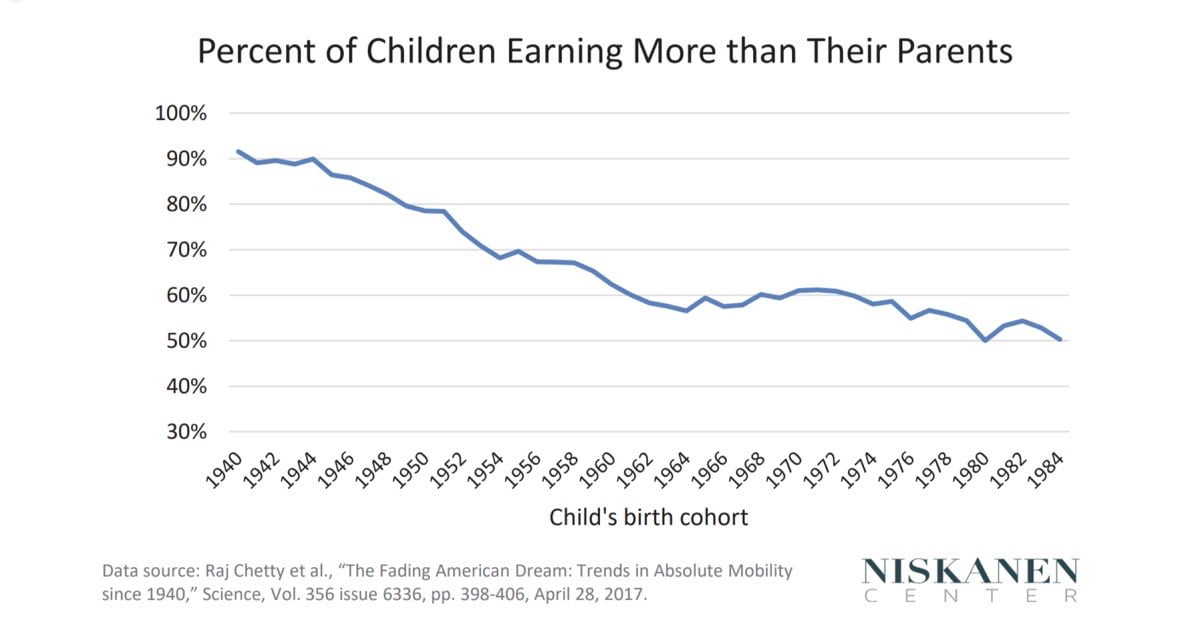
    A graph

  • 07/02/2021

    Post Link

    Winnowing MMXX1

    Britain Alone: the Path from Suez to Brexit, by Philip Stephens

    I know little about Paul A Myers except that he is one of the sharpest commentators on the online FT comments forum.

    Britain made a bad choice with Brexit. The coming years will probably reveal just how much. It failed the one test it had to make as an international strategist in the opening decades of the 21st century. It is inevitably going to wind up with something smaller and less influential — and probably less prosperous. But then it has been making bad choices for a long, long time.

    When London is able to imagine itself as a bigger and similarly successful Copenhagen, then new geopolitical success will await. Apparently just some such thinking is taking hold in Edinburgh.

    As for Edinburgh, I truly wish that to be the case.


    The Capitalist Case for Overhauling Twitter

    This next quote is via Scott Galloway in the New York Magazine.

    The political philosopher Hannah Arendt, analyzing the fall of democratic Germany to the Nazis, observed that totalitarianism comes to power through a “temporary alliance between the elite and the mob.”


    Forget Zuckerberg and Cook’s hypocrisy – it’s their companies that are the real problem | Facebook | The Guardian

    The following is from John Naughton, one-time TV critic of the Listener, and who effectively introduced me to the world of blogs and tech a long, long, time ago.

    A few years ago, during a period when there was much heated anxiety about “superintelligence” and the prospects for humanity in a world dominated by machines, the political theorist David Runciman gently pointed out that we have been living under superintelligent AIs for a couple of centuries. They’re called corporations: sociopathic, socio-technical machines that remorselessly try to achieve whatever purpose has been set for them, which in our day is to “maximise shareholder value”. Or, as Milton Friedman succinctly put it: “The only corporate social responsibility a company has is to maximise its profits.”


    The paradox of human nature, our obsession with the skies, and the realities of transplant surgery: Books in brief

    Desmond Morris in one of his popular ethology books pointed out the logical flaw in the arguments that posits that war is a function of individual violence, whether the origins of the latter are inherited or acquired. The propensity to cooperation over dissent is problematic.

    The following is from a review of The Goodness Paradox by Richard Wrangham. The subtitle is: How Evolution Made Us More and Less Violent.

    Homo sapiens see-saws endlessly between tolerance and aggression. To parse our paradoxical nature, primatologist Richard Wrangham marshals gripping research in genetics, neuroscience, history and beyond. His lucid, measured study ranges over types of aggression, the evolution of moral values, the age-old problem of tyrants, and war’s “coalitional impunity”. The propensity for proactive violence, he argues — forged by self-domestication, language and genetic selection — marks out our primarily peaceful species. We uniquely bend cooperation to ends both cruel and compassionate. [emphasis added].


  • 05/02/2021

    Post Link

    That was then and this is now

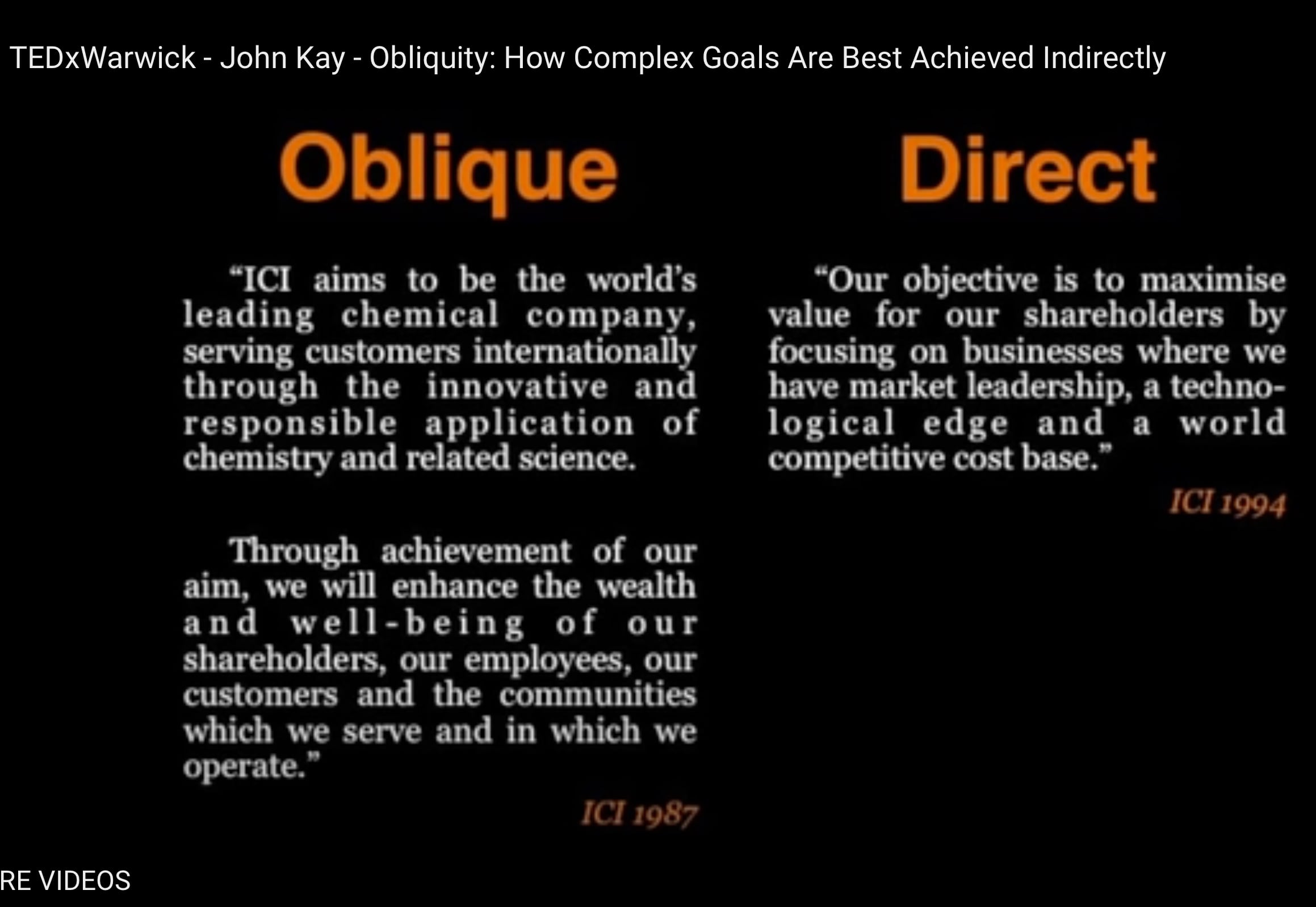
    This is a slide from a John Kay talk. It is a few years old but the message resonates more than ever.