
Opens in a new tab
Categories Filter
  • 07/01/2023

    Post Link

    All dressed up and nowhere to go

    All dressed up and nowhere to go

    How I Got Here | No Mercy / No Malice

    Tenure is a guild, only more inefficient and costly. However, the workmanship is worse. It’s meant to protect academics from the dangers of provocative, original thinking (e.g. Galileo). But in my field, marketing, it’s hard to imagine anybody needs protection, as nobody is really saying anything.

    …

    I’m home after traveling, and I’ve put my sons to bed. My oldest puts in his Invisalign, lies down next to me, and drifts off in my arms. I can’t help but stare at this thing that sort of looks, smells, and feels like me, but so much newer and better. Suddenly he stirs and begins to smile. He opens his eyes and tells me he and his buddies did an improv play at school and it was “hilarious.” He drifts back to sleep. He is warm, safe, loved, and next to a dad who wonders if he (like his dad) is unremarkable, but might still (like his dad) have remarkable opportunities.

    The article is worth reading in full even if you only have a passing interest in higher education; or the future.
  • 04/01/2023

    Post Link

    And the gods looked on

    Ands the gods looked on

    As far as Toby was concerned, Jay Crispin was your normal, rootless, amoral, plausible, half-educated, nicely spoken frozen adolescent in a bespoke suit, with an unappeasable craving for money, power and respect, regardless of where he got them from.

    And from there, he wandered off into an argument with Friedrich Schiller’s grandiose statement that human stupidity was what the gods fought in vain. Not so, in Toby’s opinion, and no excuse for anybody, whether god or man. What the gods and all reasonable humans fought in vain wasn’t stupidity at all. It was sheer, wanton, bloody indifference to anybody’s interests but their own.

    A Delicate Truth, John le Carré

    YMMV, but for me, one of his very best.

  • 01/01/2023

    Post Link

    On Writing

    On Writing

    Annie Proulx: ‘You’ve got to keep moving!’ | Financial Times

    She likens the process of writing to “embroidery or carpentry or sewing a garment”, piecing together “beginnings and endings and different parts that echo or match each other . . . To get it right takes time.”

    But I am all fingers.

  • 01/01/2023

    Post Link

    TARA beats TINA

    TARA over TINA

    I hadn’t come across the acronym TARA before, but it seems a hopeful thought for the New Year. Life is indeed more interesting with it set as the default.

    TARA: There are real alternatives

    TINA: There are no alternatives

    (I have forgotten the source — apologies)

  • 25/12/2022

    Post Link

    Zeitenwende

    If the personal is political, so is the political personal. Zeitenwende it is.

    FT

  • 23/12/2022

    Post Link

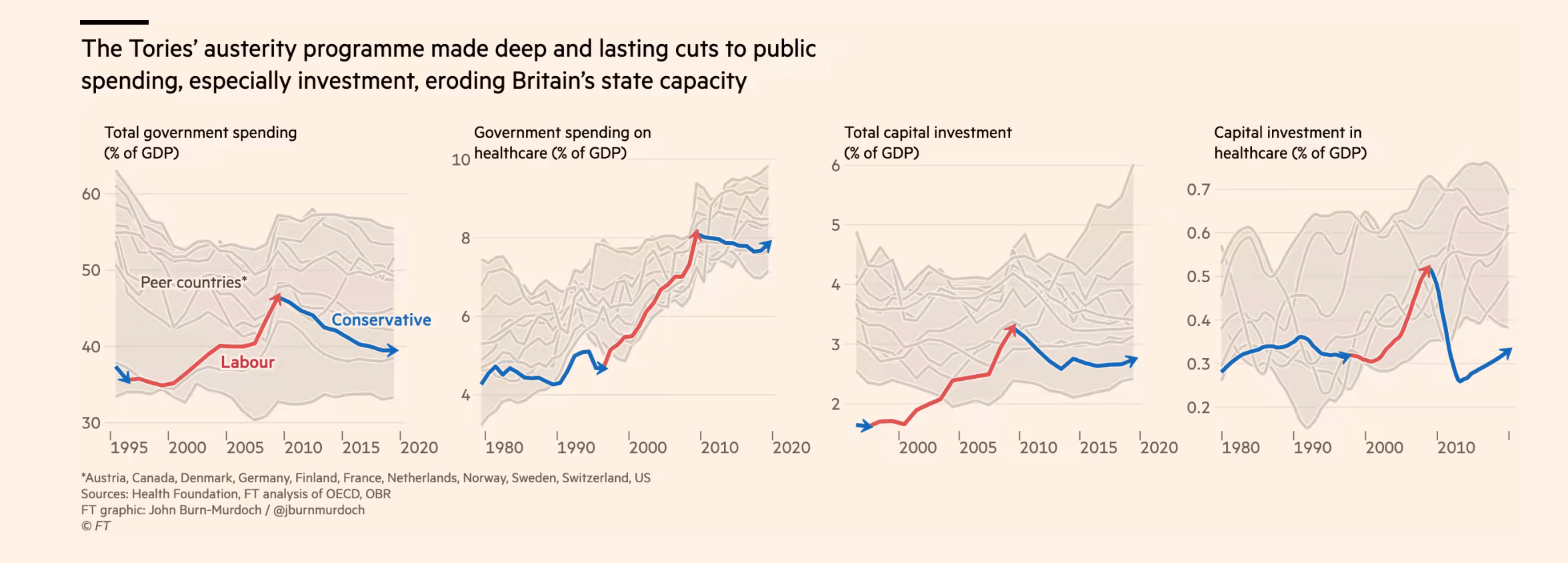
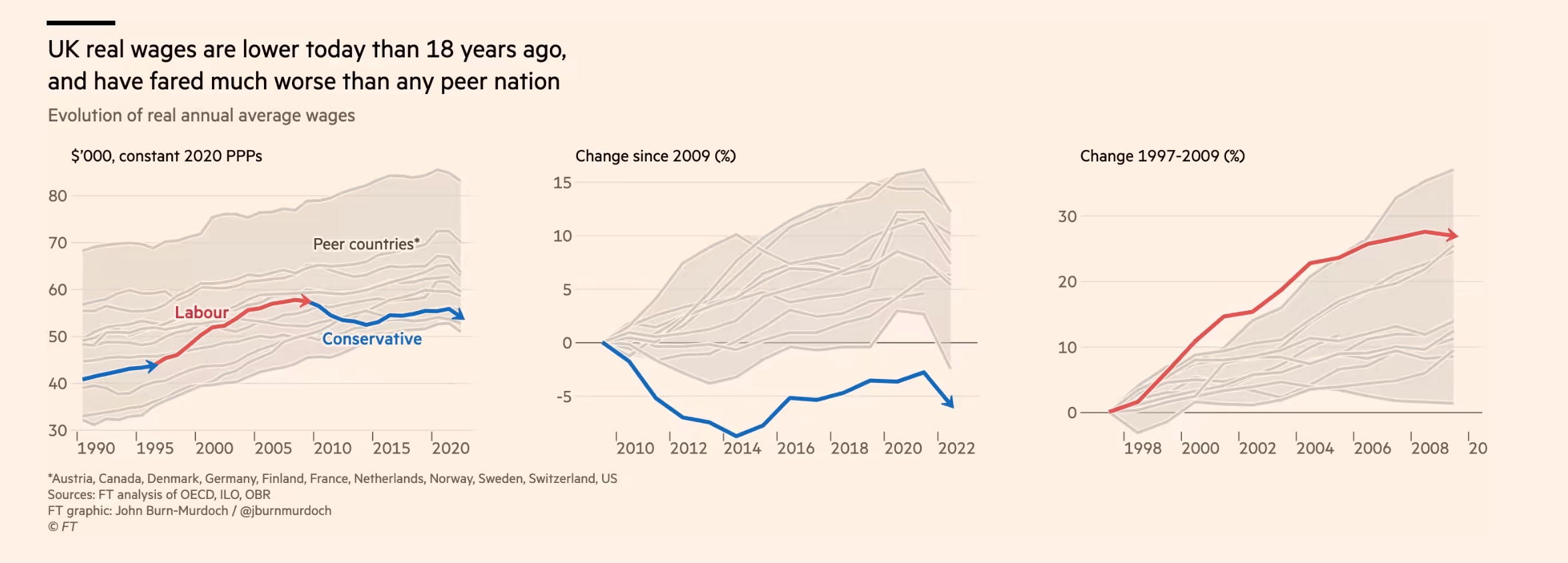
    Two graphs

    Feels about right. (From today’s FT)

  • 22/12/2022

    Post Link

    White collar crime, Xanax and Viagra

    The crime-writing Belgian ‘sheriff’ fighting EU corruption – POLITICO

    For him[Michel Claise], financial crime has destroyed fundamental aspects of society. “White-collar crime is the cancer of democracy,” Claise wrote in one of his books, “Le Forain” (The Showman).

    And prison works for white collar crime.

    Belgian justice is doing what at first sight the European Parliament hasn’t done,” the country’s Prime Minister Alexander De Croo told reporters in his first comments on the scandal on Tuesday. “The European Parliament has a lot of means to regulate itself. It turns out that this is largely a system of self-regulation based on voluntary efforts, which has clearly not been sufficient.

    But that peacocking would be ironic to Claise, who complained in October that Belgium’s police are under-resourced, fighting a war against modern, high-tech corruption using “catapults.” Earlier in the year, he said the Belgian government was “ on Xanax rather than Viagra.” Now it’s the European Parliament he has found dozing on the job.

  • 20/12/2022

    Post Link

    Trust and tax

    Chartbook #181: Finance and the polycrisis (6): Africa’s debt crisis

    The context for the following quotes from Adam Tooze is Ghana in particular and Africa in general.

    For many African states this […steady growth, feeding an adequate tax base…] is a huge challenge.

    As David Pilling writes about Nigeria in the FT:

    One measure of the trust that a nation’s people have for the state is the amount of tax they are willing to pay. However grudgingly, under an unwritten social contract people agree to part with a share of their income in the belief that the state will spend it more or less wisely. The public goods provided range from schools, hospitals and roads to police, national defence and the running of the government itself. Everyone benefits from improved services, a better educated and healthier population, safer streets and protected borders. (David Pilling).

    Which made me think of the UK.

    Further on Tooze quotes Schumpeter:

    What Joseph Schumpeter wrote in his essay “The crisis of the tax state” about the European state in the aftermath of the gigantic financial effort of World War I, is no less true for African states faced with the awesome development challenges of the 21st century.

    “fiscal measures have created and destroyed industries, industrial forms, and industrial regions even where this was not their intent, and have in this manner contributed directly to the construction (and distortion) of the edifice of the modern economy and through it of the modern spirit …. The spirit of a people, … its social structure, the deeds its policy may prepare … all this and more is written in its fiscal history. He who knows how to listen to its message here discerns the thunder of world history more clearly than anywhere else.”

    And again, I think of the UK.

  • 19/12/2022

    Post Link

    Hae ye said your prayers yet?

    Hugh Pennington | Deadly GAS · LRB 13 December 2022

    Another terrific bit of writing by Hugh Pennington in the LRB. It is saturated with insights into a golden age of medical science.

    Streptococcus pyogenes is also known as Lancefield Group A [GAS]. In the 1920s and 1930s, at the Rockefeller Institute in New York, Rebecca Lancefield discovered that streptococci could be grouped at species level by a surface polysaccharide, A, and that A strains could be subdivided by another surface antigen, the M protein.

    Ronald Hare, a bacteriologist at Queen Charlotte’s Hospital in London, worked on GAS in the 1930s, a time when they regularly killed women who had just given birth and developed puerperal fever. He collaborated with Lancefield to prove that GAS was the killer. On 16 January 1936 he pricked himself with a sliver of glass contaminated with a GAS. After a day or two his survival was in doubt.

    His boss, Leonard Colebrook, had started to evaluate Prontosil, a red dye made by I.G. Farben that prevented the death of mice infected with GAS. He gave it to Hare by IV infusion and by mouth. It turned him bright pink. He was visited in hospital by Alexander Fleming, a former colleague. Fleming said to Hare’s wife: ‘Hae ye said your prayers?’ But Hare made a full recovery.

    Prontosil also saved women with puerperal fever. The effective component of the molecule wasn’t the dye, but another part of its structure, a sulphonamide. It made Hare redundant. The disease that he had been hired to study, funded by an annual grant from the Medical Research Council, was now on the way out. He moved to Canada where he pioneered influenza vaccines and set up a penicillin factory that produced its first vials on 20 May 1944. [emphasis added]

    He returned to London after the war and in the early 1960s gave me a job at St Thomas’s Hospital Medical School. I wasn’t allowed to work on GAS. There wasn’t much left to discover about it in the lab using the techniques of the day, and penicillin was curative.

    [emphasis added]

  • 18/12/2022

    Post Link

    N of 1

    Getting too deeply into statistics is like trying to quench a thirst with salty water. The angst of facing mortality has no remedy in probability.

    Paul Kalanithi, When Breath Becomes Air