Opens in a new tab
Categories Filter
  • 04/04/2014

    Post Link

    Who pays for medical education?

    As far as I can tell most medical students do not know much about how undergraduate medical teaching is funded. This is not all together surprising, because it is complicated, and owes much to historical norms and structures that are now been swept away (at least in England). Everything about student finance appears confusing, even the 9K fees in England are not straightforward. How can increasing fees from 3K to 9K end up costing the government more? Hardly intuitive. (For more on tuition fees see ‘Explained: how is it possible to triple tuition fees and raise no extra cash?’ or have a look at Andrew McGettigan’s book.)
    Funding of undergraduate medicine appears complex because more than one funding stream is used, and there is likely lots more cross-subsidy. So, whereas for a course in Modern Languages, the student pays fees (or at least the government does on the student’s behalf, and then the government of government proxy levies additional tax on the student when they graduate), there is no other significant stream of funding. Other monies may be involved —capital costs, endowments or even research funds— but the bulk of the cost of the course has to be met from what students pay. If not, there has to be cross subsidy from elsewhere. This financial architecture seems relatively straightforward in comparison with the situation in medicine.

    In medicine the student may pay 9K (not in Scotland, of course) and in addition the Higher education funding council puts in another ~10-12K. So, a total of ~20K per student per year, for 5 years. All well and good. However, clinical teaching in hospitals and GP practices is also supported by a funding stream that comes via Health Boards—independently of the University. This money appears to exist at the aggregated level, but is much harder to locate at a lower unit level. It is called ACT in Scotland, and SIFT in England. The sums of money are very large, and are designed to reimburse the local NHS for all the staff time and facilities that are used my medical students. I do not know exact figures, but most clinical teaching is probably delivered by NHS rather than university staff (the ratio may vary with the type of teaching). For instance, a Health board or series of health boards with 840 students (280 for each ‘clinical’ year) might receive ~20K per student/year. Facilities will obviously include capital costs, but the bulk of money one would have thought would be accounted for by doctor time.
    I do not know of any high quality empirical studies of where this money goes, but it is generally accepted by those on the ground that most of this money is not used to actually deliver teaching. I have heard senior NHS figures accept it is hard to justify the bulk of this funding in terms of its apparent intended purpose (the story of how those amounts were arrived at, I will leave for another day, save to say they were not very sound). However, whatever the original rationale or justification for the scale of the funds, this is what the tax payer is contributing, and what they are being told is being used for training future doctors (‘we paid for their training!’). The reality is that some of us think most of this money is not actually being used for this purpose; and the suspicion is that an ever increasing bureaucracy eats into it. Hard data would resolve this issue.

    There are however other movements of money between universities and the NHS. Clinical academics deliver NHS work, but the universities are not generally reimbursed for this work. Individuals might however receive clinical excellence payments, which are in addition to their university salaries. In terms of the ‘direction of travel’ I suspect such payments may not enhance student teaching very much, but rather focus academics minds on research and on taking on NHS wide tasks. Just to add more complexity, a significant proportion of clinical academics receive their salary from the NHS, although this may come via the university payroll (the NHS gives the money to the university, who then pay the individual academics). I do not know what proportion of clinical academics are funded this way—people used to quote up to 40%– but I have tended to assume this percentage may have dropped over recent years. Overall, academics comprise less than 5% of consultants, but in larger teaching centres the figure will be higher. They are of course to varying degrees, part time clinicians.

    The headline figures in summary for fees are that 20K a year is coming from the student and government direct to the university, and for clinical students the government is paying perhaps another 20K via NHS health boards. This makes quite an annual figure of 40K, but the headline figure takes little account of hidden cross subsidies. In the NHS, some of this money is diverted to treat patients; and in the universities, if the data from the US that Rich DeMillo quotes is correct, it is likely diverted into research.

    A lot of money. How things could usefully change, I will leave for another day. If you can correct any of these figures, please let me know.
  • 02/04/2014

    Post Link

    Slomo and medical career progression

    A great take on medical career progression from SLOMO. http://nyti.ms/1s0fcv2

  • 01/04/2014

    Post Link

    Coursera income

    Yet Coursera, which has raised at least US$65 million in investment capital, still faces the challenge of generating enough revenue to support itself as a private company.


    [simnor_button url=”http://www.universityworldnews.com/article.php?story=20140327165147666 ” icon=”double-angle-right” label=”The silicon valley model ” colour=”white” colour_custom=”#fff” size=”medium” edge=”straight” target=”_self”]

  • 30/03/2014

    Post Link

    Mum, don’t ask me what I learned today at school.

    A couple of things interested me in the Times Higher this week. Echoes of memes I have come across before, but given an edge because of some work by Derek Muller I chanced upon via Kelly Walsh.

    The first was an article by Jack Grove quoting work showing that certain types of student feedback on teaching quality tend to reduce learning. I have come across similar findings before, but I do not know the primary literature well. Of course it is not at all surprising. I think it was Clark Glymour who quoted that every time you put an equation in a lecture to those enrolled on degrees that are viewed as being non-mathematically challenging, then student evaluations of lecturers go down. If you tie this sort of silly feedback to staff progression or reward then you are on a race to the bottom. I think the phenomenon is real, and at the softer edge, widespread. Learning is hard, and should be challenging. The pleasure and reward of mastery, only come with effort. The teacher and learner share an asymmetrical relationship.

    The second article, brought a smile to my face, because my own university—like most others I imagine— is anxious about what students say about it in the National Students Survey (NSS). Economics students at Manchester have been campaigning for their course to give greater prominence to alternative theories, especially in the light of the 2008 financial crash. They are asking students to withhold filling in their NSS feedback until a decision is reached about including a course with the title ‘Bubbles, Panics and Crashes’. The students are quoted:

    The university is very keen to get students to fill out the NSS, saying that they take their feedback very seriously – but this approach does not always seem to translate to non-NSS forms of feedback, like our petition, which is quite sad…

    (more…)

  • 28/03/2014

    Post Link

    How do you get this sort of stuff across?

     It’s understandable that it should be demanding: most of us, if we were to have our brains cut open, would prefer it be done by someone who prioritises their work over their personal life. As a trainee I realised that I had too many other interests to be a good neurosurgeon, and quit for emergency medicine – a tranquil backwater by comparison.


    From a review, of ‘Do no harm’ by Henry Marsh, in the Guardian. I think it is increasingly hard to explain to many, that for many walks of medical life, part time working may be suboptimal. The next issue, is how academics are to figure in all of this?  It was David Hubel, the Nobel Laureate, who qualified in medicine but did not practice, who pointed out that the best doctors see more patients: there is he believed (as I do) a relation between clinical load, and competence. The caveats relate to, breadth of practice, and how you ensure that the hierarchy of practice does not waste scarce high-level expertise on cases that do not require it. I think we are getting these things wrong.

  • 26/03/2014

    Post Link

    A difference in emphasis. Discuss.

    aamctomorrows doctors

  • (Some) residents prefer blogs and podcasts to textbooks

    Of the 401 residents who received the e-mailed survey, 226 (56.3%) completed it. Of these, 97.7% reported spending at least one hour per week engaging in extracurricular education, and 34.5% reported spending two to four hours per week (P < .001). Time listening to podcasts was the most popular (reported by 35.0% of residents), followed by reading textbooks (33.6%) and searching Google (21.4%; P < .001). Residents endorsed podcasts as the most beneficial (endorsed by 70.3%) compared with textbooks (endorsed by 54.3%), journals (36.5%), and Google (33.8%; P < .001). Most respondents reported evaluating the quality of evidence or reviewing references “rarely” or less than half the time. A majority (80.0%) selected the topics they accessed based on recent clinical encounters.

    [simnor_button url=”http://ovidsp.tx.ovid.com/sp-3.11.0a/ovidweb.cgi?QS2=434f4e1a73d37e8c5a069e886e3737f20a1958d49d4875d6d54b2eaffb8643848c17ab581dd41da4398e4d1a9bca3fe39df3ef677700f63097b58846b2f14930c6c27000c3a4968ed9f6db7fb7e8ff1674cfd10f35fc05f9c37dde20d4602cd63c0595a84ba784fac9a60dd2931acca1ed2e12e7cfca0705ec62fa4a87962aaa240de814a45fc7116eaf5d39ae0c7abecee0b2aeee5df0ef6609d054fe3fbeab6a9b3da8e9a8b0af003dd3dd4915d4d08f32983dc724fee852ccb3fcac6dc63ac5d1ecd8e862a93caf996907ebc5f752c77041894b6456548e0c23fdb0fe14ab362549dcadfa55830b6bc38cad1dc9ad0f95d39b9597121343ecf5da05e773ef ” icon=”double-angle-right” label=”DOI: 10.1097/ACM.0000000000000170″ colour=”white” colour_custom=”#fff” size=”medium” edge=”straight” target=”_self”]

  • 26/03/2014

    Post Link

    Purpose of medical education

    I believe the problems with the fourth year of medical school may reflect a larger problem—the failure to articulate a vision for the outcome of medical school education.


    [simnor_button url=”http://ovidsp.tx.ovid.com/sp-3.11.0a/ovidweb.cgi?QS2=434f4e1a73d37e8c4c7d6b65ba1a76f1323a7fdbcf8150f0b3015360d3c32789d34cf811b8b53640b582b18b0ddd0e0af57c23971f237d72499bb8a5480b5bed9793f6628ba7f25d6c36fbe51ecd679d97210564bd040e1c9f2936003288de87ca2c78f379ef58762a4fbcd34f13bf93016660b6057653188ac64d9e8573758f149ef7963b210e59b31ece4f3ffda0e24d6533ac4bec4aae48aed5aa8a81737697496b620a16ff4776e1900a6afc3146813615cb9a61ef54b25ca4df7787385e4dcab92f659aa579ed4ddfb750c213570d16e5a4bc58d3f5aff854e9220bbe4d6df1e1dab6f086b2a1a1dd7a04be61ddc5e9b5118c2e2d07 ” icon=”double-angle-right” label=”David Sklar, on the final year in the US” colour=”white” colour_custom=”#fff” size=”medium” edge=”straight” target=”_self”]

  • 25/03/2014

    Post Link

    How do we educate students about how real discovery works?

    I was musing over this article, party because it is a longstanding interest of mine—how do we acquire useful new knowledge— but also in the context of this blog on medical education, how do we get across to students how medical advance has occurred. Without getting into the ‘what can we learn from history’ subroutine, I think the topic important, and one that we cannot assume students will learn to think deeply about, without some guidance or prompting. To my mind, the role of education here is the classic one: as a detergent to propaganda.

    The editorial describes changes at the mental health part of NIH (NIMH) in which the new director has made clear that to be funded, clinical trials have to include some test of the underlying biological mechanism. The line is that too many trials are black-box tests, in which if the results are negative, nothing is learned. ( It is suggested that 50% of the studies currently funded, would not be funded if submitted as new grant proposals at some future time). I think they are targeting the sort of pragmatic NHS style RCT which I find so depressing. The reason is simple: without a construct, or a genuine scientific hypothesis (and I do not mean a statistical one), we have no idea whether the conclusions of any study will apply at any future time, or in any other population. And a cognate fact is that we know trials are noisy and often unreliable guides to what is going on. Fisher warned of this nearly a century ago: we tend to try and rely on statistics when we know little about what is really going on, when what we need is more thinking, and much more repetition.

    As it is, we often capture very little of the routine clinical encounter in many clinical trials. They are guides to what is going on, not rules to tell us how to behave. If the effects are very large, we can perhaps ignore much of this. But so often, we only conduct large studies, because the effect sizes are so small. If we think about it in simple terms, the R2 values are far too low: most of the variance is random, and unexplained. They are not good experiments and, it is no surprise, that we are finding out that so many papers published are wrong. Most RCT do not present the information this way, because it would be apparent we know little about what will happen to our patients. Not always, however. Systemic retinoids for acne have, I suspect, an NNT of close to 1. But even there, we had a clear demonstration of efficacy, before we had much insight into mechanism —but researchers went searching to complete the circle—not to the next RCT in a different domain.
    However, what the editorial dismisses, is what I would most want to get across to students. The article (discussing psychiatric drugs) states that:

    By the early 1990s, the pharmaceutical industry had discovered — mostly through luck — a handful of drug classes that today account for most mental-health prescriptions.

    This is a real travesty, and again supports my adage that Nature doesn’t really understand medical research or medicine. Many of the leads were not luck, but the results of astute clinicians / pharmacologists interested in what happened to their patients. Not so much those immersed in the use of rating scales, or obsessed by assuming anything interesting must be due to chance, but acute observers that provided insights worth following by pharma. Calling this luck, is like saying Charles Darwin was just lucky (although I would accept Wallace was deeply unlucky). This for me is just another representation of the master clinician, one whose expertise is based around a knowledge of patients, and who thinks about what happens to them. This is a style of medicine we are in danger of losing. Students should know that the obsession of thinking about patients is what underpins and drives clinical advance. This is not at the expense of sensible clinical experiments, or wet-bench work, just an acknowledgement that medicine has its own intellectual heartlands, and we need to communicate this to the next generation, because it is in danger of being  killed off by a pincer movement of ‘protocols’ on the one hand, and a confusion that biology and medicine are synonymous, on the other. As far as discovery in psychiatry is concerned, few can equal David Healy for explaining how we got where we did. For some other areas, see what I wrote in Science over 10 years ago. The problem for the undergraduate teacher is how to integrate real knowledge of statistics and experimental design, with a knowledge of how genuine clinical advance occurs.

  • 25/03/2014

    Post Link

    Lets breakout and dance

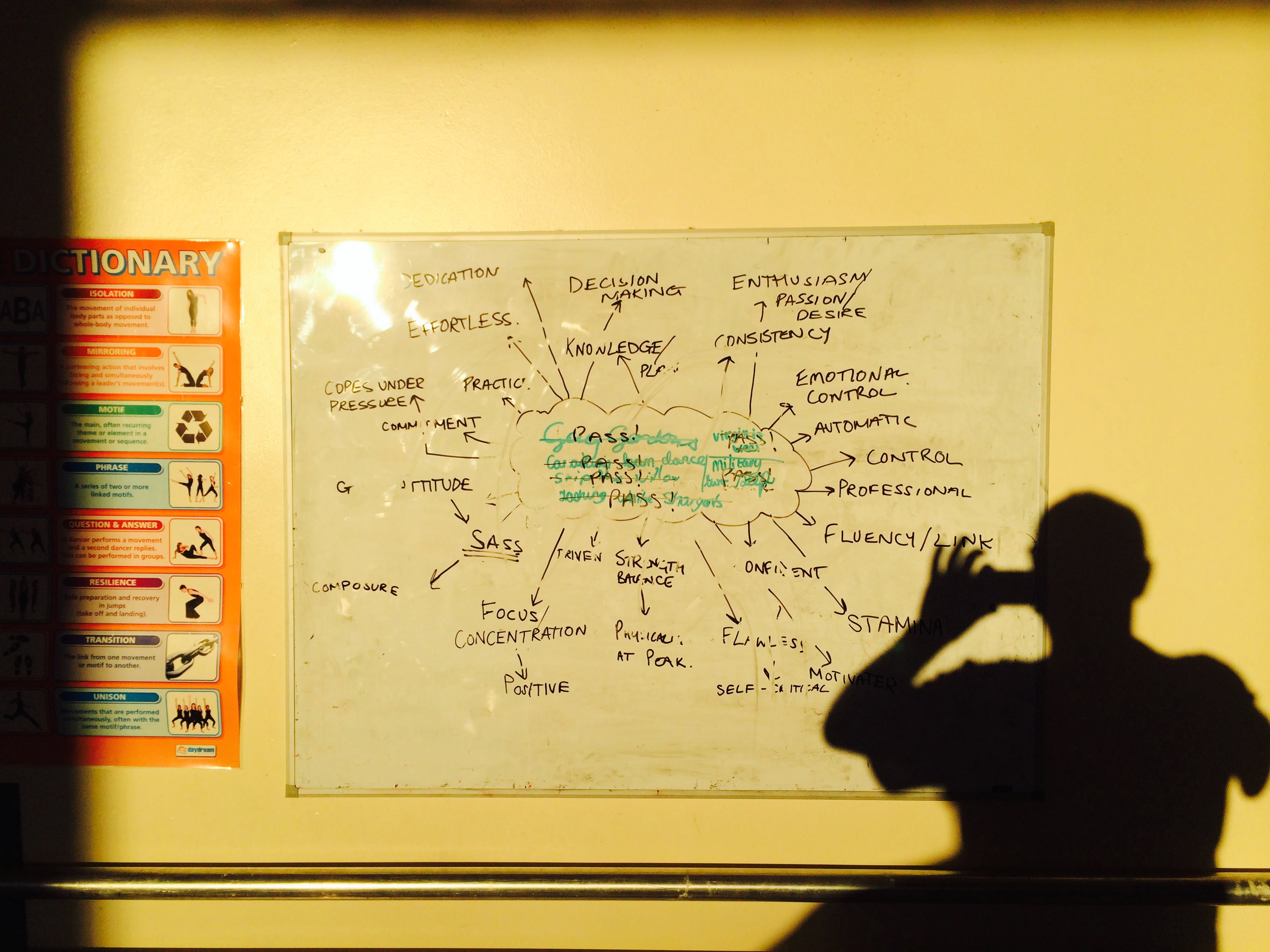
    One of my old bosses always said that if you have more than a 3 arrows on a slide, you don’t know what is going on. The context was very much classical medical research, but I think there is something to be said for his scepticism. There is a quote from Paul Valery, I think to the effect of: that which is simple, is wrong; that which is complicated is useless. I looked at this whiteboard content and wondered how much it reminded me of med ed gone wrong. More HR speak, than education. The whiteboard was seen in a gym, and I think referred to dance.

    mindmapping dance