
27/04/2015
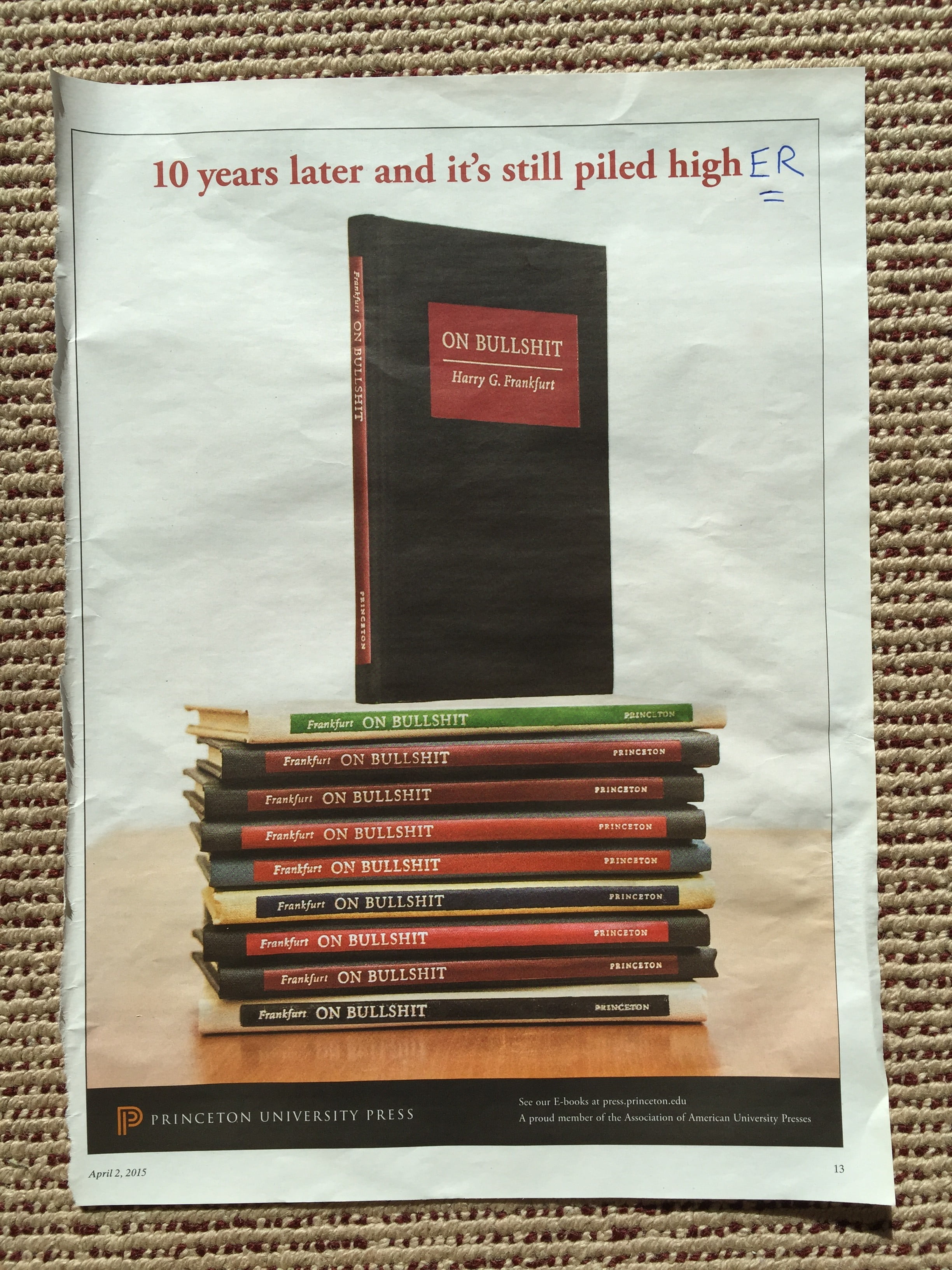
Post LinkBullshit, all over again
25/04/2015
Post LinkYet on top of this he was also a teacher (though only for the money)..
From a review of book on Bela Bartok. [ direct link to this post]
20/04/2015
Post LinkMedical education, and a deficiency of will and ambition. Just buckets.
The following is from in interview with Don Berwick in Health Affairs. Its touches on the topic of change in medical education. (Cynic JLR quote: “medical education is always advancing; it is just that it is always a century behind what is needed”)
It’s been a remarkably difficult arena to get changes going in. Partly it has to do with the economics of education—and I don’t mean the money. I mean the budgeting of time. You have a student in your hands for a certain amount of time. And the way educational systems work is to regard that time as if it were currency: It’s doled out among the various stakeholders. There are no internal stakeholders for the processes of improvement and change in the modern medical school. The stakeholders are in biochemistry and physiology and pharmacology and surgery and medicine—in the traditional buckets. So once you’ve taken all the time you’ve allocated out to the buckets, there’s nothing left over for a course on safety or system leadership or physician stewardship and change, often even ethics.
It is not completely true, but true enough to be easily recognisable. Everybody wants a bit of the action, however. One day I will produce an inventory of all the ‘must be included in the undergraduate curriculum’ statements from all and sundry. The most recent ones I have seen relate to ‘resilience’ (just like the army in Afghanistan, the GMC tell us), and of course, ‘big data’ ( future data doctors will look at data, not patients…..I jest not).
20/04/2015
Post Linkadjuncts on food stamps
As this article notes, in the U.S., 25% of adjuncts are on social assistance. This means governments are subsidizing colleges and universities by paying adjuncts things like food stamps directly.
16/04/2015
Post Linkminimal evidence about what works in med ed
At present, there is minimal evidence about what truly makes a difference across most of the medical education enterprise.
Cynthia Whitehead in Science, in a review of ‘Let me Heal: The Opportunity to Preserve Excellence in American Medicine,’ by Kenneth M Ludmerer [direct link to this post]
16/04/2015
Post LinkCompetence, and the illusion of categories.
Medical competence is not a binary trait, but rather a continuous one. I think this is self-evident. Medical certification often models the issue in terms of the former rather than the latter, however. But the Geoffrey Rose argument about the total burden of hypertension owing more to those with moderate hypertension than those with more elevated blood pressure, may apply. It is shifting the average that may make a greater contribution to good medical practice than pulling out weeds at the left side of the distribution. Finding the weeds may disturb all the other young seedlings. What if our interventions at this extreme come at the cost of lowering the overall rate of growth? Who has skin in the game then?
14/04/2015
Post LinkDo not admit you have been to college, let alone have an MBA.
Three quotes from an article ‘The Commoditization of Credentialism’. [via Stephen Downes]
Her parents had been firmly American middle class and she’d managed to get into Harvard based on an outstanding high school track record. She’d blazed through her four years there before heading off to NYU to get her law degree. A year into her law career at a large NYC firm, she’d “pulled the trigger.” It became clear to her that the path she had in front of her spending the next decade of her life to pay off over $200,000 in student debt from undergrad and law school wasn’t the future she’d imagined. So she’d bought a one way plane ticket to South American and hadn’t been back.
I was speaking with the founder of a software company at a startup event last year. Walking to the after party, she paused to make sure no one was nearby, and leaned in to whisper, “I have a MBA.”
“Really?”
“Yea, I don’t really talk about it. We got turned down for funding twice because both my cofounder and I have MBAs.”
The cost of credentials is rising. Tuition is getting more and more expensive at the same time as the value of the degree is falling. In a world where competence was scarce and information was opaque, credentials were valuable. In a world where competence is abundant and information is transparent, they care what you’ve done.
But have a look at a typically deep essay ‘After Credentials‘, from Paul Graham. As he says, you can try and make credentials more fit for purpose, but surely the better option is as follows:
Instead of trying to make credentials harder to hack, we can also make them matter less.
Royal Colleges, watch out. Amen.
13/04/2015
Post Linka student with an expiration date
“A student who can answer questions without understanding them is a student with an expiration date.” [link to quote] [direct link to this post]
11/04/2015
Post LinkEverybody knows
There is a mantra, familiar to all who think about schooling, that goes as follows: everybody is an expert on schooling because everybody went to school.
Now play with a few words: Every doctor is an expert on medical schooling because every doctor went to medical school.
03/04/2015
Post LinkWorth a glance #13
Change the cancer conversation. I was surprised to see this in Nature, but the article makes many arguments for why the terminology —War on Cancer — is inappropriate. It is also unusual for Nature to highlight how dysfunctional some medical research is.
Lectures revisited. My friend and former colleague, Bruce Charlton outlines what good lectures are all about. The problem is that few meet aspire to or meet his standards. Although, for the record, and since we qualified at the same medical school, I found most of our lectures fairly poor.
Oliver Sacks in Nature quoting Vernon Mountcastle on his retirement : Mountcastle wrote: “I miss laboratory work in a way that is difficult to describe. It has always been my heart’s joy, and my own experience has always been that even the most trivial original discovery of one’s own evokes a special kind of ecstasy — it is almost like falling in love for the first time, all over again!” If more scientists worked directly at the bench themselves, we would have better science.
How Medical Tech Gave a Patient a Massive Overdose. I find none of this too surprising. We know quite a bit about IT and design, but hospitals in my experience ignore it. They are increasingly run by people who lack any sympathy for either those providing clinical care, or real patients. Excel spreadsheet merchants, all over the place. And if it is the UK, politics.