Opens in a new tab
Categories Filter
  • 27/05/2016

    Post Link

    Overtime pay for post-docs

    “Overtime pay for postdoctoral scientists is welcome — but could mean fewer positions.” Nature

    This is from the US, and it only refers to those below a certain salary.  When I worked in France, in Pierre Chambon’s rather large laboratory, wives or girlfriends were referred to as ‘Chambon widows’.

  • 26/05/2016

    Post Link

    An education system modelled on what didn’t work 100 years ago

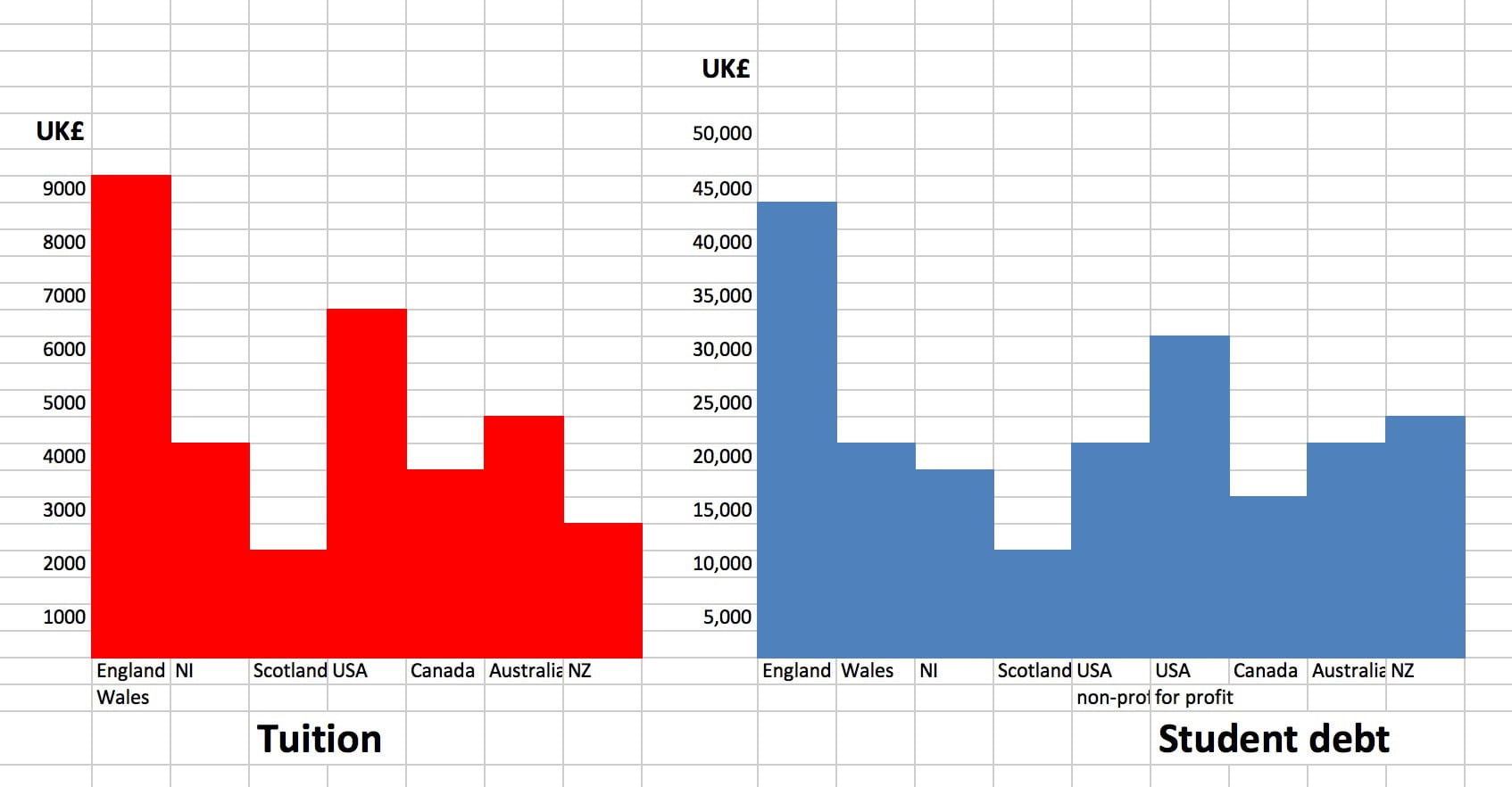
    Tution-vs-debt-2

    This figure is from Tony Bates based on this Sutton Trust publication. He adds:

    “a model of education that is clearly influenced by the British public boarding school system from which most of the Conservative government ministers have graduated. The current English education system is in a time warp that seems to belong more to the 1920s than the 2020s”

    Yes, as in a century ago.

  • 26/05/2016

    Post Link

    Skills gaps? It’s the money, stupid.

    From Thijs van Rens in the HBR

    It is usually taken for granted that the skills gap is a problem of skills supply, and public concerns often focus on a lack of STEM skills and soft skills. So proposed solutions tend to involve reforming education and worker training programs. The most popular approach has been to reduce tuition fees for selective fields of study, usually STEM majors.

    However, I argue that this view is not correct. Research that I and my colleagues have conducted suggests that the skills gap persists mainly because employers are unwilling or unable to pay market price for the skills they require…..

    Yet the skills gap remains, because the adjustments that workers and firms make will only eliminate the gap if wages reflect the relative supply and demand for various skills across occupations. But our data shows that this is not happening: Many jobs in industries that generate high profits (retail trade, educational services, mining, and forestry) tend to pay low wages and are therefore unattractive to workers, whereas jobs in industries that pay higher wages (finance, computer and electronics manufacturing, paper and printing) are not very profitable.

    Via Stephen Downes

  • 25/05/2016

    Post Link

    The academy and a life beyond the boundaries

    Nice turn of phrase, from Benedict Anderson’s autobiography, in the Economist. I think it says a lot about the Academy.

    “Scholars who feel comfortable with their position in a discipline, department or university will try neither to sail out of harbour nor to look for a wind,” he writes, paraphrasing an expression in Indonesia. “But what is to be cherished is the readiness to look for that wind and the courage to follow it when it blows in your direction.”

  • 25/05/2016

    Post Link

    But on reflection….

    “Such anecdotal claims aside, little empirical evidence supports the use of reflection as a tool to enhance professionalism, so further research is needed in this area.” 

    Paper in Academic Medicine here.

    Depending on you prejudices, you might consider the full paper more nuanced. But if you cannot sort out causality, you cannot master nature.

  • 22/05/2016

    Post Link

    Creating life in higher ed: steps toward a better world*

    A couple of comments and events I heard about in the Re:learning Podcast series got me re:thinking about ideas that I have tossed around before. The session with Christine Ortiz, currently a MIT graduate dean, was about her attempt to set up a new university / college. This is very much a bricks and mortar place. By contrast, Tyler Cowan, he of Marginal Revolution, is setting up a university of the air. Cowan argues that the distinction between what is a university and what is not a university is breaking down. His ‘institution’ is an outgrowth from the distinctive Marginal Revolution blog. He is not giving up the day job, unlike Christine Ortiz. There are lots of interesting things, here.

    First, barriers to entry are getting lower. Of course, barriers are higher for bricks and mortar places, but many modern universities are in danger of losing the power — and failing to appreciate the value — of residential institutions. If you keep piling students into lectures theatres and student staff co-knowledge is poor, you have to ask why online might not be a better value proposition. Awhile back I was chatting to a physics professor from Holland, who was talking about their attempts to build liberal arts colleges within a larger university framework. I have no idea how well it is working, but the idea is interesting. Many medical schools, it seems to me, are largely places where student placements are organised, rather then delivered.

    Second, there really is a sense of experimentation, that was not there 20 years ago. This is why being in higher education is so much more interesting now that it was even just 10 years ago. MOOCs, hype or not, doesn’t really matter. Change is in the air.

    Third, universities are multisided markets or platforms, in which students have limited power. This will have to change. Cross subsidies between teaching and learning, research, ‘wealth creation’ are all going to come up for scrutiny. If we imagine university accreditation like we would APIs, we might see real change. If we were really serious about ‘competency’ (self evidently, we are not) we might free up the ways in which students can master whatever it is that is judged important. Or what they want to achieve, with or without my flavour of libertarian paternalism (no happy chart feedback here!).

    But I have to pinch myself at how exciting this all could be. I think we have to protect and nurture the academic ideal, but not at the expense of all that is outside it. Nor our students. Things really are different.

    * Part of Marginal revolution’s, byline

  • 19/05/2016

    Post Link

    The fatal attraction of the short term

    A couple of sentences from this article on the value of interdisciplinary research got me thinking — or at least pulling some memes off my dusty intellectual shelf of clutter. The article is about Ian Goldin, and some ideas I am sure he talks about in his new book, which I haven’t read.

    First:

    He added that “one of the reasons” for the 2008 financial crisis was that “people lost their ethics, their judgement, and their wisdom” because of disciplinary silos.

    I agree. I remember the Economist putting it more harshly: …’professors fixated on crawling along the frontiers of knowledge with a magnifying glass’[Economist, December 10th 2011]. Economics, a bit like psychiatry in medicine, is the canary in the mine. Nor would teaching mandatory ethics courses (‘I am certified in ethics A+!), do very much. Enron’s management were stars at HBS. This is one of the tragedies of many modern universities, so busy edging their way up largely meaningless ranking scales, that they are unable to tackle the problems society faces.

    Second:

    Golden was quoted as saying, ‘[there is] a “real pressure” on universities to be “thinking ahead” and teaching information that will remain relevant when current students “reach their mid-careers”’.

    There are two aspects to this. One is that the whole idea of education is a way of hedging against a changing environment. If the world was constant, we could dispense with much (but not all) education — training would suffice. This is just another way of saying advance comes from when sons do not do what their fathers did (‘20th century physics was made by the sons of coblers’. Substitute your gender, please). But from a teaching perspective there is another facet to think about. We cannot adequately judge how well we educate our students over the short term (alone). Yes, they can pass finals. Yes, they can take a history etc. But the test of education is how well they behave and think 20 years down the line. This is a large search space that we can only navigate using theories about what makes the world change, and what makes people push at the boundaries: do not cite Cronbach’s alpha, at me. But in examinations and certification, like so much else in science and society, we are blinded by the apparent certitude of short term goals. And the allure of summary measures, rather than the messiness of the real world.

  • 19/05/2016

    Post Link

    Big data exceptionalism

    This comment (and phrase) from Bruce Schneier struck a chord with me.

    NYU professor Helen Nissenbaum gave an excellent lecture at Brown University last month, where she rebutted those who think that we should not regulate data collection, only data use: something she calls “big data exceptionalism.” Basically, this is the idea that collecting the “haystack” isn’t the problem; it what is done with it that is………Under this framework, the problem with wholesale data collection is not that it is used to curtail your freedom; the problem is that the collector has the power to curtail your freedom. Whether they use it or not, the fact that they have that power over us is itself a harm.

    Of course, as Alan Kay said, we need ‘big ideas’ rather than assuming ‘big data’ will do our thinking for us. This is not to deny that large data sets are not useful, nor that they do not allow you to answer questions, you might not have been able to do so before. But A/B testing only gets you so far. And beware technicians who want to mould nature to their method, not vice versa; or change what meaningful consent means.

  • 18/05/2016

    Post Link

    Textbooks: easy money

    ‘The rising prices of textbooks appears to be reaching a tipping point, the professor adds. The latest US Census Bureau statistics show that textbook prices increased more than 800 per cent from 1978 to 2014, more than triple the cost of inflation and more than the rate of increase of college tuition.’

    FT

  • 12/05/2016

    Post Link

    NHS meltdown

    I don’t tend to blog or write much about the nitty-gritty of some of the day job. And I try to avoid the partisanship that affects so much of medicine in terms of this disease or that disease being a priority….  can we have more research money or money for more doctors etc. But this post is perhaps an exception, and it is written out of utter frustration at the incompetence of the UK health services.

    Some data from a paper in press in the JID looking at age-cohort models of melanoma, trying to predict what might happen over time. When I came into dermatology, crude incidence rates for melanoma /100,000 were 5.8. When I retire (if I get that for) they are estimated to be 31.4/100,000. A timespan of one career.

    Some context. Yes, this is incidence not mortality; diagnostic patterns have changed over time; and our knowledge of the natural history of melanoma, incomplete. But, in the absence of a major scientific advance that changes the field ( I see little evidence of this), incidence rates will be a key driver of health care needs. Given that melanoma diagnosis is clinical, and that we need to see 10–20 patients to pick up one melanoma, we are looking at a sixfold change in workload over one clinician’s career. And this ignores the more intensive nature of treatment and follow up, so workload will increase even more. Nor is melanoma the most common cancer we see. If cancer is ‘half our work’, melanoma rates are possibly an underestimate of what changes we will see, as the exponent relating incidence to UVR, is even higher for the non-melanoma skin cancers (NMSC).

    At present, perhaps 20% of UK consultant dermatologist posts are vacant, and the UK has the lowest number of dermatologists per unit population in the EU by an order of magnitude (certainly in comparison with the German speaking world). I will repeat that: by an order of magnitude. Primary care is in meltdown, too.  And while there are lots of well qualified  trainees who want to become dermatologists, training positions are essentially static, reflecting classic market corruption by a monopoly. And to cap it all, the Colleges (‘little Englanders’) have recently made the situation even worse, with bizarre changes to dermatology training, that will worsen care in the UK, rather than reflect the changes that will be necessary looking to the future:bracing forward with their eyes on the rear view mirror.

    This is not an easy problem to solve. Nor do I think disease rates have to drive doctor numbers in a 1 for 1 way (they don’t); we need to rethink how this  profession works.  But if you claim to provide a national health service, it is surely negligent not to at least realise that there is a problem — and tell people. My university produces plans. Yes, lots of padding, but also attempts to think how we will function in 2020 and 2025. If you look at health boards, in any meaningful sense, I just see a void. And of course, this isn’t just about dermatology, as my GP politely joined out to me last night: it is across the board.