Opens in a new tab
Categories Filter
  • 15/07/2016

    Post Link

    Minute particulars

    “I have never kept count of the many inventions I made but it must run into the hundreds. Most of them were trivial, such as a wax pencil that would write clearly on cold wet glassware straight from a refrigerator. It was published as one of my first letters to Nature in 1945.”

    “A Rough Ride to the Future” by James Lovelock.  Blake said it: it is all about ‘minute particulars’. Of a piece.

  • 14/07/2016

    Post Link

    assessments are fog

    For many, assessments are a lighthouse in the fog of education—a clear guide by which to make safe decisions. But in reality, assessments create the fog.

    Dan Schwartz here

  • 13/07/2016

    Post Link

    Plan for dealing with scale in medical education

    If you are interested in making undergraduate medical education work, you have to be interested in scale. We have to think about scale in at least two ways.

    First, within certain limits it is possible to invest more if you teach bigger numbers. If you want to produce high class online material, it will cost a lot. If you want to find out what works, larger numbers of ‘trials’ will help. If you want to produce meaningful online material, rather than just some dismal Powerpoints, it is only cost effective if class sizes are large. For many disciplines in many medical schools, there is simply not enough critical mass to produce great content. Or at least there isn’t, if teaching always plays second fiddle to research and clinical service.

    The other side of the coin is simply that bedside teaching does not scale. The larger the group, the worse the teaching; and patient resource is limiting. There are of course plenty of patients, but medical schools are modelled around where the resource was fifty years ago, rather than where it is now. They are reluctant to change because the ‘start up’ costs are large, and because schools are fixated on short term rather than long term educational goals. In the old bedside model, the ready availability of suitable patients was a large (hidden) subsidy. As it disappears, people are waking up to how expensive it will be to replace. Many of these costs will be direct costs to universities, rather than hospitals, simply because the political realities in the UK mean than hospitals are simply unable to find the finance to change the way they work. Most of the money that is said to support student teaching is siphoned off to support clinical service. It is just that nobody wants to call it fraud.

    From a student perspective these issues matter enormously. Student experience is often poor, and the sense of ‘place’ lacking in many, if not most, UK medical schools. The (justified) disenchantment felt by junior doctors at the hands of the NHS employers and so-called educational establishment, will spread to our undergraduates (more than it has already).

    There is a quote from Clay Shirky that is germane here*.

    You have to find some way to protect your own users from scale. This doesn’t mean the scale of the whole system can’t grow. But you can’t try to make the system large by taking individual conversations and blowing them up like a balloon; human interaction, many to many interaction, doesn’t blow up like a balloon. It either dissipates, or turns into broadcast, or collapses. So plan for dealing with scale in advance, because it’s going to happen anyway.

    *I got this via Mike Caulfield’s blog post here

  • 12/07/2016

    Post Link

    Wiping the Blackboard

    I came across this report from Blackboard Learn via Stephen Downes. The report is based on research Blackboard did in the US. I had to pinch myself to check I was reading it right.

    Amongst the conclusions or findings were:

    [direct quotes]

    • When students take a class online, they make a tacit agreement to a poorer experience which undermines their educational self worth.
    • Students perceive online classes as a loophole they can exploit that also shortcuts the “real” college experience.
    • Online classes don’t have the familiar reference points of in-person classes which can make the courses feel like a minefield of unexpected difficulties.
    • Students take more pride in the skills they develop to cope with an online class than what they learn from it.
    • Online classes neglect the aspects of college that create a lasting perception of value

    I do not think this is inevitable with online courses or teaching online, rather it represents a failure to understand that the ‘L’ in LMS is usually subservient to the ‘M’. I suspect many of these points apply to online material as part of residential courses, too. Getting the online bit right requires large investment of academic staff time. I do not see how you can do it well without increasing costs  — at least in the short term.

    Mike Caulfied has some useful  points to make on this report here

  • 11/07/2016

    Post Link

    Bad news for the academy

    A physicist who chose physics over Wall Street in 1990 was making a sacrifice that a physicist in 1960 wasn’t.

    Very thoughtful essay by Paul Graham. Bad news for the academy.

  • 10/07/2016

    Post Link

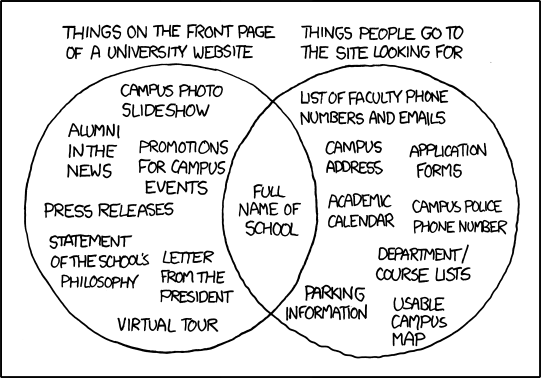
    University web sites

    Seen it before, but always makes me smile. And think.

    The ratio of expertise or expense between what you currently spend on the students already registered with you, versus that which you spend attracting new students, is a statement of ethical values (or lack of them). The same goes for the staff who work for you already. Your current students may get a bunch of ugly  Powerpoints with no design support; the potential  students get professional videos.

  • 09/07/2016

    Post Link

    Starters and finishers

    There is an interview in EdSurge with Dan Schwartz, the Dean of the Stanford School of Education. He talks about many interesting ideas elsewhere, but in this interview he says some fairly standard things about universities versus industry.

    ‘As an academic: I’m a great starter, and I can prove that something works. But my desire to ever have a 1–800-Call-Dan hotline for people who want to know how to use my inventions is like…zero.

    Now, if its software, I could put it up on the Internet and let people use it. But I can’t market it, and I can’t keep maintaining the code. And I need to get a business plan, but I don’t know how to do that. ‘

    This is very much about universities being the sort of place you start things, not where you finish them. I agree. Indeed one of the problems I see is that people want research to increasingly resemble product development. This will make all the figures look great (‘D’ is more expensive), but eventually will bankrupt universities.

    Medical schools have taken on all sorts of activities that are critical to the practice of medicine, it is just that some or many of them should be done elsewhere. Please invent new statistical methodologies, or ways of measuring disease, but let others outwith medical schools apply them in the ‘D’ of the R + D. Economists use the census, but they do not do the legwork themselves.

    But this got me thinking (not surprising given the theme of his article) about the one area where business or product development is central to a university’s activity: teaching delivery and learning (ugly phrases all, I know, but they are placeholders for more). And I do not believe we are good at doing this. We are good starters, but developing coherent programmes that dovetail into a particular niche, is not something we do well — certainly not in undergraduate medicine. The most obvious reasons for this deficiency are:

    1.  The problems of scaling educational activity
    2.  The historical structures ( I will use ‘ward’ as my synecdoche ) are no longer fit for purpose.
    3. Many of our staffing structures would make more sense if our true goal was to make teaching worse.

    I am not convinced people get this, or realise the time for fiddling or small tweaks has long gone.

    The structural framework of many university activities, especially advanced research, are well suited to their goals, and few institutions are as efficient at the business of genuine invention (leave aside, that universities are getting worse at this — this is only in part their fault). But if I look at the modern medical school we are not good finishers in our central ask, and we need to be.

  • 07/07/2016

    Post Link

    The great recession and health care

    ‘We also identified a significant increase over time in the percentage of people who incurred catastrophic health expenditures (greater than 30 percent of the household income) in the Czech Republic, Italy, and Spain…

    These findings indicate the substantial weakening of financial protection for people ages fifty and older in European health systems after the Great Recession.’

    From ‘The Great Recession And Increased Cost Sharing In European Health Systems’, published in Health Affairs.

    What continues to surprise me is how long it takes to appreciate the catastrophe that has been allowed to unfold, without any good reason.

  • 04/07/2016

    Post Link

    Psoriasis in five minutes

    I have been busy

    Psoriasis in five minutes from jonathan rees on Vimeo.

  • 27/06/2016

    Post Link

    Anybody remember the OU?

    Coursera pilots a new course format

    ‘Starting today, we will begin piloting a few courses in which all content is available only to learners who have purchased the course, either directly or by applying for and receiving financial aid.’

    Stephen Downes comments ‘You will recognize it as “what we had before MOOCs” ‘ Anybody remember the OU? Although at least with the OU you could watch the TV programmes and look at the books in the bookshop.