Opens in a new tab
Categories Filter
  • 15/06/2017

    Post Link

    We need a science of philanthropy

    Or so says an article in Nature. No we don’t , is my response

    Philanthropists are flying blind because little is known about how to donate money well. Facebook co-founder Mark Zuckerberg’s US$100-million gift to schools in Newark, New Jersey, reportedly achieved nothing. Some grants to academic scientists create so much administration that researchers are better off without them. And some funders’ decisions seem to be no better than if awardees were chosen at random, with the funded work achieving no more than the rejecte

    There is no science to philanthropy. You can study it, you can come up with ideas about it, and try to meld systems of rationality about it. But this is just an abuse of the word science, an abuse meant to demarcate this area of activity from things that are non-science and are, by implication, less robust or rigorous. This is one of the ways the science (and STEM) lobby misunderstand the world. But, the quoted paragraph, does of course say something meaningful.
  • 14/06/2017

    Post Link

    NHS computer security

    “Certainly, for frontline doctors like us who are used to wrestling with clunky NHS IT systems, the biggest surprise of the malware attack was not that it happened but why it had taken so long. It is an irony lost on no NHS doctor that though we can transplant faces, build bionic limbs, even operate on fetuses still in the womb, a working, functional NHS computer can seem rarer and more precious than gold dust.’

    Here.

  • 13/06/2017

    Post Link

    Learning in higher ed

    There are two models. Sage on the stage. Or building structures than scale. Individual brilliance and interpretation; or Hollywood. There are not not enough sages; but people deny we can build structures that scale.

    I see this dialectic everywhere in education. When do we need n=1; and what can do at scale. It is not just education however. All over the creative world we can see this battle play out. As Paul Simon put it:

    “I’m sittin’ in the railway station, got a ticket for my destination

    On a tour of one-night-stands, my suitcase and guitar at hand

    And every stop is neatly planned for a poet and a one-man band”

    On the other hand look at this. The song maker (Max Martin) few have heard of.

    Woodie Flowers in a devastating critique of MITx said it well.

    I believe the “sweet spot” for expensive universities like MIT is:

    1) access to highly-produced training systems accompanied by

    2) a rich on-campus opportunity to become educated.

    MITx seems aimed at neither.

    Medicine gets this confused big time. There is training and education. If we did the former better, we could offer a real education. But to do the training better, we need scale. And that means content. We could do things better and cheaper.

  • 12/06/2017

    Post Link

    Politics is nothing else but medicine on a large scale

    A few years back at an ADA meeting in Napa I got to listen to a dermatologist who understood how to influence government. I had never heard anybody speak live who was so effective, so effortless in his command of his brief, and with such charm. Maybe JFK might have had this effect, too. The there was Obama.

    I do not have these skills, but more worryingly I do not think UK medicine does them that well either. I do not mean the ‘honours’ business, but meaningful attempts to balance the power and corruption of the state. We don’t seem to do activism well, either.

    Some advice from last week’s NEJM, worth a read: ‘Effective Legislative Advocacy — Lessons from Successful Medical Trainee Campaigns’. Which, if nothing else, forced me to chase up the quote I (and others) have been misquoting for years from Rudolf Virchow.

    Speaking on BBC Radio 4’s Midweek programme on 22 February 2006, Jonathon Kaplan quoted Virchow as saying that, “pathology is politics writ large”. He seems to have been misquoting the usual part‐quotation that, “Medicine is a social science and politics is nothing but medicine writ large”. In fact, what Virchow really said was that, “Medicine is a social science and politics is nothing else but medicine on a large scale. Medicine as a social science, as the science of human beings, has the obligation to point out problems and to attempt their theoretical solution; the politician, the practical anthropologist, must find the means for their actual solution”

    Link here to J Epidemiol Community Health. 2006 Aug; 60(8): 671.

  • 09/06/2017

    Post Link

    Consent for whom?

    Interesting piece in today’s NEJM on data sharing and clinical trials and how meaningfully patients are involved.

    Patients also said they wanted trial results to be shared with participants themselves, along with an explanation of what the results mean for them — something that generally doesn’t happen now. In addition, most participants said they had entered a trial not to advance knowledge, but to obtain what their doctor thought was the best treatment option for them. All of which raises some questions about how well patients understand consent forms.

    Which reminded me of a powerful paper by the late David Horrobin in the Lancet in which, from the position of being a patient with a terminal illness, he challenged what many say:

    The idea that altruism is an important consideration for most patients with cancer is a figment of the ethicist’s and statistician’s imagination. Of course, many people, when confronted with the certainty of their own death, will say that even if they cannot live they would like to contribute to understanding so that others will have a chance of survival. But the idea that this is a really important issue for most patients is nonsense. What they want is to survive, and to do that they want the best treatment.

    I have always been suspicious of the ‘equipoise’ argument and terrified when I see participation rates in clinical trials  as a NHS performance measure. It is bad enough that doctors might end up acting as agents of the state. But this is worse than shilling for pharma.

    Thew NEJM piece also draws attention to people’s reluctance to share with commercial entities. What this tells you, is that many people view some corporations —pharma — in this instance as pirates. Or worse. This topic is not going away. Nor is the need for (commercial) pharma to finance and develop new drugs.


  • 08/06/2017

    Post Link

    An age of optimisation rather than optimism for a different future

    Institutions with histories matter. It is just that in many instances innovation often comes from the periphery. I think this is often true in many fields: science, music, even medical education. It is not always this way, but often enough to make me suspicious of the ‘centre’. The centre of course gets to write the history books.

    An article by Mark Mazower in the NYRB, praising Richard Evans, the historian of the Third Reich, caught my attention. It seems that nobody in the centre was too excited about understanding the event that changed much of the world forever. Mazower writes:

    If you wanted to do research on Saint Anselm or Cromwell, there were numerous supervisors to choose from at leading universities; if you wanted to write about Erich Ludendorff or Hitler, there was almost no one. The study of modern Europe was a backwater, dominated by historians with good wartime records and helpful Whitehall connections—old Bletchley Park hands and former intelligence officials, some of whom had broken off university careers to take part in the war and then returned.

    Forward-looking, encouraging of the social sciences, open to international scholarship from the moment of its establishment, St. Antony’s is the college famously written off by the snobbish Roddy Martindale in John le Carré’s Tinker, Tailor, Soldier, Spy as “redbrick.” The truth is that it was indeed the redbrick universities, the creations of the 1950s and 1960s, that gave Evans and others their chance and shaped historical consciousness as a result. The Evans generation, if we can call them that, men (and only a very few women) born between 1943 and 1950, came mostly from the English provinces and usually got their first jobs in the provinces, too.

    It is interesting how academics who had had career breaks were important. And how you often  will need new institutions to change accepted practice. All those boffins whose careers were interrupted by the war led to the flowering of invention we saw after the second world war. You have to continually recreate new types of ivory towers. But I see little of this today. Instead, we live in an age of optimisation, rather than of optimism that things can be different. The future is being captured by the present ever more than it once was. At least in much of the academy.

  • 07/06/2017

    Post Link

    Pathological medical students

    Some nice memes in this letter from an MD student in Australia. Please discuss. Pharma might be interested

    Considering this, if we thought about the pervasive attitudes that inform our definition of a “good” medical student as a disease, it’s hard to believe that we would not try to treat it.

    Academic Medicine.

    DOI: 10.1097/ACM.0000000000001700

  • 06/06/2017

    Post Link

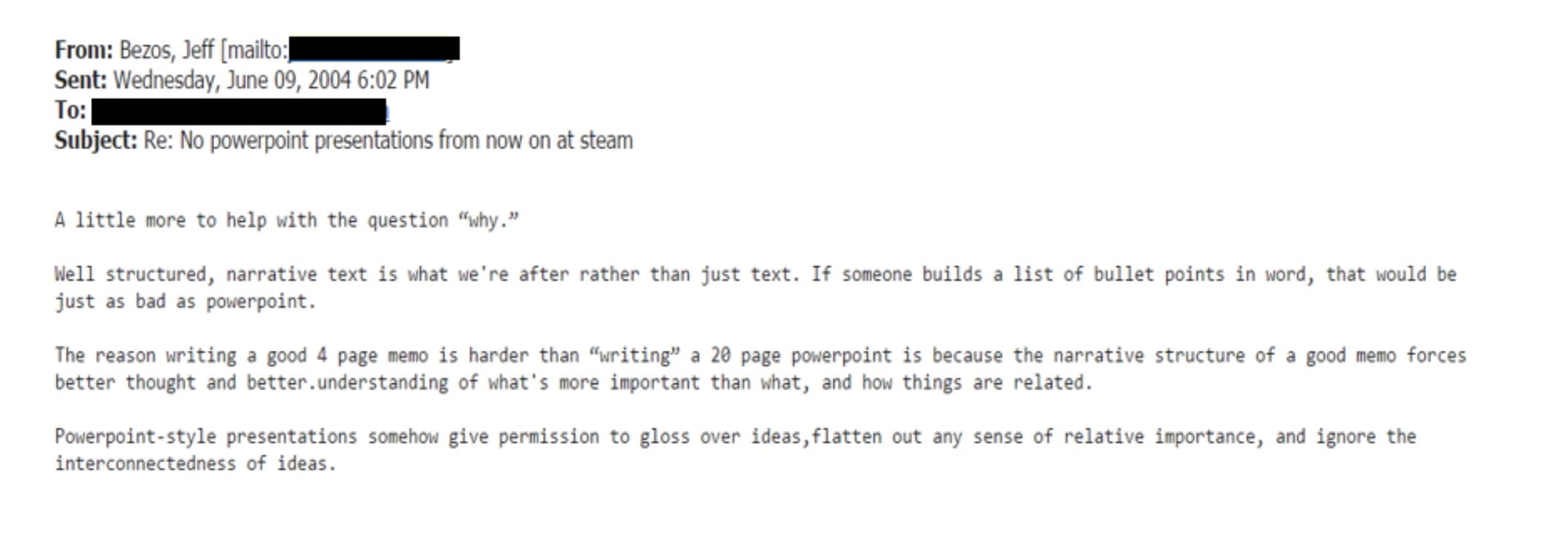
    The day they banned Powerpoint

    Edward Tufte’s ‘The Cognitive Style of Powerpoint’ is funny. The problem is that it is not just funny, but deadly serious. Literally. His argument and case studies concern how humans died because people failed to understand how to communicate. And the title says it all. Powerpoint (at least its templates) degrades communication.

    Communication is a big thing in medical education, and it is not unusual to have to sit through tedious talks on the subject. They usually start with Powerpoint slides, so at least you know that they are not going to say anything worthwhile and you can get your phone out and play.

    Below is a memo, from Jeff Bezos, of Amazon.

    Perhaps the single most important thing we could do to improve university education to is to remove all copies of Powerpoint. Words matter. Sentences even more.


     Via Visually. See more  here
  • 05/06/2017

    Post Link

    We learn more from examples than from principles

    This is from a book review on the ‘birth of cool’, by Robert Eaglestone in the THE.

    Despite laying out some principles (“cool is…”), the book focuses on honed case studies of “the saints of cool” (as Hannah Arendt argues, we learn more from examples than from principles).

    This little gem was new to me —but not the concept, or the principle…..

    Academia tends to love rules, and formal systems, but for some domains of competence, they are grossly overrated. Formal logic is often not what is need, and we may seem more with a metaphor. Alan Kay’s aphorism: a different perspective may be as valuable as 80 IQ points.

  • 02/06/2017

    Post Link

    Brilliant article from Steven Levy on Backchannel.

    When I covered Kasparov-Deep Blue match, I thought the drama came from a battle between computer and human. But it was really a story of people, with brutal capitalist impulse, teaming up with AI to destroy the confidence and dignity of the greatest champion the world had seen. That leads me to believe it’s not Skynet that should worry us about AI, but rather the homo sapiens who build, implement, and employ those systems.

    Well, this is all about one of the great issues of our age. As I wrote in 2008:

    Change in medicine is increasingly driven by the twin forces of specialization, and the desire to codify medical practice, i.e. to produce rules that can be followed by those from a range of educational and professional backgrounds. The battle is over the intellectual heartlands of clinical practice and how the knowledge that underpins clinical practice is acquired, distributed and validated.

    The mistake is to believe that this process is not mired in political and financial assumptions about what good care means — and who can make money out of it.